Published Jul 04, 2026
AI Trading Insights: Powering Automated Strategies for Modern Traders
The financial markets are undergoing a profound transformation, with artificial intelligence and machine learning shifting from futuristic concepts to indispensable tools for serious traders. Once the exclusive domain of institutional quant firms, advanced AI capabilities are now democratizing access to sophisticated algorithmic trading. This seismic shift is evident in the accelerating speed of strategy development and execution, particularly in volatile markets like cryptocurrency, where generative AI can automate tasks like parsing API documentation and onboarding new trading venues within mere weeks, a process that historically took months.
Key Takeaways
Generative AI significantly accelerates strategy development and execution, automating complex tasks like API integration and data processing within weeks, especially crucial in fast-moving markets.
AI excels at identifying complex market patterns, conducting sentiment analysis from *massive volumes* of data, and executing arbitrage strategies across *multiple markets simultaneously* to capitalize on inefficiencies.
Modern AI trading systems primarily react to real-time data—price, liquidity, volatility, and order flow—rather than attempting human-like market forecasting, enabling rapid response to market shifts.
Reinforcement Learning (RL) agents dynamically adapt to changing market conditions, optimizing asset allocation and risk parameters in real-time by learning from both profits and losses.
While AI enhances productivity and execution consistency, human oversight, intuition, and strategic thinking remain essential for navigating evolving markets and developing novel trading approaches.
The AI Co-Pilot: Accelerating Strategy Development and Execution
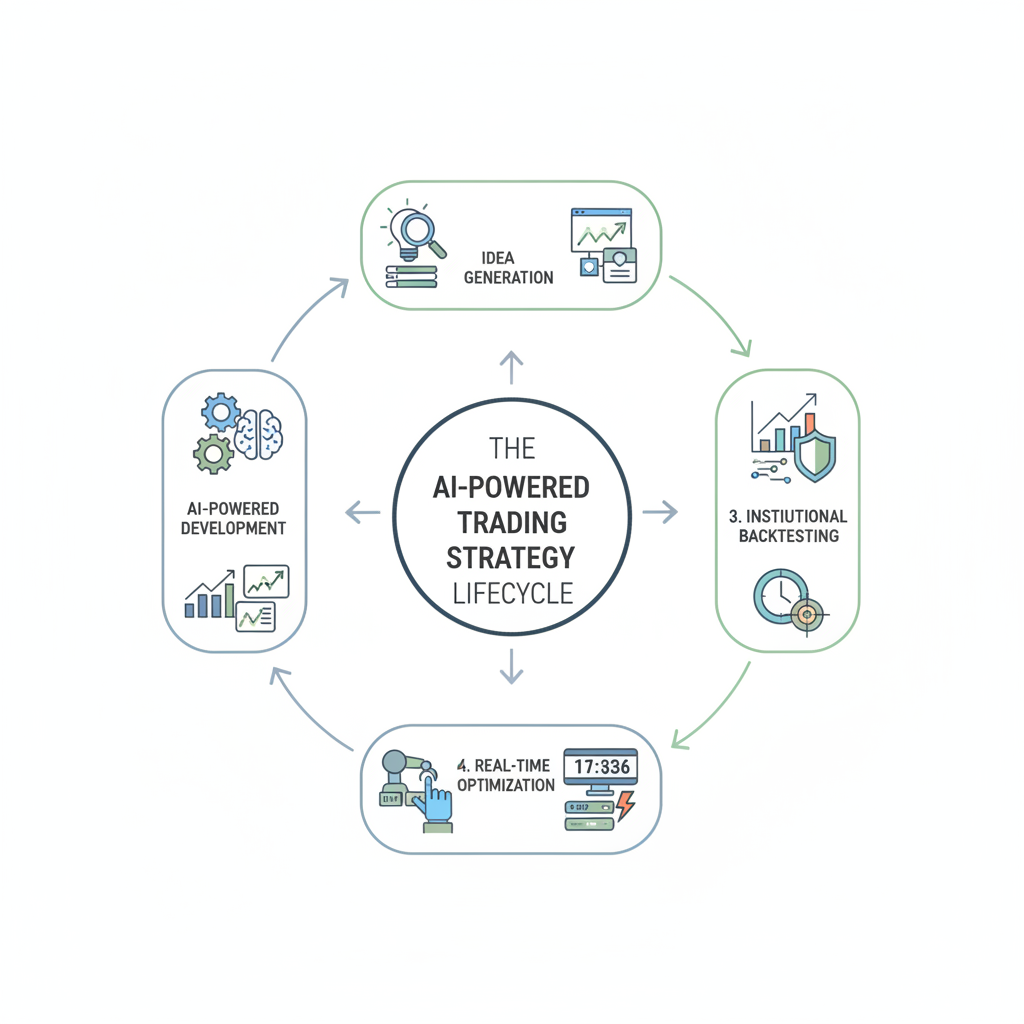
Artificial intelligence is not just enhancing existing trading processes; it is fundamentally reshaping how strategies are conceived, developed, and deployed. A recent workshop on AI-Based Trading highlighted that AI and machine learning are playing a critical "co-pilot role" for traders across all levels, from portfolio optimization to risk management. The ability of AI to accelerate strategy development is particularly impactful.
Generative AI can automate tasks like parsing API documentation and onboarding new trading venues within weeks, significantly speeding up crucial processes in fast-moving markets like crypto.
This speed is not merely about efficiency; it's a competitive advantage. Traditional strategy development, often reliant on manual coding and data analysis, can be time-consuming and prone to human error. Generative AI, exemplified by models like ChatGPT, streamlines tasks such as software development, data processing, and document summarization. This capability is invaluable for fundamental analysis, where processing and summarizing vast volumes of financial data are critical for identifying market opportunities and risks. For traders seeking to develop new strategies, AI acts as a powerful assistant, capable of sifting through and synthesizing information at a scale and speed impossible for human analysts alone. This allows traders to focus on higher-level strategic thinking, refining their ideas with AI's analytical support rather than getting bogged down in repetitive data tasks. By offering suggestions and asking clarifying questions, AI strategy generation tools can refine a trader's initial concept into a coherent, actionable strategy, often achieving a suitable match or refinement in 90% of cases, according to observations from advanced strategy discovery engines. The result is a significant reduction in the time-to-market for new trading strategies, enabling quicker adaptation to evolving market conditions. This rapid prototyping and iteration cycle allows traders to test a wide array of hypotheses, quickly discarding underperforming ones and refining promising avenues.
Actionable Takeaway: Leverage AI-powered strategy generation tools to rapidly prototype and iterate trading ideas, drastically cutting down development time and enhancing responsiveness to market changes. Focus on defining clear strategy criteria and letting AI handle the heavy lifting of backtesting combinations and suggesting refinements.
Beyond Prediction: AI's Role in Real-Time Market Reaction and Pattern Recognition
A common misconception about AI in trading is its ability to "predict" market direction like a human analyst. However, most sophisticated AI trading systems do not forecast markets in the conventional sense. Instead, they excel at reacting to real-time data and identifying complex patterns that are invisible to the human eye. These systems primarily respond to changing data points such as price movement, liquidity conditions, volatility, and order flow. By following predefined rules, AI trading strategies trigger actions when specific "pre-fed" market conditions appear, enabling high-speed, disciplined execution.
One of AI's most powerful applications is in pattern recognition and data mining. AI tools can compile and analyze massive volumes of historical data, extracting insights into past market behavior. This data mining capability extends beyond price charts to encompass sentiment analysis, where AI processes text and linguistics from news outlets, social media, and community forums. This allows systems to identify patterns within subjective material, gauging market sentiment and shedding light on potential investor behavior. For instance, some firms are already experimenting with AI that analyzes Twitter and financial news, aiming to automate sentiment analysis and detect meaningful market shifts faster than human traders.
The rise of automated trading, driven by AI, has also fundamentally altered market microstructure. As price approaches critical levels, stop orders accumulate, liquidity thins, and automated momentum logic within AI strategies activates. This can lead to "liquidity sweeps" where clustered orders are triggered in a short interval, producing sudden price movements. Traders who understand this new dynamic—analyzing structure, participation, and liquidity behavior—can still find opportunities within these automated market environments, even as price moves appear more sudden and liquidity shifts more often due to interacting algorithms. AI's ability to monitor multiple markets simultaneously also makes it exceptionally effective in arbitrage trading, quickly spotting and capitalizing on small price inefficiencies across different exchanges.
Actionable Takeaway: Develop strategies that capitalize on AI's strengths in real-time reaction and pattern recognition. Focus on defining clear, data-driven conditions for entry and exit, utilizing AI for ultra-fast execution and comprehensive sentiment analysis across diverse data sources.
Adaptive Strategies: The Power of Reinforcement Learning and Iterative Backtesting
The intelligence of AI in trading extends beyond static rule-based systems to dynamic, self-learning models. Reinforcement Learning (RL) is at the forefront of this evolution, enabling AI agents to adapt to changing market conditions in real-time. These agents learn from both profits and losses, continuously optimizing critical aspects like asset allocation, position sizing, and exit strategies dynamically. This approach differs significantly from classical optimization methods because it does not require prior knowledge of how to efficiently optimize a trading strategy; instead, the learning algorithm is able to self-evolve when exposed to unseen scenarios. This capability is particularly powerful for problems with high-dimensional state and action spaces, common in complex multi-asset trading environments.
The ability to optimize trading strategies is further enhanced by rigorous backtesting and risk management automation. AI doesn't just generate trade ideas; it also puts them through an institutional-grade validation process. This includes testing strategies against extensive historical data and automating risk parameters such as stop losses and drawdown limits. Iterative backtesting allows traders to tweak key variables like margin size, instrument choice, and data resolution, tailoring a strategy's responsiveness to market trends and volatility. This "Backtest & Iterate" cycle helps in pinpointing settings that can reduce drawdowns and boost profit potential, ensuring automated strategies are as precise and effective as possible.
Moreover, AI tools can delve into a trader's historical performance, identifying areas for improvement such as delayed entries or premature exits. By suggesting actionable solutions for timing and refining position sizing based on real trading habits, AI provides a continuous feedback loop. Automated risk management features, including advanced order types and trailing stops, are executed without emotional influence, maintaining consistent rule enforcement in both simulated and live trading environments. This comprehensive approach to strategy optimization and risk management is crucial for building robust, long-term profitable automated systems.
Actionable Takeaway: Integrate iterative backtesting and reinforcement learning principles into your strategy development. Continuously refine parameters based on performance feedback, leveraging AI to automatically enforce disciplined risk management and adapt to evolving market dynamics without emotional bias.
The Human-AI Synergy: Intuition Meets Automation
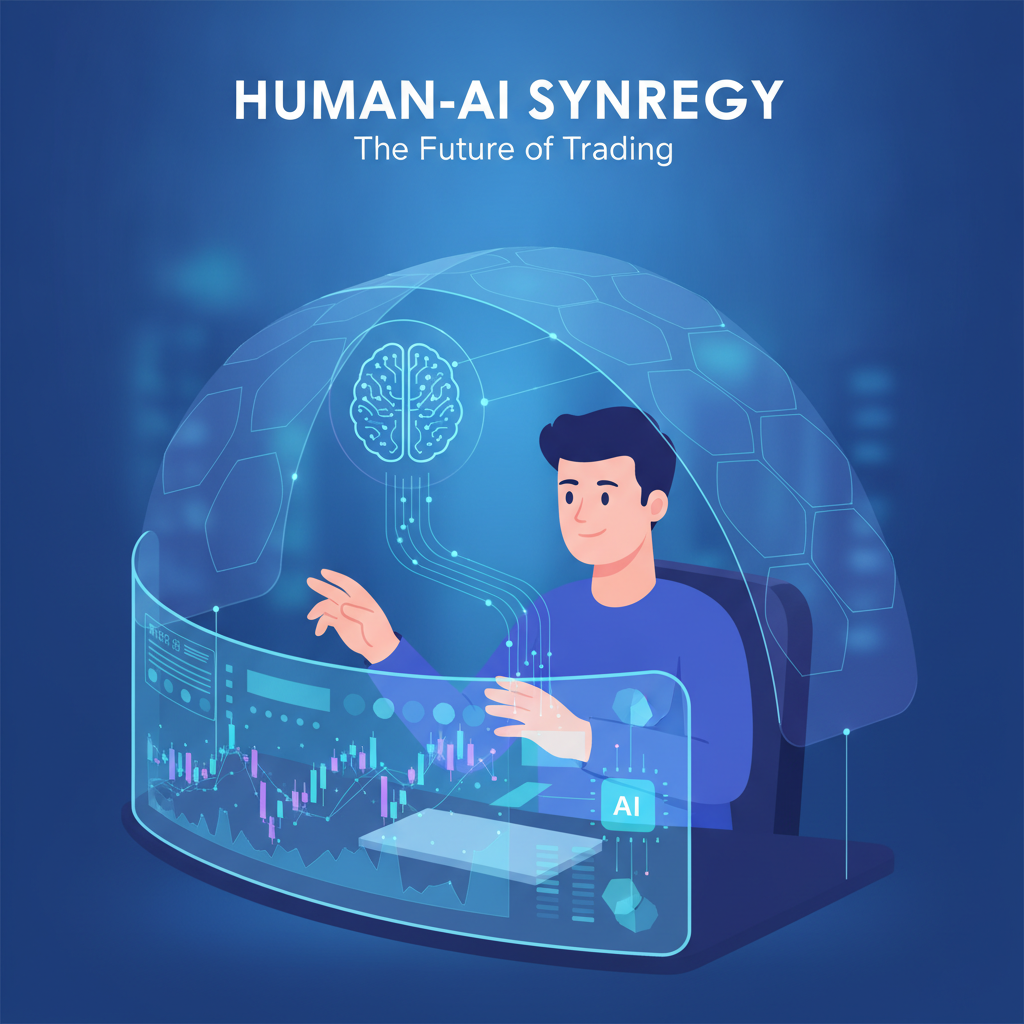
Despite the remarkable advancements in AI, a crucial insight echoed by experts is that AI will not completely replace human traders. While AI in trading will undoubtedly become more powerful, markets are in a constant state of evolution. Human oversight, intuition, and creativity remain essential for navigating unexpected changes, developing novel strategies, and understanding the nuanced narratives and macroeconomic factors that AI systems, while adept at processing, may not fully "comprehend" in a human sense. The future of trading isn't a battle between human and machine, but a partnership. AI takes on the role of an invaluable co-pilot, enhancing productivity by streamlining software development, data processing, and document summarization. It is particularly valuable for fundamental analysis, where summarizing large volumes of financial data is critical for strategy development. AI allows human traders to focus on higher-level strategic thinking, hypothesis generation, and adapting to truly novel market paradigms that even the most advanced algorithms might initially struggle to interpret. While generative AI will likely outperform human discretionary traders in specific, well-defined market conditions, human adaptability and the ability to formulate entirely new trading philosophies will remain paramount. Traders who embrace this synergy—combining their market intuition and strategic thinking with AI's analytical power and automated execution capabilities—will be best positioned to thrive in the evolving financial landscape. Responsible use and compliance are also critical; AI tools should always be accompanied by due diligence and never treated as a guarantee of profit.
Actionable Takeaway: Cultivate a symbiotic relationship with AI. Focus your human intelligence on strategic foresight, creative strategy generation, and interpreting market anomalies, while delegating data analysis, rigorous backtesting, and emotion-free execution to AI. Always exercise due diligence and understand that AI is a tool, not a crystal ball.
How Horizon Addresses This
Horizon Global Trade is built precisely for the serious trader who thinks systematically but may lack the coding skills or institutional resources to fully capitalize on AI and automation. Our platform directly addresses the challenges and opportunities discussed:
AI Strategy Generation (No Coding Required): Horizon enables traders to generate custom trading strategies using AI, removing the barrier of complex programming languages. This aligns with the accelerating strategy development facilitated by generative AI, allowing you to rapidly prototype and refine your ideas.
Institutional-Grade Backtesting Engine: With detailed performance metrics, out-of-sample backtesting, Monte Carlo simulation, and heatmaps, Horizon provides the rigorous validation needed to ensure your strategies are truly robust. This directly supports the need for iterative backtesting and risk management automation, moving beyond simple historical performance to truly test strategy resilience.
Automated Execution & Risk Management: Connect your broker and deploy strategies for live trading with automated execution. Horizon helps you maintain logical, consistent trading by enforcing predefined rules without emotional interference, a core benefit of AI-driven automation.
Strategy Marketplace: Access a marketplace of community-built strategies, allowing you to evaluate, filter, and choose from data-backed strategies, much like advanced AI discovery engines. You can also sell access to your own strategies, building reputation based on real performance.
Multi-Asset Support: Whether you trade stocks, forex, crypto, futures, or options, Horizon's multi-asset support ensures your AI-powered strategies can be applied across diverse markets, leveraging AI's ability to monitor multiple assets simultaneously for opportunities like arbitrage.
Horizon empowers you to transform your trading edge into automated, disciplined execution, bridging the gap between innovative ideas and institutional-grade capabilities. Explore Horizon Trade today to elevate your automated trading strategies.
Conclusion
The integration of artificial intelligence into trading is not merely a trend; it's a fundamental shift in how market participants generate alpha, manage risk, and execute trades. From accelerating strategy development with generative AI within weeks to enabling real-time adaptive strategies through reinforcement learning, AI serves as an indispensable co-pilot for the modern trader. While AI systems excel at pattern recognition, sentiment analysis, and emotionless execution across vast datasets, the human element—intuition, creativity, and strategic oversight—remains crucial for navigating ever-evolving markets. The most successful traders will be those who master the synergy between human intelligence and AI automation, leveraging technology to amplify their edge and operate at an institutional level. Ready to harness these AI trading insights for your own automated strategies? Explore more articles and resources on the Horizon Trade blog and discover how our platform can help you build, backtest, and deploy your AI-powered trading systems with confidence by signing up to https://horizon.trade