Published Jul 04, 2026
Comparing the Best Brokers for Automated Trading Success in 2026

In the dynamic landscape of modern finance, automated trading has become the undeniable backbone of market activity. Algorithms now account for an astonishing over 70% of U.S. stock trades and 92% of Forex trades, transforming how strategies are conceived, tested, and executed. For serious traders seeking to translate their systematic edge into consistent performance, the choice of a brokerage partner capable of handling the demands of automated execution is not merely important—it’s critical. This report delves into the essential characteristics of top-tier brokers for automated trading, offering actionable insights for those ready to elevate their trading operations.
Key Takeaways
Automated trading dominates financial markets, with algorithms powering over 70% of U.S. equity and 92% of Forex trades, necessitating specialized brokerage capabilities.
Critical broker selection criteria for automation include robust platform integration (e.g., MetaTrader), low-latency execution, minimal slippage, reliable Virtual Private Server (VPS) support, and comprehensive asset class coverage.
Top-rated brokers like AvaTrade (4.9), XM (4.8), and Pepperstone (4.8) consistently demonstrate strong performance in automated trading tests, offering quick fills and stable EA handling.
Platforms such as Interactive Brokers (IBKR) and TradeStation provide advanced tools like algorithmic strategy frameworks and custom scripting languages for sophisticated automated traders.
Retail investor accounts face significant risks, with 73-89% losing money when trading CFDs, underscoring the need for disciplined, rigorously tested automated strategies and reliable broker infrastructure.
The Imperative of Automation: Adapting to Modern Market Structure
The ascendancy of algorithmic trading is not just a trend; it's a fundamental shift in market structure. Once the exclusive domain of institutional players with vast resources, automated strategies are now accessible to a broader range of professional traders, thanks to advancements in technology and platform accessibility. This paradigm shift means that manual discretionary trading, while still viable for some, increasingly struggles to compete against the speed, precision, and tireless execution of algorithms. A study highlighted that more than two-thirds of all U.S. stock trades are now executed by algorithms, a figure that only continues to climb.
Algorithms now account for an astonishing over 70% of U.S. stock trades and 92% of Forex trades, fundamentally transforming how strategies are conceived, tested, and executed.
This reality imposes new demands on brokerage services. Traders operating automated systems require not only access to various financial instruments but also a technological infrastructure that supports high-frequency order placement, real-time data feeds, and minimal latency. Brokers that fail to meet these stringent requirements become bottlenecks, undermining even the most well-designed strategies. The core insight here is that the broker is no longer just a custodian of assets but a critical enabler of a trader's technological edge.
Essential Criteria for Automated Trading Broker Selection

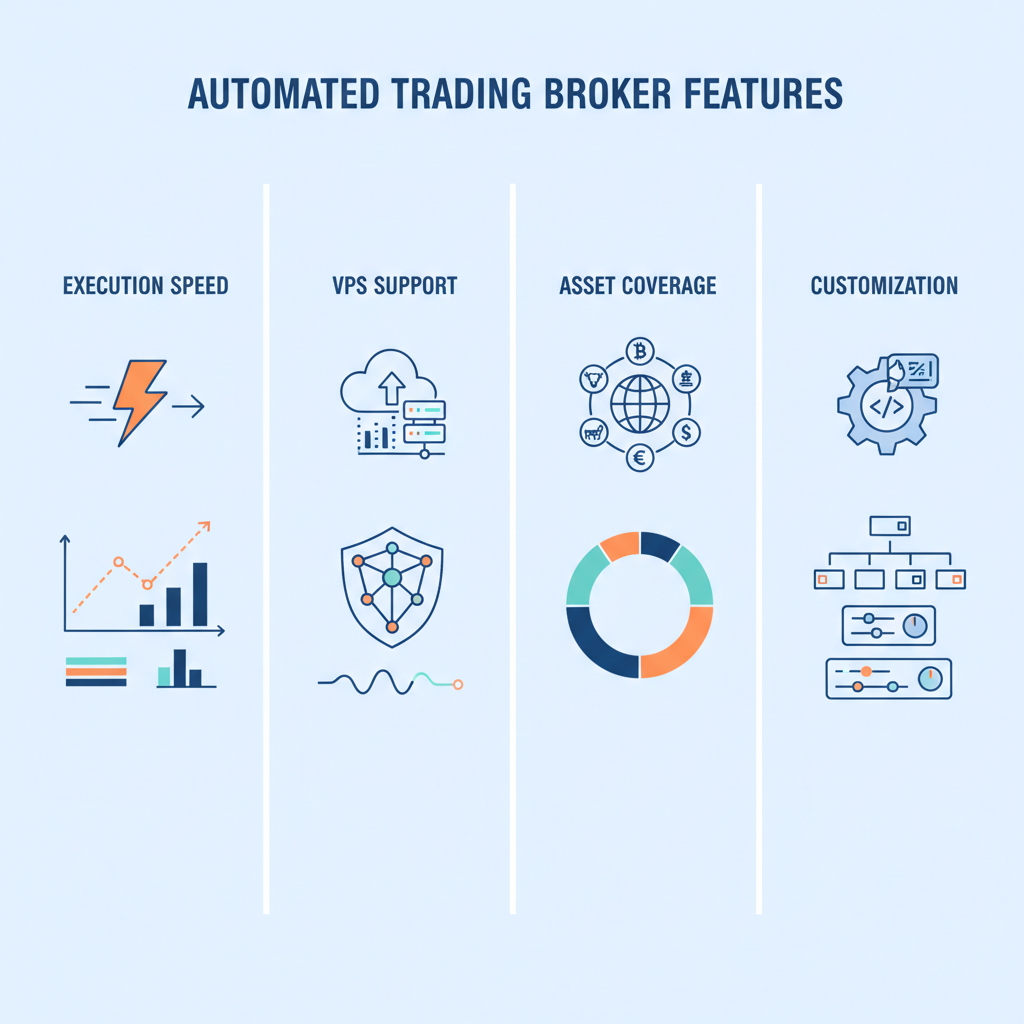
Choosing the right broker for automated trading is a multi-faceted decision, going beyond simple commission rates or account minimums. Systematic traders must evaluate several technical and operational characteristics to ensure their automated strategies can perform optimally. Here are the key criteria:
1. Robust Platform Integration and Execution Quality
A broker’s compatibility with leading automated trading platforms and its execution quality are paramount. Many traders rely on established platforms like MetaTrader 4 (MT4) and MetaTrader 5 (MT5) due to their extensive ecosystem of Expert Advisors (EAs) and customization options. MetaTrader continues to dominate the automated trading space, with its MQL5 language, MetaEditor, and Strategy Tester cementing its status as a favorite among algorithm developers. Brokers that seamlessly integrate with these platforms, ensuring quick fills and low slippage, are highly valued.
For instance, AvaTrade consistently demonstrated smooth EA operation on MT4/MT5 in automation tests, with quick fills and minimal slippage. Similarly, XM provided low-latency fills and clean EA handling, with backtests closely matching live behavior across various assets. Execution speed is often measured in milliseconds, and even minor delays can significantly impact the profitability of high-frequency or arbitrage strategies.
Practical Insight: Prioritize brokers known for their direct, reliable integration with your preferred automated trading platform and demonstrable performance in real-world execution tests, especially regarding latency and slippage.
2. Virtual Private Server (VPS) Support and Uptime
Automated strategies require continuous operation, 24/7, without interruption. This necessitates the use of a Virtual Private Server (VPS), which hosts trading terminals in a remote, stable environment, immune to local internet outages or power failures. A broker's support for VPS integration, or even offering proprietary VPS services, is a significant advantage. This ensures that trading algorithms remain online and execute trades precisely as programmed, even when the trader's local machine is off.
MetaTrader users, for example, often rely on a VPS to keep their terminals running 24/7 in the cloud, bypassing the need for their personal computer to remain active. RoboForex and XM both offer robust VPS support, ensuring strategies run without hiccups and maintain stable performance. The reliability of a VPS directly correlates with the reliability of your automated strategy’s deployment.
Practical Insight: Opt for brokers that either offer integrated VPS solutions or provide clear, documented support for third-party VPS services, ensuring your strategies maintain maximum uptime.
3. Asset Class Coverage and Data Robustness
Diversification is key for robust trading, and automated strategies can benefit immensely from multi-asset class support. A broker offering access to stocks, forex, cryptocurrencies, futures, and options allows traders to deploy diverse strategies across various market conditions. Furthermore, the quality and depth of historical data provided by the broker are crucial for comprehensive backtesting and strategy development.
For futures markets, platforms like TradeStation and Interactive Brokers support major exchanges (e.g., CME) with tick-level data, essential for precise execution. Interactive Brokers (IBKR) offers access to over 135 global markets with real-time data feeds, enabling algorithms to trade a wide array of instruments. Similarly, MetaTrader 5 (MT5) expands its reach beyond forex into stocks, futures, and cryptocurrencies.
Practical Insight: Choose a broker that provides broad market access and extensive, high-quality historical data across the asset classes relevant to your automated strategies, facilitating thorough backtesting and diversification.
4. Advanced Features and Customization Capabilities
For traders developing their own sophisticated algorithms, advanced features such as custom scripting languages, robust APIs, and detailed risk management tools are indispensable. Some brokers integrate proprietary languages or offer highly customizable environments for strategy creation and deployment.
TradeStation, a go-to platform for active U.S. stock traders, features EasyLanguage coding, allowing users to create custom scripts without extensive coding knowledge. IBKR's Trader Workstation (TWS) provides a wide array of algorithmic trading strategies—from trend-following to mean-reversion—and advanced order types like bracket orders and trailing stops. These features are critical for implementing nuanced strategies and precise risk controls, which are vital given that 73-89% of retail investor accounts lose money when trading CFDs.
Practical Insight: Evaluate brokers not just on basic automation, but on their capacity to support advanced customization, robust risk management, and the depth of their API or proprietary scripting capabilities for truly unique strategies.
Top Brokers for Automated Trading: A Detailed Look
Based on our research, several brokers consistently stand out for their robust support of automated trading strategies:
1. AvaTrade
Rated 4.9 out of 5 in automation tests, AvaTrade is a strong contender. It excelled in running Expert Advisors (EAs) smoothly on MT4/MT5, delivering quick fills and low slippage. Their support for third-party VPS integration allows strategies to remain online 24/7. Beyond direct EA deployment, AvaTrade offers "no-code" or copy automation solutions through DupliTrade and ZuluTrade, providing reliable signal transmission across FX, indices, and commodities. This makes it an excellent choice for traders looking for both direct algorithmic control and social trading integration.
2. XM
XM achieved a 4.8 rating for its automated trading capabilities. Our tests confirmed its steady performance, with low-latency fills on MT4/MT5 and clean handling of EAs. The broker's VPS support ensures uninterrupted strategy execution. Crucially, backtests on XM closely mirrored live behavior across FX, metals, and indices, providing high confidence for strategy deployment. This consistency between simulated and live performance is a hallmark of a reliable automated trading environment.
3. RoboForex
With a 4.5 rating, RoboForex is another highly capable broker for automated trading. It offers comprehensive support for MT4/MT5 and cTrader integrations. Its VPS services keep EAs online around the clock, and our tests noted crisp fills and stable performance across FX, commodities, and indices. RoboForex’s multi-platform support provides flexibility for traders who might use different interfaces for various strategies.
4. Interactive Brokers (IBKR)
While not rated on the Daytrading.com list for *pure* automated trading in the same way, IBKR is a powerhouse for institutional-grade algorithmic trading. Its Trader Workstation (TWS) platform offers an extensive algorithmic trading framework, providing access to over 135 global markets with real-time data feeds. IBKR supports a wide array of algorithmic strategies, advanced order types, and robust risk management tools like predefined stop-loss levels and position sizing. Its capabilities are particularly suited for experienced quant traders and those requiring global market access and sophisticated strategy development.
5. TradeStation
TradeStation is a premier choice for active U.S. stock and futures traders. It’s known for its powerful analysis tools and low commission rates, with its TS Select plan offering $0 commissions on stocks and ETFs. Its EasyLanguage feature empowers users to create custom scripts without needing extensive coding knowledge, making advanced automation more accessible. TradeStation's robust historical data and advanced backtesting tools are invaluable for systematic traders seeking to develop and validate complex strategies across futures and equities.
Other notable brokers for automated trading, often highlighted for their competitive spreads and execution, include IC Markets (4.8 rating) and Pepperstone (4.8 rating). These brokers consistently offer excellent conditions for EA deployment and general trading, making them strong contenders for automated strategy users.
How Horizon Addresses This
While selecting the right broker is paramount for deploying automated strategies, the real challenge often lies in developing, rigorously testing, and managing these strategies effectively. Horizon Trade complements the robust execution capabilities of top brokers by providing an institutional-grade platform for strategy generation and backtesting. With Horizon, traders can generate custom trading strategies using AI with no coding required, transforming ideas into actionable algorithms. Our platform offers a sophisticated backtesting engine, complete with detailed performance metrics, out-of-sample backtesting, Monte Carlo simulations, and heatmaps, allowing you to ascertain the true robustness of your strategy before committing real capital. Once validated, horizon.trade enables seamless broker integration for live trading with automated execution, and offers real-time analytics to monitor performance. This comprehensive ecosystem ensures that your systematically developed edge is not only executed efficiently by your chosen broker but is also built on a foundation of rigorous analysis and AI-driven insights.
Conclusion
The journey to successful automated trading is multifaceted, requiring both a well-conceived strategy and a robust brokerage infrastructure to support its execution. As algorithms increasingly define market movements, the ability to identify and partner with brokers that offer low-latency execution, reliable VPS support, extensive asset coverage, and advanced customization features becomes a non-negotiable imperative for systematic traders. The brokers highlighted—AvaTrade, XM, RoboForex, Interactive Brokers, and TradeStation—represent the pinnacle of automated trading support, each offering unique strengths that cater to different trading styles and asset preferences. By meticulously evaluating these criteria and leveraging platforms like Horizon Trade to develop and refine your strategies, you can position yourself at the forefront of algorithmic efficiency and unlock the full potential of your trading edge. Explore Horizon's capabilities today to build, backtest, and deploy your next-level automated trading strategy with confidence.