Published Jul 04, 2026
Multi-Broker Trading Automation Software: The Professional Trader's Edge
In today's hyper-competitive financial markets, the notion of manual, single-broker trading as a viable path for professional growth is rapidly fading. According to industry analysis, automated trading now accounts for a significant portion of daily market volume, with some estimates placing algorithmic strategies responsible for a substantial share of US equity trading. For professional traders, this shift isn't merely a trend; it's a fundamental recalibration of operational necessity, demanding sophisticated tools that can navigate multiple brokers and asset classes with speed, precision, and robust risk management.
Key Takeaways
Automated trading platforms like MetaTrader 5 boast support for over 80 brokers, enabling widespread integration for professional traders seeking multi-broker capabilities.
Platforms designed for automated trading offer significant efficiency gains, with some users reporting savings of up to 8 hours per week and the capacity to execute hundreds of trades automatically.
While MetaTrader 5 offers a marketplace with thousands of Expert Advisors (EAs), the quality varies, underscoring the need for robust, institutional-grade backtesting.
Achieving optimal performance in automated trading often requires navigating technical complexities such as "symbol mapping" to ensure data feeds and brokers correctly interpret trade orders.
For extreme low-latency execution, specialized solutions like FPGA can achieve sub-microsecond latency, highlighting the infrastructure demands of high-frequency strategies.
Automated trading, while reducing emotional bias, introduces technical risks such as system failures and incorrectly configured parameters, demanding platforms with built-in risk controls and robust validation.
The Imperative for Automation in Professional Trading
The transition from discretionary to systematic trading is a defining characteristic of professional market participation in the 21st century. Automated trading software, at its core, removes emotional decision-making from the trading process, operating instead on mathematical models and predetermined parameters to execute trades when specific market conditions align with a strategy Source Name. This systematic approach is not just about avoiding human error; it's about scalability and efficiency.
Automated trading systems can monitor multiple markets simultaneously, execute trades in milliseconds, and operate around the clock, offering significant efficiency gains compared to manual methods.
For instance, platforms designed for streamlined execution can save traders up to 8 hours per week and enable the execution of hundreds of trades 100% automatically, a scale unattainable through manual order entry. This efficiency allows professional traders to diversify their strategies, manage larger portfolios, and exploit fleeting market opportunities across various asset classes, including stocks, forex, crypto, futures, and options. However, this power comes with inherent technical risks, such as system failures, connectivity issues, and the potential for significant losses if parameters are incorrectly configured Source Name.
The practical insight for professionals is clear: automation is no longer a luxury but a necessity for competitive edge and operational leverage. The focus must shift from merely automating trades to implementing automation through robust, reliable, and intelligently designed software that minimizes technical vulnerabilities while maximizing strategic potential.
Unlocking Diversification and Scale with Multi-Broker Connectivity
For serious traders, confining operations to a single broker can introduce unnecessary limitations, particularly regarding asset access, liquidity, and risk diversification. Multi-broker trading automation software provides the critical infrastructure to overcome these constraints, allowing professional traders to manage diverse portfolios across various financial institutions.
Platforms like MetaTrader 5 exemplify this widespread compatibility, supporting over 80 different brokers, making it a dominant choice for forex and CFD automation. This broad support allows traders to select brokers based on their specific needs for asset classes, execution quality, or regulatory environment, rather than being confined by platform compatibility.
Beyond simply connecting to multiple brokers, advanced platforms offer features crucial for managing complex, diversified strategies:
Financial Advisor Accounts: Some brokers, such as Interactive Brokers, support financial advisor accounts, enabling the management of multiple sub-accounts through a single main account, a feature supported by platforms like MultiCharts.
Separate Symbol Tracking: The ability to auto-trade the same symbol from multiple charts or even computers simultaneously, with each chart's market position tracked separately, offers granular control over complex strategies Source Name.
Direct Market Access (DMA): Routing orders to dedicated broker gateways or directly to exchanges for futures and crypto via server colocation significantly reduces latency and optimizes performance, crucial for professional strategies Source Name.
A key technical challenge in multi-broker environments is "symbol mapping," ensuring that data feeds and brokers accurately recognize and process orders for specific symbols, especially when the data provider differs from the broker Source Name. This necessitates platforms with flexible configuration options to bridge these discrepancies seamlessly.
The practical takeaway is that multi-broker connectivity isn't just about choice; it's about constructing a resilient, diversified trading architecture that can adapt to changing market conditions and regulatory landscapes. Professional traders should prioritize platforms that offer robust, flexible broker integrations and advanced account management features to truly scale their operations.
Beyond Backtesting: Validating Robust Strategies for Live Markets
The cornerstone of any successful automated trading strategy is rigorous validation. While traditional backtesting against historical data is a foundational step, it carries a significant risk: "over-optimization." This occurs when a strategy performs brilliantly on historical data but fails to deliver in live markets due to parameters being too finely tuned to past conditions Source Name.
Professional traders require institutional-grade backtesting capabilities that go beyond simple curve-fitting. These include:
Tick-Level Data Testing: Platforms like MetaTrader 5 offer built-in Strategy Testers with tick-level data, providing a more granular and realistic simulation of market conditions Source Name.
Out-of-Sample Testing: Critically, strategies must be tested on data not used during the development phase to confirm their generalization capability to unseen market conditions.
Monte Carlo Simulations: These simulations introduce random variability into historical data to stress-test a strategy's robustness under a wide range of potential future scenarios, providing a more reliable measure of expected performance and risk.
Heatmaps and Robustness Checks: Visual tools and statistical analyses that explore how sensitive a strategy's performance is to small changes in its parameters, identifying areas of fragility or stability.
The marketplace for automated trading strategies, such as the MQL5 marketplace for MetaTrader 5, offers thousands of Expert Advisors. However, the quality of these community-contributed strategies "varies wildly, many scams," highlighting the absolute necessity for traders to independently validate any strategy, whether self-developed or acquired Source Name. This underscores that merely having access to automated strategies is insufficient; the ability to thoroughly vet them is paramount.
The actionable insight here is to invest in platforms that provide comprehensive, multi-faceted backtesting and validation tools. A strategy's theoretical edge is only as valuable as its proven robustness under diverse and realistic market simulations, minimizing the risk of over-optimization and ensuring readiness for live deployment.
Navigating the Technical Landscape: Latency, Connectivity, and Customization
Automated trading, particularly for professional and high-frequency strategies, is deeply intertwined with technological infrastructure. While the promise of efficiency is high, navigating the technical landscape presents several challenges that demand sophisticated solutions.
One of the most critical aspects is latency—the time delay between a market event and the execution of a trade. For strategies requiring extreme speed, solutions like servers collocated at exchanges can eliminate "hops" between the strategy and the exchange. For the most demanding scenarios, FPGA (Field-Programmable Gate Array) solutions can deliver sub-microsecond latency by running feed handlers and gateways on hardware rather than software, pre-creating orders for instant release Source Name.
Beyond raw speed, the ease and reliability of setting up automated systems are crucial. While some systems can take 30-60 minutes to configure, platforms that offer "no coding required" solutions simplify the barrier to entry, allowing traders to focus on strategy development rather than programming complexities. However, even with no-code solutions, technical risks such as system failures and connectivity issues remain, emphasizing the need for robust, always-on infrastructure Source Name.
Customization is another vital component. Professional traders often have unique insights or specific risk parameters that require flexible strategy development environments. While platforms like MetaTrader 4 or 5 offer custom programming languages (MQL4/MQL5), these languages can be niche, limiting their transferability to other platforms Source Name. The ideal solution blends the power of customization with the accessibility of intuitive interfaces.
The actionable takeaway for professional traders is to evaluate platforms not just on features but on their underlying technical robustness, ease of integration, and flexibility for customization. A platform that minimizes setup hurdles, ensures high availability, and offers scalable infrastructure empowers traders to focus on their core competency: generating alpha.
Risk Management and Compliance in Automated Multi-Broker Environments
As trading operations grow from individual efforts to professional firms with multiple traders, the complexity of risk management and compliance escalates dramatically. Automated trading in a multi-broker environment introduces new layers of these requirements, making sophisticated tools indispensable.
Effective risk management is paramount. Automated systems, while removing emotional bias, can execute trades rapidly and at scale, meaning errors or misconfigurations can lead to significant losses swiftly Source Name. Professional platforms must offer:
Pre-trade Risk Controls: Automated checks that prevent orders exceeding predefined limits on position size, leverage, or exposure before execution.
Real-time Monitoring: Dashboards that provide immediate insights into portfolio performance, margin levels, and overall risk exposure across all connected brokers and accounts.
Account Synchronization: For those managing multiple prop firm accounts, synchronization features allow a single signal to trigger trades across all linked accounts, ensuring consistency and simplified management Source Name.
For broker-dealers and RIAs, compliance is not optional; it's a regulatory mandate. Platforms catering to this segment, such as ETNA Trading, offer institutional-grade features like automated compliance controls, pre-trade risk checks, post-trade surveillance, and regulatory reporting capabilities (e.g., FINRA/SEC, Series 57/FINRA Rule 1032 readiness). This level of integration ensures that automated strategies adhere to all relevant regulations, mitigating significant legal and financial risks.
The appeal of multi-broker automated trading lies in its ability to enhance efficiency and scale, but these advantages must be balanced with robust control mechanisms. The integration of advanced risk management and compliance tools directly into the trading platform is essential for professional traders and firms seeking to operate at the highest level of diligence and accountability.
How Horizon Addresses This
Horizon Global Trade is specifically engineered to meet the sophisticated demands of professional traders seeking multi-broker trading automation without the coding overhead. Our platform directly addresses the pain points outlined, transforming your trading ideas into automated, disciplined execution.
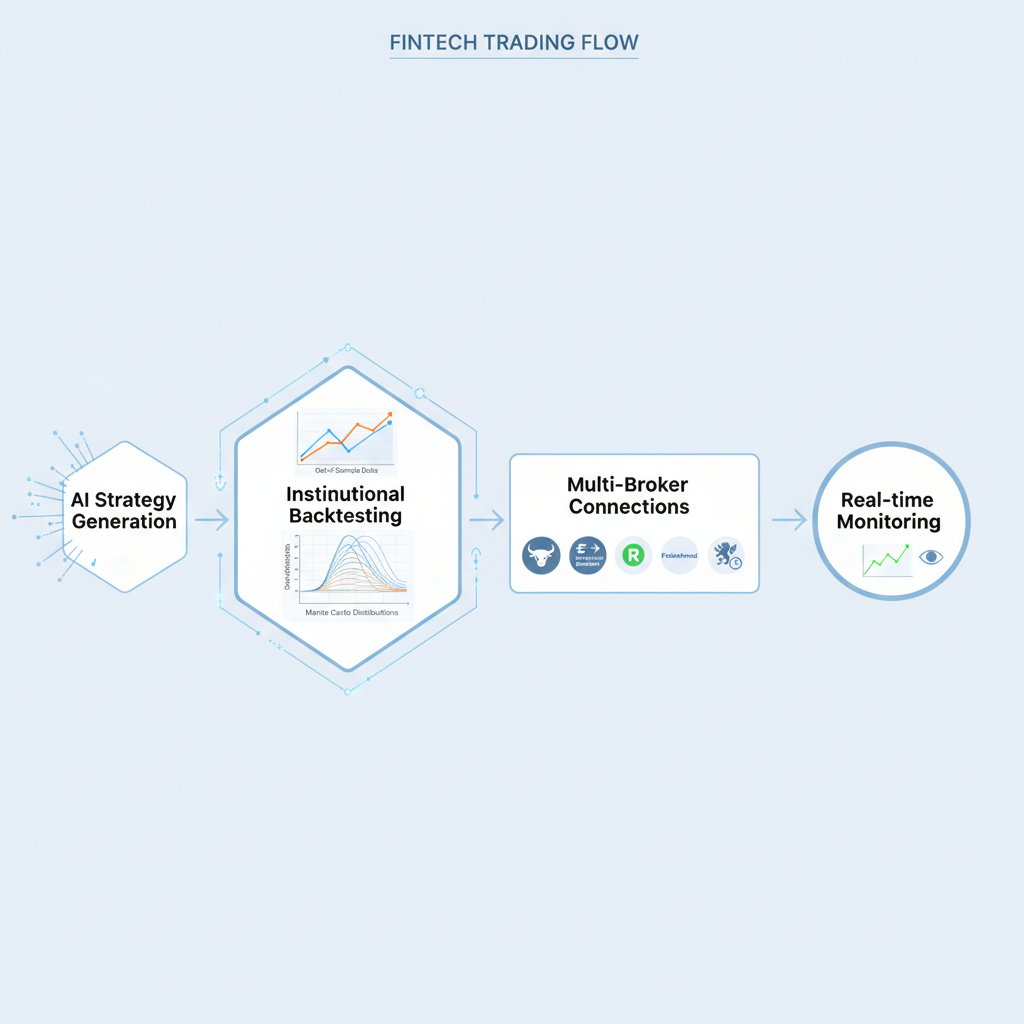
Horizon allows you to generate custom trading strategies using AI with no coding required, eliminating the technical barrier often associated with advanced automation. Our institutional-grade backtesting engine goes beyond basic historical simulations, offering out-of-sample testing, Monte Carlo simulations, and heatmaps to ensure your strategies are truly robust and not merely over-optimized for past data. With multi-asset support (stocks, forex, crypto, futures, options) and seamless broker integrations, Horizon enables true multi-broker diversification and automated execution across your preferred accounts. Real-time analytics provide constant oversight, while our strategy marketplace offers access to community-built strategies, all underpinned by transparent performance metrics. Horizon provides the intelligent infrastructure for traders ready to operate at the next level, merging the power of AI with professional-grade execution and validation.
Conclusion
The evolution of trading has firmly placed multi-broker trading automation software at the forefront for professional traders. It represents a paradigm shift from fragmented, manual operations to integrated, systematic execution, offering unparalleled efficiency, diversification, and scalable risk management. Navigating this landscape successfully requires platforms that provide not just automation, but intelligent automation—backed by robust testing, seamless multi-broker integration, and comprehensive risk controls.
For those who think systematically but may lack the technical coding skills, the future of professional trading lies in platforms that democratize advanced algorithmic capabilities. By embracing these cutting-edge tools, traders can transform their strategic insights into consistent, disciplined performance, positioning themselves for sustained success in dynamic global markets. Explore how a powerful, AI-driven platform can elevate your trading operations by visiting horizon.trade today and discover the next level of automated trading.