Published Jul 04, 2026
No-Code Trading Platforms With Broker Support Explained
Once the exclusive domain of institutional quants and skilled programmers, algorithmic trading now drives a significant portion of global financial markets. Indeed, automated trading strategies are responsible for nearly 75% of US stock market volume, according to recent analysis Source: Build Alpha. This surge highlights a profound shift towards systematic, disciplined execution over manual, emotion-driven trading. However, for most serious traders who possess keen market insight but lack programming expertise, the barrier to entry has historically been insurmountable. The emergence of no-code trading platforms, especially those offering seamless broker integration, marks a pivotal moment, transforming complex algorithmic strategies into accessible, actionable tools for a broader audience of systematic traders.
Key Takeaways
Algorithmic trading accounts for approximately 75% of US equity volume, underscoring the market's shift towards automated strategies Source: Build Alpha.
No-code trading platforms democratize access to automation by allowing traders to build strategies using visual interfaces or plain English, eliminating the need for programming languages like Pine Script or MQL Source: QuantVPS.
Direct broker integration via APIs is critical for live execution, enabling platforms to automatically place buy/sell orders based on pre-set conditions, bypassing manual intervention Source: VPSForexTrader.
Comprehensive backtesting, including historical simulations and advanced metrics, is essential for validating strategy robustness before live deployment, with some platforms offering unlimited backtest runs Source: Investfly.
Multi-asset support (stocks, forex, crypto, futures, options) combined with broker connectivity allows traders to diversify and execute strategies across various markets from a single platform Source: Investfly.
The Evolution of Algorithmic Trading and the No-Code Revolution
The journey from manual order placement to high-frequency algorithmic execution has been swift and transformative. For decades, institutional trading desks leveraged proprietary software and teams of quantitative analysts to deploy complex algorithms. These systems were built to capitalize on minuscule price discrepancies, manage large portfolios, and execute orders with unparalleled speed and precision. The sheer computational power and coding proficiency required meant that the average retail or even professional independent trader was effectively locked out of this algorithmic arena.
However, the technological landscape began to shift. The rise of cloud computing, advanced data analytics, and artificial intelligence started to break down these barriers. By the mid-2010s, the concept of "no-code" development began to gain traction across various industries, promising to democratize software creation. It was only a matter of time before this philosophy permeated the financial sector.
Algorithmic strategies now command a dominant position in capital markets, accounting for roughly 60-73% of US equity trading volume, a dramatic increase from approximately 20% in 2005 Source: Build Alpha.
No-code trading platforms emerged as a direct response to this need. They abstract away the complexity of programming languages like Python, C++, MQL, or Pine Script, replacing them with intuitive visual interfaces, drag-and-drop builders, or natural language processing (NLP) capabilities. Instead of writing lines of code, traders can define their entry and exit conditions using plain English "if-then" statements or by visually connecting pre-built logical blocks. This innovation allows traders to focus on their market edge and strategy logic rather than the technical minutiae of implementation.
The core promise of no-code platforms is twofold: first, to empower traders without coding backgrounds to build sophisticated automation; and second, to accelerate the strategy development process for even experienced quants, allowing for rapid iteration and testing. This shift is not merely about simplification; it's about unlocking a new level of efficiency and accessibility for systematic traders globally.
Core Components of Effective No-Code Trading Platforms
A truly effective no-code trading platform is more than just a visual interface; it's a comprehensive ecosystem designed to support the entire lifecycle of an automated trading strategy. At its heart lies the ability to translate a trader's logical intent into executable code without manual programming.
One of the most critical components is the **visual strategy builder**. This typically involves a graphical user interface where users can drag-and-drop elements representing indicators, price action rules, timeframes, and order types. For instance, a trader might visually construct a rule like "IF RSI crosses below 30 AND price closes above 20-period moving average, THEN BUY X shares." This visual representation allows for immediate feedback and easy modification, a stark contrast to debugging lines of code.
Many no-code platforms enable rapid strategy iteration, allowing users to "tweak conditions, and they are reflected immediately in the chart with every single buy and sell signal," significantly accelerating the development cycle Source: YouTube - 4 Best Automated Trading Platforms.
Beyond visual construction, **AI-powered strategy generation** is becoming a differentiating factor. This advanced capability leverages machine learning algorithms to analyze historical data and suggest or even automatically generate strategies based on predefined objectives and risk parameters. For a trader with an idea but unsure how to formalize it, this can provide a powerful starting point, often leading to robust strategies that might not have been discovered through manual experimentation.
Equally vital is a **robust backtesting engine**. Before any strategy goes live, it must be rigorously tested against historical market data. A quality no-code platform provides institutional-grade backtesting capabilities, offering detailed performance metrics such as total return, Sharpe ratio, maximum drawdown, and win rate. Crucially, features like out-of-sample backtesting, Monte Carlo simulations, and heatmaps are essential to determine if a strategy is truly robust or merely overfitting to past data. Some platforms even offer unlimited backtest runs, giving traders the freedom to thoroughly optimize their systems.
Finally, a no-code platform often includes **paper trading** or virtual portfolios. This allows traders to test their strategies in a simulated live environment using real-time market data without risking actual capital. This step is invaluable for building confidence and making final adjustments before connecting to a live brokerage account.
The Crucial Role of Broker Integration for Automated Execution
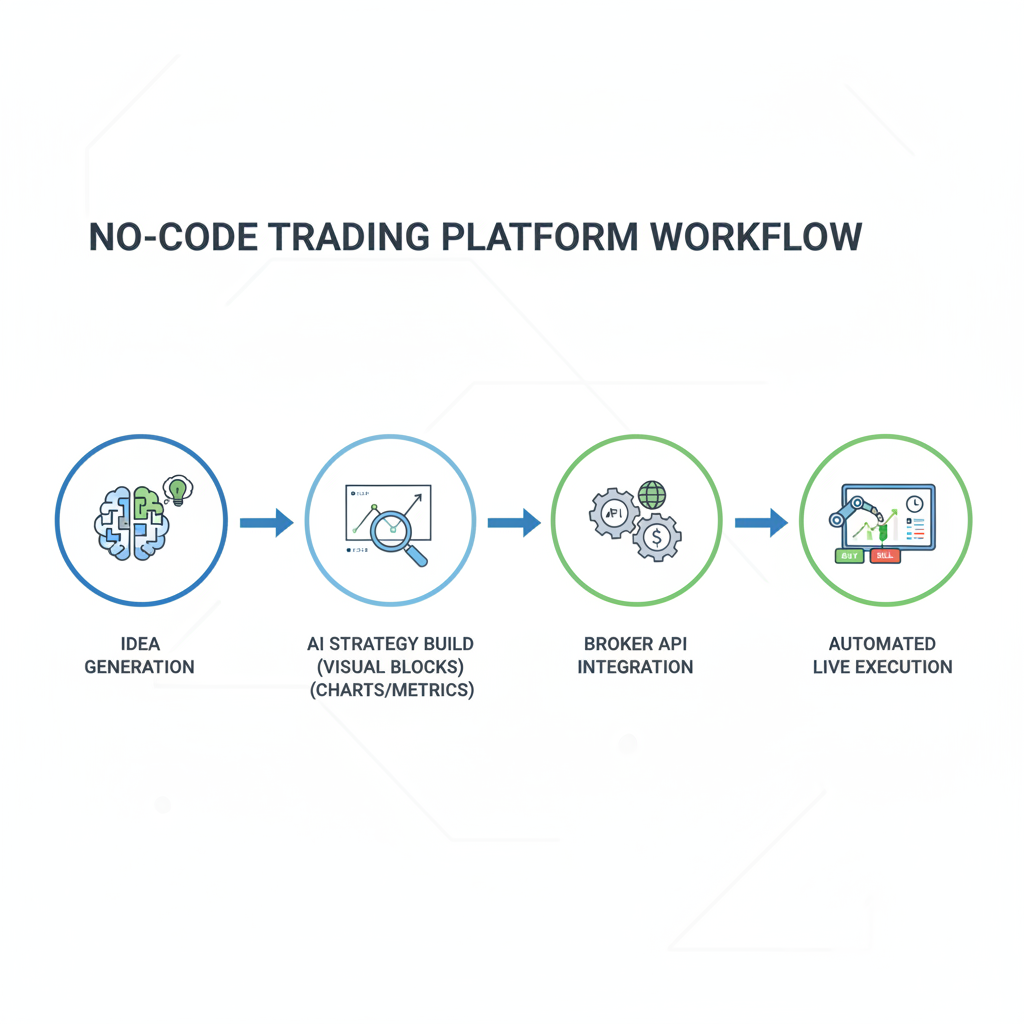
While building a strategy is one challenge, executing it seamlessly and reliably is another. This is where robust broker integration becomes not just a feature, but a fundamental necessity for any serious no-code trading platform. Without direct connectivity to a brokerage, a no-code platform remains a sophisticated analysis tool, requiring manual intervention for actual trades. The true power of automation is unlocked when strategies can move directly from theory to disciplined execution.
Broker integration typically occurs through **Application Programming Interfaces (APIs)**. These digital interfaces allow the no-code platform to communicate directly with the brokerage's infrastructure, sending real-time buy and sell orders. This eliminates latency, reduces slippage, and, most importantly, removes the emotional component from trading decisions. As soon as a strategy's pre-set conditions are met, the platform can automatically create and send orders to the connected broker, often within milliseconds Source: VPSForexTrader.
Seamless broker connectivity is a "crucial" step in the no-code trading workflow, allowing platforms to "automatically create buy/sell orders as soon as the pre-set conditions have been met" Source: VPSForexTrader.
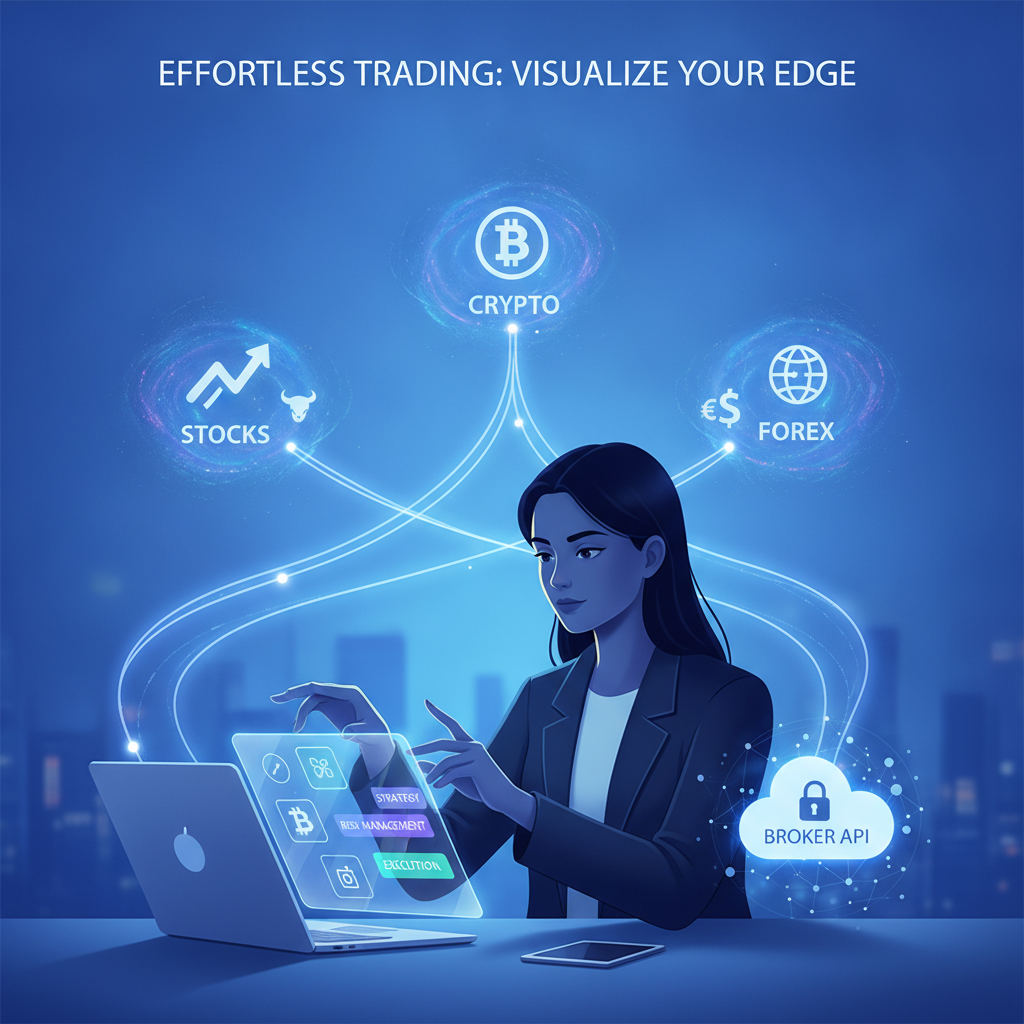
A key aspect of effective broker support is **multi-asset compatibility**. Serious traders often seek diversification across different market segments. A platform that can connect to brokers supporting stocks, forex, cryptocurrencies, futures, and options provides immense flexibility. For example, some platforms boast support for six major asset classes, including specific options strategies like iron condors and covered calls, alongside traditional equities and currencies. This enables traders to build complex multi-asset strategies that couldn't be managed manually.
Beyond execution, robust integration also facilitates **real-time performance monitoring** and **alerts**. Traders can receive instant notifications via mobile or email if a trade condition is triggered, an order is filled, or an error occurs during execution Source: VPSForexTrader. This ensures that even though the execution is automated, the trader remains informed and can intervene if necessary, maintaining oversight without being tied to the screen.
The goal is to provide "high availability automated trade execution to your broker" Source: YouTube - 4 Best Automated Trading Platforms. This level of integration transforms a conceptual strategy into a live, earning asset, allowing traders to scale their operations and focus on strategy development rather than manual trade management.
Key Features to Look For in No-Code Platforms with Broker Support
When evaluating no-code trading platforms with broker integration, systematic traders should look beyond superficial features and prioritize those that offer genuine depth and flexibility. The choice of platform can significantly impact the robustness, profitability, and scalability of trading operations.
1. Comprehensive Strategy Building & AI Generation: Look for platforms that offer not just visual drag-and-drop builders, but also advanced AI capabilities to generate or refine strategies. This should include the ability to specify nuanced entry and exit conditions, stop-losses, take-profits, and position sizing rules without any coding. The more granular control available without code, the better.
2. Institutional-Grade Backtesting & Validation: This is non-negotiable. The platform must provide a powerful backtesting engine with access to extensive historical data across multiple asset classes. Key metrics should include Sharpe ratio, Sortino ratio, max drawdown, win rate, and annualized returns. Features like walk-forward analysis, Monte Carlo simulations, and scenario testing are crucial for confirming a strategy's resilience under varying market conditions.
3. Broad Broker & Multi-Asset Support: Verify that the platform integrates with a wide range of reputable brokers and supports the specific asset classes you trade—be it stocks, options, futures, forex, or cryptocurrencies. Some platforms offer multi-asset capabilities that allow strategies to diversify across different markets, an important consideration for risk management and opportunity capture.
4. Real-time Monitoring & Analytics: Once deployed, strategies need continuous oversight. The platform should offer a dashboard for real-time performance tracking, displaying key metrics, open positions, and profit/loss. Alert systems for critical events (e.g., maximum drawdown hit, significant profit target reached, unexpected errors) are essential for proactive management.
5. Community & Marketplace: A vibrant community can be a valuable resource. Platforms that offer a marketplace for community-built strategies allow traders to explore, learn from, and even subscribe to proven strategies. This fosters collaboration and can provide inspiration for new strategy ideas Source: Medium. The ability to showcase personal strategy performance transparently can also build reputation within such communities.
6. Paper Trading & Risk Management Tools: A robust paper trading environment is critical for testing live execution without financial risk. Additionally, look for built-in risk management features such as daily loss limits, position size controls, and automated strategy pauses or shutdowns under specific conditions.
Choosing the right platform involves a careful assessment of these features against your individual trading style, capital, and asset class preferences. The goal is to find a solution that not only removes the coding barrier but also provides the sophisticated tools necessary for professional, systematic trading.
How Horizon Addresses This
For serious traders who think systematically but cannot code, Horizon Trade stands as an institutional-grade AI trading platform designed to transform your trading edge into automated, disciplined execution. Horizon directly addresses the pain points discussed, starting with its unique AI-powered strategy generation engine, allowing traders to create custom trading strategies without a single line of code. This eliminates the programming barrier, enabling you to build sophisticated algorithms using intuitive inputs.
Our platform offers an institutional-grade backtesting engine, complete with comprehensive performance metrics, out-of-sample testing, Monte Carlo simulations, and heatmaps to rigorously validate your strategies against historical market data across multiple asset classes (stocks, forex, crypto, futures, options). This ensures your strategies are genuinely robust, not just optimized for past performance. Once validated, Horizon facilitates seamless broker integration, allowing you to deploy strategies for live trading with automated execution, ensuring your logic is executed without emotional interference or manual delays. Furthermore, traders can leverage a vibrant marketplace of community-built strategies, offering opportunities to buy, copy, or even sell access to their own proven systems, complete with transparent performance records. With real-time analytics, you can continuously monitor strategy performance and make informed adjustments, empowering you to operate at the next level of systematic trading.
Conclusion
The trading landscape has irrevocably shifted, with automated strategies now dictating the pace and precision of global markets. No-code trading platforms, particularly those fortified with robust broker support, have become the bridge for systematic traders who possess invaluable market insights but lack the specialized programming skills historically required. By demystifying algorithmic development through intuitive interfaces and AI-powered tools, these platforms are not just simplifying trading; they are democratizing access to institutional-grade execution capabilities. As technology continues to evolve, the integration of AI, advanced analytics, and seamless broker connectivity will further empower a new generation of disciplined traders to convert their edge into consistent, automated performance. Sign up to horizon.trade and explore how these innovations can elevate your trading strategy today.