Published Jun 18, 2026
AI Trading Strategy Builders: Democratizing Algorithmic Edge for Non-Coders
The landscape of global financial markets is increasingly shaped by algorithmic trading. Once the exclusive domain of institutional quants wielding complex code, automated strategies now account for a substantial majority of trading volume. In fact, algorithmic trading accounts for a staggering 60-73% of US equity trading volume, a significant leap from roughly 20% in 2005 (Stefan Jansen, Machine Learning for Algorithmic Trading). This paradigm shift demands that serious traders adopt systematic approaches, yet the technical barrier of programming often prevents brilliant market insights from becoming executable strategies. Enter the AI Trading Strategy Builder — a revolutionary class of platforms designed to democratize algorithmic trading, enabling systematic thinkers to build, test, and deploy sophisticated strategies without writing a single line of code.
Key Takeaways
Algorithmic trading currently drives 60-73% of US equity volume, highlighting the necessity of systematic approaches.
AI strategy builders translate natural language into executable code, drastically accelerating the process from idea to automated strategy.
Institutional-grade backtesting, utilizing terabytes of tick-level historical data and advanced simulations, is critical for validating the robustness of AI-generated strategies.
A comprehensive AI trading ecosystem integrates strategy creation with automated execution, real-time monitoring, and even marketplaces for strategy monetization.
Successful AI strategy development requires precise human input and rigorous validation to mitigate pitfalls such as vague definitions or over-reliance on flawed indicators.
The Dawn of the AI-Powered Trading Strategy: Bridging the Code Gap
For decades, translating a trading hypothesis into an executable algorithm required extensive programming skills, typically in languages like Python or C++. This inherent complexity created a significant barrier for fundamental and discretionary traders who possessed deep market intuition but lacked coding proficiency. The emergence of AI-powered strategy builders is fundamentally altering this dynamic, transforming the conceptualization and deployment of algorithmic strategies.
Modern AI tools are designed to bridge this gap, enabling traders to interact with sophisticated computational models using natural language. This shift empowers a broader demographic of traders to participate in systematic trading, moving away from manual, emotion-driven decisions towards disciplined, automated execution. The Machine Learning for Algorithmic Trading workflow, as outlined by Stefan Jansen, emphasizes iterative development from ideation to backtesting and execution, a process now made accessible through AI interfaces.
"AI strategy builders are democratizing algorithmic trading, enabling systematic thinkers to build, test, and deploy sophisticated strategies without writing a single line of code."
This democratization is crucial because, in an environment where speed and precision are paramount, relying solely on manual trading or rudimentary automation is increasingly disadvantageous. The ability to rapidly prototype, test, and refine strategies allows traders to adapt to ever-changing market conditions with agility, translating their unique market edge into a quantifiable, automated system.
From Concept to Code: How AI Transforms Trading Ideas

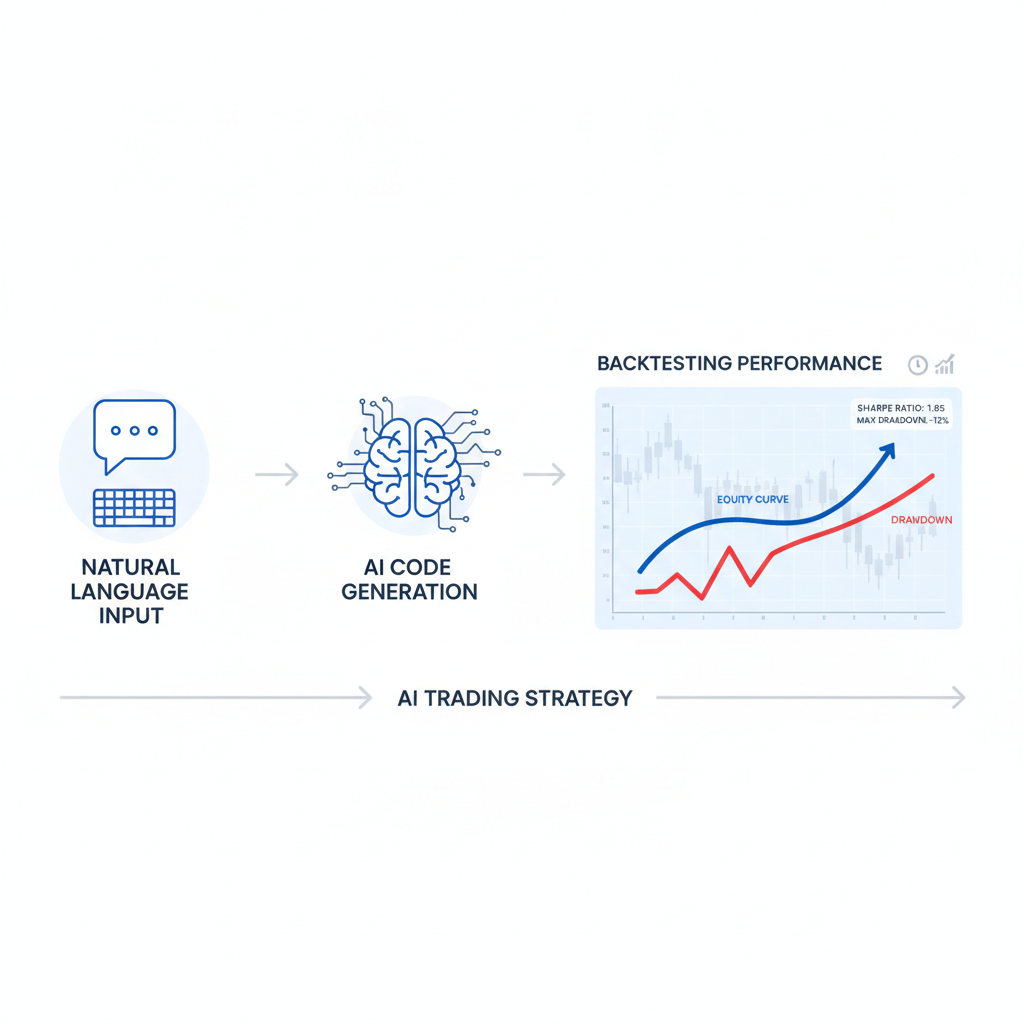
The core innovation of AI trading strategy builders lies in their ability to interpret human language and translate it into machine-readable code. This process effectively eliminates the need for traders to learn complex programming syntax, allowing them to focus entirely on their trading logic, entry/exit conditions, and risk management parameters.
Platforms offering this functionality allow users to describe their strategy in plain English. For instance, a trader might articulate rules like "enter a long position when the 50-period moving average crosses above the 200-period moving average, and RSI is below 30" or "exit when profit reaches 1.5% or loss exceeds 0.75%." The AI then processes these instructions, generating the underlying algorithmic code instantly.
AlgoBuilder, for example, highlights this capability, stating: "No coding needed — just describe your idea and watch it come to life." This approach moves beyond simple indicator-based strategies to encompass more complex, multi-condition logic and risk filters, all defined through intuitive conversational interfaces. This capability significantly accelerates the strategy development cycle, enabling traders to test numerous hypotheses in a fraction of the time it would take to manually code each one.
The speed and flexibility offered by AI in this phase means that instead of spending days coding, debugging, and compiling, traders can spend that time refining their ideas, experimenting with different parameters, and exploring novel market dynamics. This shift empowers systematic traders to iterate rapidly, transforming intuitive concepts into disciplined, automated trading systems.
The Imperative of Institutional-Grade Backtesting for AI Strategies
Generating an AI-powered strategy is only the first step; validating its efficacy and robustness is paramount. This is where institutional-grade backtesting engines become indispensable. A truly robust AI trading strategy builder must offer comprehensive backtesting capabilities that mirror real-world market conditions, far beyond simple historical replays.
Advanced platforms simulate strategies against vast datasets, often leveraging terabytes of tick-level historical data, to provide high-resolution insights into performance. Key features of such backtesting include:
Realistic Cost Modeling: Accounting for commissions, slippage, and other transaction costs, which can significantly erode profitability in live trading. The "AI-based algorithmic trading strategies (with Python tutorial)" on Medium emphasizes the inclusion of "Backtests with realistic costs."
Out-of-Sample Backtesting: Ensuring the strategy performs well on data it hasn't "seen" during its development, crucial for preventing overfitting and validating predictive power.
Monte Carlo Simulations: Running the strategy thousands of times with randomized market inputs to assess its stability and potential range of outcomes under varying conditions.
Heatmaps and Performance Metrics: Visualizing strategy performance across different market states, alongside detailed metrics like Sharpe ratio, maximum drawdown, and profit factor, to understand strengths and weaknesses.
Without such rigorous testing, even an AI-generated strategy can prove fragile in live markets. The goal is to move from theoretical edge to a statistically validated edge. For instance, being able to "Simulate five years in a few minutes, with millisecond resolution and built-in slippage modeling" provides the depth necessary to test like professional funds. This meticulous approach ensures that the strategy isn't merely optimized for past data but possesses a genuine, resilient edge capable of navigating future market volatility and uncertainty.
Beyond Creation: Automated Execution and Ecosystems for AI Strategies
An AI trading strategy builder’s utility extends beyond generating code; it encompasses the entire lifecycle from ideation to live deployment and continuous monitoring. A complete ecosystem enables traders to seamlessly transition from a thoroughly backtested strategy to automated execution in the market.
This typically involves integrations with various brokers, allowing traders to deploy their AI-generated strategies for live trading with automated order placement. Before full deployment, many platforms offer robust paper trading environments, as noted in the Medium article: "Paper trade: run the strategy daily without sending real orders and compare expected versus realized fills." This step is crucial for verifying the strategy's real-time performance without capital risk, identifying potential "operational risk" issues such as "latency variability, rejections, liquidity gaps, and occasional data outages." The recommendation is to "Start tiny: deploy minimal capital under strict daily and weekly loss limits and scale gradually."
Furthermore, the concept of a strategy marketplace has gained traction. These marketplaces allow traders to explore, purchase, or copy strategies developed by a community of users. This fosters collaboration and provides an avenue for experienced traders to monetize their successful strategies, while newer users can learn from proven approaches. Such an ecosystem also includes real-time analytics dashboards, allowing traders to monitor their deployed strategies, track key performance indicators, and receive alerts, ensuring continuous oversight even during automated operation.
The integration of these functionalities ensures that traders have a comprehensive toolkit at their disposal, transforming a raw idea into a fully automated, monitored, and potentially monetized trading operation.
Navigating the Pitfalls: Human Insight in AI Trading Strategy Development
While AI trading strategy builders offer unprecedented power, they are not a substitute for human intelligence and critical oversight. The quality of an AI-generated strategy is heavily dependent on the clarity and robustness of the inputs provided by the trader. Blindly relying on AI without understanding its underlying logic or potential weaknesses can lead to significant pitfalls.
One common issue arises when prompts are vague or rely on ambiguous definitions. A Reddit discussion titled "I Asked AI to Build the 'Best' Trading Strategy" illustrates these challenges. The AI-generated strategy proposed concepts like a "flux zone" defined by "the convergence of EMAs within a range of 5% of the asset's average daily range (ADR)." Critics immediately pointed out that "small changes in market volatility or price action could render this condition either too frequent or too rare, affecting its reliability." Another proposed "Quantum Flow Index (QFI)" was a complex blend of RSI, Bollinger Bands, and Heikin-Ashi, leading to concerns about "amplified weaknesses and increased risk of lagging signals."
These examples highlight that even with advanced AI, the principle of "garbage in, garbage out" holds true. Traders must possess a clear understanding of their market edge and be able to articulate it with precision. Key considerations include:
Clear Definitions: Ensuring all conditions and indicators are unambiguously defined.
Robustness Testing: Moving beyond simple backtesting to include out-of-sample data, Monte Carlo simulations, and stress tests.
Risk Management: Explicitly defining stop-loss, take-profit, and position-sizing rules to mitigate potential losses.
Market Context: Understanding that even the best AI cannot perfectly predict all market events, and human discretion remains crucial for adapting to unprecedented conditions.
The most successful AI strategy development combines the speed and processing power of AI with the nuanced understanding, critical thinking, and disciplined risk management of an experienced trader. It is about augmenting human intelligence, not replacing it entirely.
How Horizon Addresses This
Horizon (https://horizon.trade) is engineered to empower systematic traders who think strategically but may not possess coding expertise. Our AI-powered algorithmic trading platform directly addresses the challenges and opportunities presented by AI strategy builders:
AI Strategy Generation Without Code: Horizon's intuitive interface allows traders to generate custom trading strategies using natural language, transforming ideas into executable algorithms without writing a single line of code.
Institutional-Grade Backtesting: We provide a robust backtesting engine that includes out-of-sample validation, Monte Carlo simulations, and detailed performance heatmaps. This ensures your AI-generated strategies are rigorously tested against historical market data with realistic costs and slippage modeling, proving true robustness.
Seamless Deployment & Monitoring: Connect your broker and deploy strategies for live trading with automated execution. Monitor real-time performance with comprehensive analytics, keeping your edge sharp and your operations disciplined.
Multi-Asset Support: Whether you trade stocks, forex, crypto, futures, or options, Horizon supports diverse asset classes, allowing you to apply your AI-powered strategies across multiple markets.
Strategy Marketplace: Explore a marketplace of community-built strategies, providing inspiration or opportunities to buy/copy and customize. Alternatively, monetize your own proven strategies by selling access to others, building a reputation based on real performance.
Horizon is built for the professional in the middle—intelligent, capitalized, and ready to operate at the next level, offering the tools to transform your trading ideas into automated, disciplined execution.
Conclusion
The advent of AI trading strategy builders marks a pivotal moment in the evolution of financial markets. By dismantling the traditional coding barrier, these platforms empower a new generation of systematic traders to transform their analytical insights and market intuition into robust, automated strategies. However, the true power of AI in trading is unlocked when combined with rigorous testing and informed human oversight. For serious traders aiming to elevate their game, leveraging an institutional-grade platform that marries AI strategy generation with comprehensive backtesting, seamless execution, and a supportive ecosystem is no longer a luxury but a necessity. Explore how Horizon can help you harness the full potential of AI to achieve disciplined, automated trading success. For more insights into advanced trading methodologies, we encourage you to explore other articles on our website.