Published Jun 18, 2026
Algorithmic Trading Without Coding: Unlocking Strategies with AI and Robust Validation
Once the exclusive domain of quantitative analysts and seasoned programmers, algorithmic trading is experiencing a profound democratization. The sheer volume of automated trades underscores this shift: algorithmic strategies now account for an estimated 60% to 73% of daily US equity trading volume, a significant leap from roughly 20% in 2005. This expansion highlights a critical need for accessible, yet powerful, tools that can translate trading intuition into automated, disciplined execution without requiring extensive coding expertise.
Key Takeaways
The no-code algorithmic trading market is projected to reach an impressive $45.5 billion by 2025, signifying a rapid shift towards accessible automation for traders.
Traditional algorithmic trading demanded deep programming knowledge, but modern visual, drag-and-drop interfaces now empower non-coders to define and deploy complex strategies.
While offering significant ease and speed, standard no-code solutions frequently encounter limitations in terms of customization depth, multi-asset class integration, and truly robust backtesting capabilities, often leading to vendor lock-in.
Advanced AI-powered platforms are revolutionizing strategy generation, allowing users to move beyond pre-built templates to *generate* hundreds of unique, complex strategies from their core ideas without writing a single line of code.
Institutional-grade backtesting, including out-of-sample validation, Monte Carlo simulations, and performance heatmaps, is indispensable for rigorously verifying strategy robustness and ensuring actual viability beyond mere historical data fitting.
The Democratization of Algorithmic Trading: A $45.5 Billion Shift
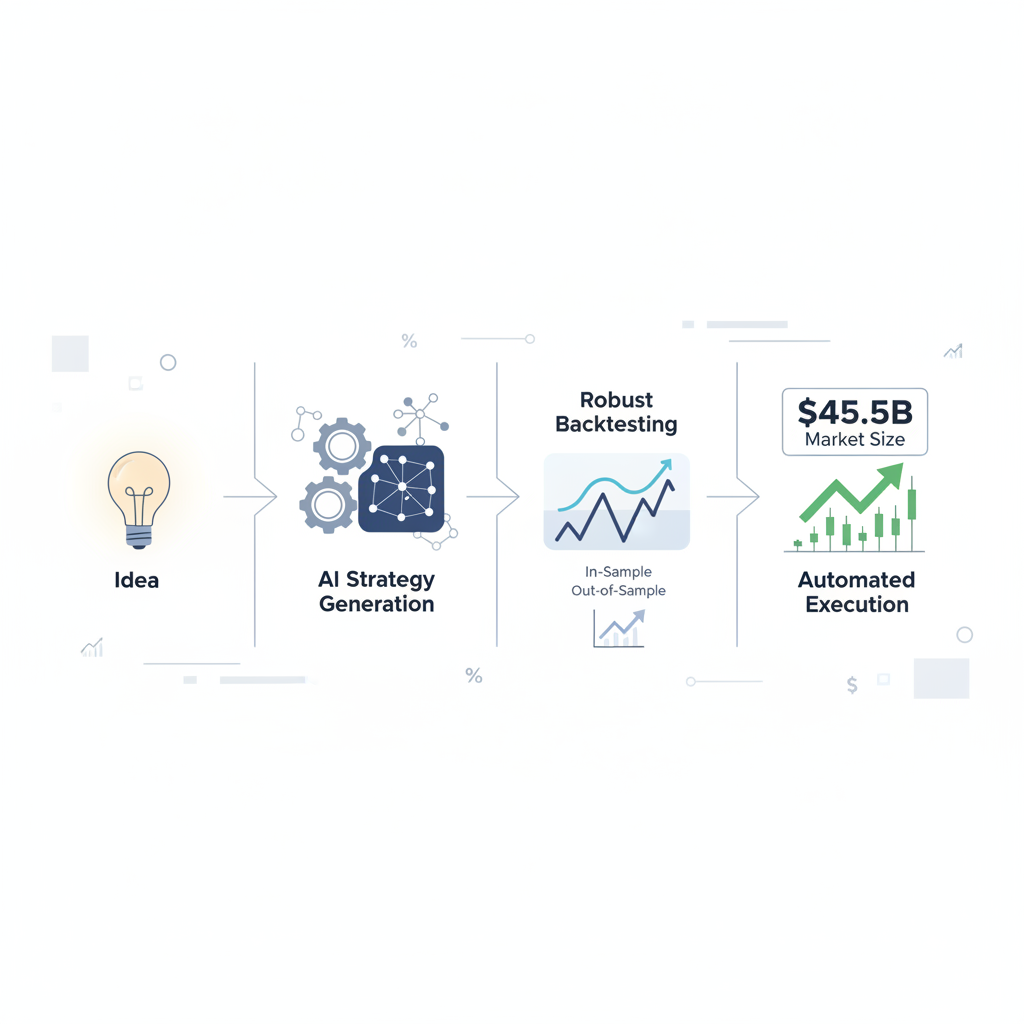
The financial world has long grappled with a technical divide: those with coding prowess could tap into the efficiency and scalability of algorithmic trading, while others were often confined to manual execution. This paradigm is rapidly dissolving with the advent of no-code algorithmic trading platforms. Research indicates that the no-code algorithmic trading market is on track to become a $45.5 billion industry by 2025, reflecting a profound shift in how traders engage with automation.
No-code algorithmic trading is revolutionizing the financial world by making sophisticated trading strategies accessible to everyone, regardless of coding expertise.
This accessibility offers compelling advantages. By abstracting away the complexities of programming languages, these platforms lower the barrier to entry, allowing traders to focus on strategy logic rather than syntax. Moreover, using pre-tested algorithms within these environments can significantly reduce the risk of bugs that often plague custom-coded strategies, leading to more reliable execution (QuantVPS). The ease of use and reduced development time are major draws, enabling traders to quickly iterate and deploy ideas that once required weeks or months of development cycles.
Historically, building an algorithmic trading setup involved intricate development environments and a deep understanding of programming languages like Python or C++. Today, platforms are designed to cater to a wider audience, from novices to seasoned professionals, by providing intuitive interfaces that simplify strategy creation, backtesting, and deployment. This shift means that systematic traders, who possess valuable market insights but lack coding skills, can now translate their edge into automated systems.
Actionable Insight: For traders looking to enter or scale their algorithmic operations, prioritizing platforms that offer robust no-code capabilities is crucial. This allows for rapid prototyping and deployment of strategies, minimizing the time spent on technical implementation and maximizing focus on market logic.
Beyond Drag-and-Drop: The Mechanics of No-Code Strategy Building

At its core, no-code algorithmic trading empowers users through visual strategy builders. Instead of writing lines of code, traders interact with logical building blocks in a graphical interface. This intuitive drag-and-drop approach mirrors how traders naturally conceive strategies, mapping concepts like "entry conditions," "exit rules," "risk management parameters," and "position sizing algorithms" directly to visual components (Tradetron).
These platforms typically come equipped with an extensive library of pre-built signals and indicators. For instance, some platforms boast thousands of built-in entry and exit signals, covering a vast array of market phenomena. These include:
Seasonality: Patterns linked to specific times of the year, month, or day.
Price Action & Candlestick Patterns: Classic chart formations and individual candle signals.
Technical Analysis Indicators: Moving averages, RSI, MACD, Bollinger Bands, and custom indicator construction.
Volume & Volatility: Metrics related to trading activity and market fluctuation.
Market Breadth: How widespread buying or selling is across the market.
Economic Data & News Events: Integrating macro factors into trading decisions.
Options Flows & Gamma Exposure: Insights from the options market.
The ability to integrate these non-price-based signals is particularly powerful. They provide much-needed context to traditional price-action and volume-based strategies, helping to keep algorithms attuned to the current market regime across multiple conditions. This level of detail, once accessible primarily to quant developers, is now available through accessible interfaces.
Actionable Insight: When evaluating no-code platforms, assess the breadth and depth of their pre-built indicator and signal libraries. A comprehensive selection allows for more nuanced and adaptable strategies, providing an edge beyond simple moving average crossovers.
The AI Advantage: Generating Complex Strategies Without Code
While traditional no-code platforms excel at simplifying the definition of trading rules, the true innovation lies in leveraging AI to *generate* strategies from a trader's intent. This moves beyond merely selecting from a list of predefined templates or indicators to an intelligent system that can explore vast permutations of rules and parameters to identify robust strategies.
Imagine being able to feed an AI engine your core trading idea—for example, "buy dips in strong trends" or "exploit mean reversion in oversold conditions"—and have it construct complex, multi-variable strategies tailored to your specifications. Platforms incorporating AI can generate hundreds or even thousands of algorithmic trading strategies based on historical data, simply at the click of a button, requiring no prior algo trading experience.
This AI-driven approach often utilizes genetic algorithms or machine learning models to search for optimal combinations of entry points, exit rules, risk management parameters, and asset classes. The system continuously refines and evaluates potential strategies against specified risk and performance metrics, such as desired return, maximum drawdown, and Sharpe ratio. This process allows for the discovery of non-obvious strategies that a human might not conceive through manual iteration.
The advantage here is not just speed, but also the ability to explore a much larger strategy space. A human trader might test a handful of variations; an AI can intelligently search through millions, dramatically increasing the probability of finding a truly robust and performant strategy. Furthermore, AI can help in parameter optimization, fine-tuning the inputs of a strategy to improve its performance across different market conditions, all without the user needing to write optimization algorithms themselves.
Actionable Insight: To truly unlock the potential of algorithmic trading without coding, seek out platforms that integrate AI for strategy generation. This capability transforms the process from merely building known strategies to discovering novel and robust approaches.
Navigating the Pitfalls: Customization, Robustness, and Vendor Lock-in
Despite their undeniable advantages, no-code platforms present several notable challenges that serious traders must address. The primary concern is often limited customization. Many entry-level no-code solutions rely heavily on predefined templates, which can be too restrictive for traders aiming for intricate, multi-asset, or highly specific strategies . This lack of flexibility can lead to generic strategies that fail to capture a trader's unique edge.
Another critical hurdle is ensuring **strategy robustness and performance**. While a strategy might look good on historical data, this "in-sample" performance can be misleading. Without rigorous backtesting that includes:
Out-of-sample validation: Testing the strategy on data it hasn't "seen" before to prevent overfitting.
Monte Carlo simulations: Assessing strategy performance across thousands of hypothetical market scenarios to understand its statistical reliability.
Heatmaps and detailed performance metrics: Visualizing how different parameters affect performance and providing comprehensive statistics like Sharpe Ratio, Sortino Ratio, max drawdown, and average trade profit.
...traders risk deploying strategies that are fragile and destined to fail in live markets. QuantConnect, for example, emphasizes moving from research to "point-in-time, fee, slippage, and spread-adjusted backtesting on lightning-fast cloud cores," performing more than 15,000 backtests daily on its platform. This level of rigorous validation is essential to truly determine if a strategy is robust or merely lucky.
Finally, traders face concerns regarding scalability and vendor lock-in. If a platform's capabilities are fixed, traders might find themselves restricted as their strategies evolve or their capital grows. This "vendor lock-in" can limit both adaptability and long-term growth potential, making it tough to fine-tune strategies or troubleshoot problems effectively due to restricted access to underlying code or insufficient export options (QuantVPS).
Actionable Insight: Prioritize platforms that offer deep customization options, even without code, and provide institutional-grade backtesting tools. Look for evidence of out-of-sample testing, Monte Carlo capabilities, and detailed performance analytics to ensure your strategies are genuinely robust.
How Horizon Addresses This
For serious traders who think systematically but cannot code, Horizon Trade stands as an institutional-grade AI trading platform that transforms your edge or any trading ideas—proven or in progress—into automated, disciplined execution. Horizon directly addresses the limitations of standard no-code platforms by offering unparalleled customization and robustness.
Our AI strategy generation engine allows you to articulate your trading ideas using natural language or intuitive visual builders, then leverage artificial intelligence to generate truly custom and complex strategies, far beyond simple templates. This means you maintain full control over your unique edge while benefiting from AI's ability to explore vast strategy permutations. With Horizon, you can design multi-asset strategies covering stocks, forex, crypto, futures, and options, ensuring your ideas are not constrained by platform limitations.
Horizon's institutional-grade backtesting engine tackles the crucial challenge of strategy robustness head-on. You can backtest your AI-generated or custom-built strategies against extensive historical market data, receiving detailed performance metrics, including Sharpe Ratio, Sortino Ratio, maximum drawdown, and profitability. Crucially, we provide advanced validation tools like out-of-sample backtesting, Monte Carlo simulations, and performance heatmaps to definitively assess if your strategy is truly robust and not merely overfit to past data. This rigorous validation ensures you deploy only the most resilient strategies. Once confident, deploy your strategies for live trading with automated execution via seamless broker integrations, and monitor performance with real-time analytics. Explore our blog for more articles on advanced trading concepts.
Conclusion
The landscape of algorithmic trading has evolved dramatically, making sophisticated strategies accessible to a wider audience than ever before. While the rise of no-code platforms promises ease and efficiency, serious traders must look beyond basic functionality to ensure true customization, scalability, and, most importantly, the robustness of their strategies. The integration of AI into no-code environments offers a powerful solution, enabling the generation of complex, unique algorithms without the need for programming. Paired with institutional-grade backtesting and comprehensive validation tools, traders can confidently transform their systematic thinking into disciplined, automated execution. The future of trading belongs to those who can leverage technology to build, test, and deploy their edge with precision. Are you ready to elevate your trading?