Published Jun 26, 2026
Automating RSI Divergence Trading Bots for Strategic Execution

Many traders are drawn to the Relative Strength Index (RSI) for its clear signals of overbought or oversold conditions, yet manually monitoring for nuanced patterns like divergence across multiple assets is a demanding, error-prone task. The advent of automated trading systems, particularly those focused on RSI divergence, offers a disciplined solution to capture these high-probability setups consistently, removing emotional biases and enabling 24/7 market vigilance.
Key Takeaways
- RSI divergence signals potential reversals when price and indicator move in opposite directions, offering advanced trading opportunities often missed by basic overbought/oversold signals.
- Automating RSI strategies provides 24/7 market monitoring and disciplined execution, eliminating human emotional biases inherent in manual trading decisions.
- Optimal RSI bot performance often requires combining standard 14-period RSI signals with trend filters like EMAs (e.g., 50/200 periods) or momentum indicators such as MACD (e.g., 12-26-9 settings).
- Developing an RSI divergence bot involves defining clear entry/exit logic, often requiring programming expertise, and thorough backtesting across various market conditions to ensure robustness.
- Rigorous backtesting, including out-of-sample data and Monte Carlo simulations, is crucial to validate the robustness of any RSI automated trading system before live deployment.
The Foundation: Understanding the RSI Indicator and Basic Automation
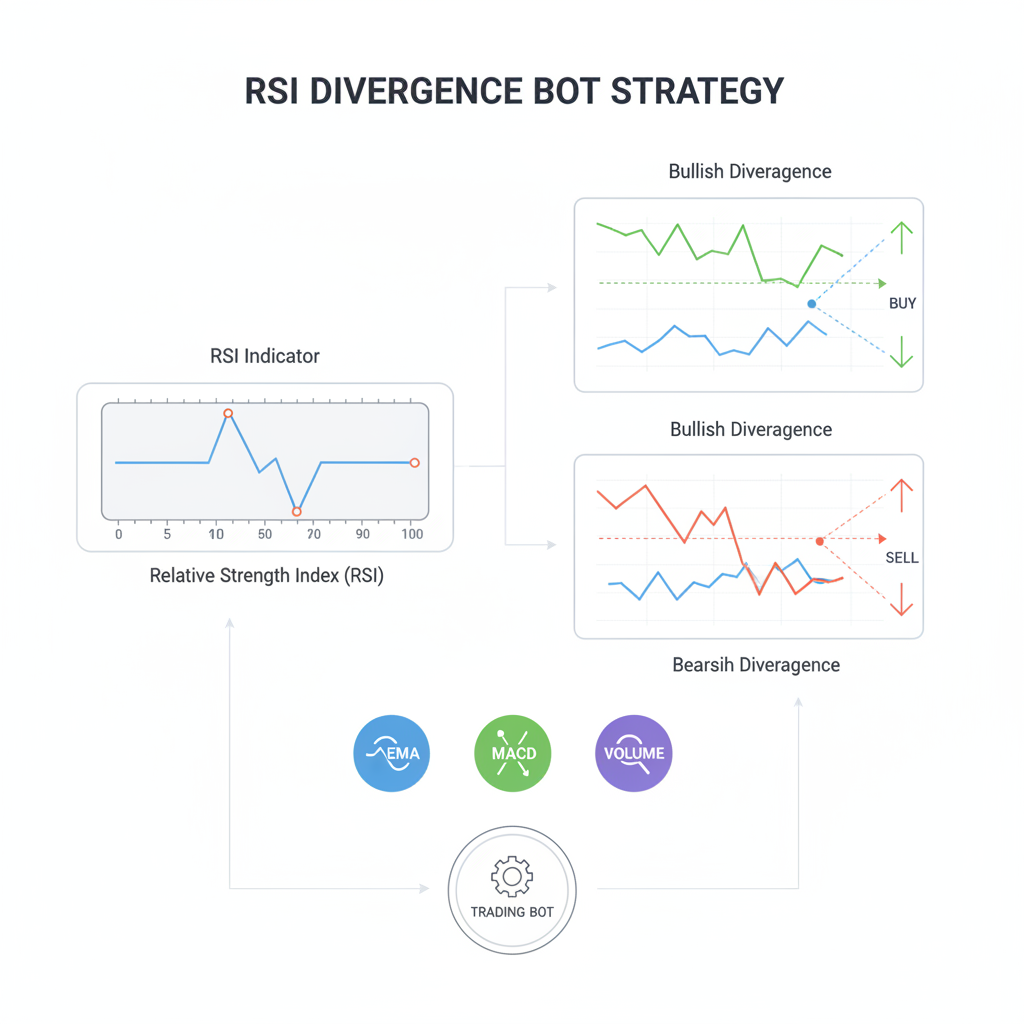
The Relative Strength Index (RSI) is a momentum oscillator developed by J. Welles Wilder Jr., designed to measure the speed and change of price movements. Operating on a scale from 0 to 100, it visually represents whether an asset is overbought or oversold, providing traders with potential reversal signals. Conventionally, an RSI reading above 70 suggests an asset is overbought and may be due for a pullback, while a reading below 30 indicates it is oversold and could be poised for a rebound Wundertrading.
An RSI automated trading system, or bot, is programmed to monitor market conditions continuously, identifying these potential entry and exit points based on pre-set RSI thresholds. This automation ensures that trades are executed according to a defined strategy without human intervention, removing the emotional decisions that often lead to poor trading outcomes AesirCrypto. While the default setting for the RSI period is typically 14, sophisticated bots allow traders to customize these levels based on their specific risk tolerance, asset volatility, and trading style Alpaca Markets. For instance, some aggressive swing trading strategies might use more extreme thresholds, opening a short call spread when RSI is above 80 and a short put spread when RSI is below 20 Optionalpha.
"An RSI trading bot is a type of crypto trading bot that executes trades based on the Relative Strength Index (RSI) indicator. As a form of automated crypto trading, it monitors market conditions 24/7, identifies potential entry and exit points using RSI signals, and executes trades according to pre-set parameters—all without human intervention." — Wundertrading
The primary advantage of automating an RSI strategy is the ability to maintain discipline and capitalize on opportunities around the clock, especially in volatile markets like cryptocurrency. By offloading the repetitive tasks of monitoring and execution, traders can ensure their strategy is consistently applied, eliminating the fatigue and emotional biases that can hinder manual trading performance Optionalpha.
Practical Insight: Starting with basic overbought/oversold RSI strategies in an automated system can be a solid foundation, but traders should always consider customizing thresholds and incorporating additional filters to adapt to specific market conditions and asset characteristics.
Advanced Precision: Automating RSI Divergence Trading Bots

While basic overbought/oversold signals are useful, an RSI divergence trading bot elevates strategy by identifying more nuanced and often more powerful signals. Divergence occurs when the price of an asset moves in the opposite direction of its RSI, frequently signaling an impending trend reversal altFINS. Automating the detection and trading of these divergences can significantly enhance a bot's predictive power.
Types of RSI Divergence
- Bullish Divergence: This occurs when the asset's price makes a lower low, but the RSI forms a higher low. This pattern suggests that despite falling prices, the selling momentum is weakening, signaling a potential upward reversal. A bot programmed for this would interpret it as a buy signal altFINS.
- Bearish Divergence: Conversely, bearish divergence is observed when the price records a higher high, but the RSI registers a lower high. This indicates that despite rising prices, the buying momentum is decreasing, suggesting a potential downward reversal. This would typically trigger a sell signal for an automated system AesirCrypto.
Programming a bot to detect these divergences involves complex logic that compares price action (e.g., historical lows/highs) with corresponding RSI values over specific periods. Manual detection of these patterns can be subjective and time-consuming, especially across multiple assets and timeframes. An RSI divergence trading bot, however, can scan for these precise conditions 24/7, executing trades the moment the criteria are met Wundertrading.
These divergence signals are often most effective when they occur near established support or resistance levels and on higher timeframes, providing more robust reversal indications altFINS. For traders looking to implement such a system, building a custom bot often involves using programming languages like Python to define the logic for divergence detection, setup logic (entry conditions), and execution logic (entry & exit methods) eMaster Class Academy.
Practical Insight: When designing an RSI divergence bot, prioritize clear, unambiguous rules for identifying highs and lows in both price and RSI to minimize false signals. Focus on higher timeframes for more reliable divergence setups and consider combining with confluence from support/resistance zones.
Optimizing Performance: Best RSI Settings for Bots and Auxiliary Indicators
While RSI divergence offers a powerful edge, relying solely on it can lead to false signals, especially in choppy markets. The "best RSI settings for a bot" are rarely a single static configuration; rather, they involve a combination of optimized RSI parameters and confirmatory indicators to filter out noise and improve signal quality Medium.
Combining RSI with Trend Filters
One of the most effective ways to enhance an RSI automated trading system is to integrate trend-following indicators. For instance, requiring the price to be above a key moving average (MA) before acting on an RSI buy signal, or below an MA for a sell signal, can significantly reduce false entries Wundertrading. Common moving averages used for this purpose include the 50-period Exponential Moving Average (EMA) and the 200-period EMA, with a bullish market often defined by price staying above both EMAs eMaster Class Academy.
Other powerful filters include:
- Simple Moving Average (SMA): The 200-day SMA is a widely recognized indicator for long-term market trends. A bot might only generate a buy signal if the core RSI conditions are met AND the price is above this long-term trend line GitHub - Ajay-Maury/RSI-bot.
- Average Directional Index (ADX): Ranging from 0 to 100, the ADX measures the strength of a trend. Integrating ADX can ensure that RSI signals are only acted upon when a meaningful trend is in place, or conversely, when the market is clearly range-bound GitHub - Ajay-Maury/RSI-bot.
- Moving Average Convergence Divergence (MACD): This indicator highlights the relationship between two moving averages of a security's price. Common settings are Fast EMA 12, Slow EMA 26, and Signal EMA 9. A bot can use MACD crossovers (e.g., MACD line crossing above its signal line for bullish confirmation) to validate RSI signals Alpaca Markets.
Beyond divergence and trend confirmation, RSI bots can be tailored for specific market behaviors. For sideways markets, an RSI automated trading system can implement an RSI Range Strategy, programming the bot to buy when RSI is around 30 (support) and sell when it's around 70 (resistance), profiting from predictable oscillations Wundertrading. These combined strategies and customizable settings highlight that the "best" approach is one that is thoroughly backtested and optimized for the specific asset and market conditions it trades.
Practical Insight: When configuring an RSI bot, always test combinations of RSI periods, overbought/oversold thresholds, and at least one other trend-following or momentum indicator. A strategy that integrates a 200-period SMA for trend filtering and MACD crossovers for confirmation can significantly improve robustness.
The Imperative of Robust Testing for Any RSI Automated Trading System
The success of any RSI automated trading system, particularly one employing complex strategies like divergence, hinges entirely on rigorous testing. Deploying a bot without comprehensive backtesting and validation is akin to trading blindfolded. The goal of testing is not just to see if a strategy has made money historically, but to ascertain its robustness and predictive power across varied market conditions, ensuring it doesn't simply overfit to past data Wundertrading.
Effective testing protocols for an RSI bot include:
- Historical Backtesting: Simulating the strategy against extensive historical market data is the foundational step. This process helps identify potential issues, measure performance metrics (like return, drawdown, and Sharpe ratio), and validate the strategy's core logic GitHub - Ajay-Maury/RSI-bot. Traders should analyze metrics such as stop-loss and take-profit percentages to understand risk-reward dynamics GitHub - Ajay-Maury/RSI-bot.
- Out-of-Sample Testing: After optimizing a strategy on one dataset, it's crucial to test it on a period of historical data that was NOT used in the optimization process. This helps confirm that the strategy is not over-optimized to specific market nuances of the training data.
- Monte Carlo Simulation: This advanced technique involves running a strategy many times with random variations in trade order, entry/exit prices, or sequence of market events. It helps assess the strategy's sensitivity to randomness and provides a more realistic distribution of potential outcomes, revealing its true robustness.
- Paper Trading (Demo Mode): Before committing real capital, an RSI automated trading system should run in a simulated live environment. This "demo mode" helps identify any operational glitches, latency issues, or unexpected behaviors that might not surface during historical backtesting, allowing for real-time adjustments without financial risk Wundertrading.
- Risk Management Integration: Beyond performance, a robust bot incorporates built-in risk controls. This includes setting capital allocation limits (e.g., a total allocation of $5,000) and position limits (e.g., no more than three open positions at any time or per day) to prevent over-allocation and excessive risk exposure Optionalpha.
The journey from concept to a live, profitable RSI divergence trading bot is iterative, requiring continuous testing, refinement, and adaptation. Successful traders view bots as sophisticated tools that enhance their strategy, not as magic solutions that replace thorough analysis and disciplined risk management Wundertrading.
Practical Insight: Never skip paper trading. It is the bridge between historical backtesting and live deployment, offering invaluable real-world feedback on your bot's performance and operational stability. Pay close attention to latency and execution slippage during this phase.
How Horizon Addresses This
Horizon Trade revolutionizes the process of building and deploying RSI automated trading systems, especially those incorporating nuanced strategies like divergence, by removing the coding barrier. For serious traders who think systematically but lack programming expertise, Horizon provides an intuitive, AI-powered platform to transform their insights into robust, automated strategies.
- AI Strategy Generation: Easily generate custom RSI divergence trading bot strategies using AI, without writing a single line of code. Simply articulate your RSI concepts, and Horizon's AI assists in structuring the logic, including sophisticated filters like EMAs and MACD.
- Institutional-Grade Backtesting: Validate your RSI automated trading system with Horizon's powerful backtesting engine. Conduct thorough historical simulations, including crucial out-of-sample backtesting, Monte Carlo simulations for robustness checks, and heatmaps to visualize performance across varying parameters. This ensures your chosen RSI settings and divergence logic are truly robust.
- Multi-Asset Support: Deploy your optimized RSI strategies across a wide range of assets—stocks, forex, crypto, futures, and options—all from a single platform.
- Automated Execution & Monitoring: Seamlessly connect your broker and deploy your strategies for live or paper trading with automated execution. Monitor real-time performance analytics to track your bot's effectiveness and make data-driven adjustments.
- Strategy Marketplace: Access a marketplace of community-built strategies, including advanced RSI systems, which you can customize or even sell access to your own proven bots, leveraging your real-time performance reputation.
Horizon empowers traders to move beyond manual monitoring and complex coding, enabling them to confidently automate even the most intricate RSI divergence strategies with institutional-grade tools.
Conclusion
The journey from a trading idea rooted in the Relative Strength Index to a fully operational, profitable RSI divergence trading bot represents a significant leap in systematic trading. By automating the detection of subtle yet powerful signals like bullish and bearish divergence, and combining them with confirmatory indicators like moving averages and MACD, traders can build sophisticated systems that operate with unparalleled discipline and consistency. The key to unlocking this potential lies in meticulous strategy design, careful selection of the best RSI settings for the bot, and, most critically, rigorous backtesting and validation through methods like out-of-sample analysis and Monte Carlo simulations. Platforms like Horizon Trade are democratizing access to these institutional-grade capabilities, allowing serious traders to transform their analytical edge into automated, reliable execution without the complexities of coding. Explore how AI-powered automation can elevate your RSI trading strategies and bring a new level of precision to your market participation today. For more insights into algorithmic trading and strategy development, visit Horizon Global Trade's blog.
Sources
- RSI Trading Bot Explained: How It Works & Key Benefits
- Top 10 Crypto Trading Bot Strategies For 2024
- Build a Python Trading Bot (2025) | RSI Divergence Strategy & Backtest – Ep. 3
- Build an RSI Swing Trading Bot with Credit Spreads
- GitHub - Ajay-Maury/RSI-bot: An interactive stock backtesting tool & trading bot using Python & Streamlit. Implements an RSI-based strategy with EMA, SMA, ADX & MACD filters for Indian stocks (NSE/BSE).
- How to Build a Free Trading Bot with ChatGPT and Alpaca
- Trading RSI and RSI Divergence - altFINS
- Best RSI Settings and Strategies. Objective Reality Check.