Published Jul 04, 2026
Beyond Pine Script: Unlocking Automated Trading for Non-Coders with AI

The landscape of modern trading is increasingly dominated by algorithms. Once the exclusive domain of institutional quant teams, algorithmic strategies now form the backbone of market activity. Yet, for systematic traders without a coding background, translating complex ideas into automated execution remains a formidable challenge. While tools like Pine Script have democratized indicator development, their inherent limitations often fall short of the rigorous demands of professional-grade automated trading.
Key Takeaways
Pine Script, while user-friendly for chart indicators, lacks native direct execution capabilities, requiring external services for automation.
Serious traders demand institutional-grade backtesting, multi-asset support, and advanced data access, which Pine Script's "TradingView universe" limitations often cannot provide.
Pine Script imposes significant technical limitations, including a maximum of 5,000 bars for most historical data series and 100,000 elements for collections, hindering complex, data-intensive strategies.
AI-powered no-code platforms directly address the gap, allowing non-coders to generate, backtest, and deploy sophisticated algorithmic strategies with the robustness and flexibility traditionally reserved for professional developers.
Platforms that separate strategy logic from execution, offer extensive backtesting metrics, and support direct broker integration represent a significant advantage for non-coders seeking true automation.
The Promise and Pine Script's Practical Limits for Automated Trading
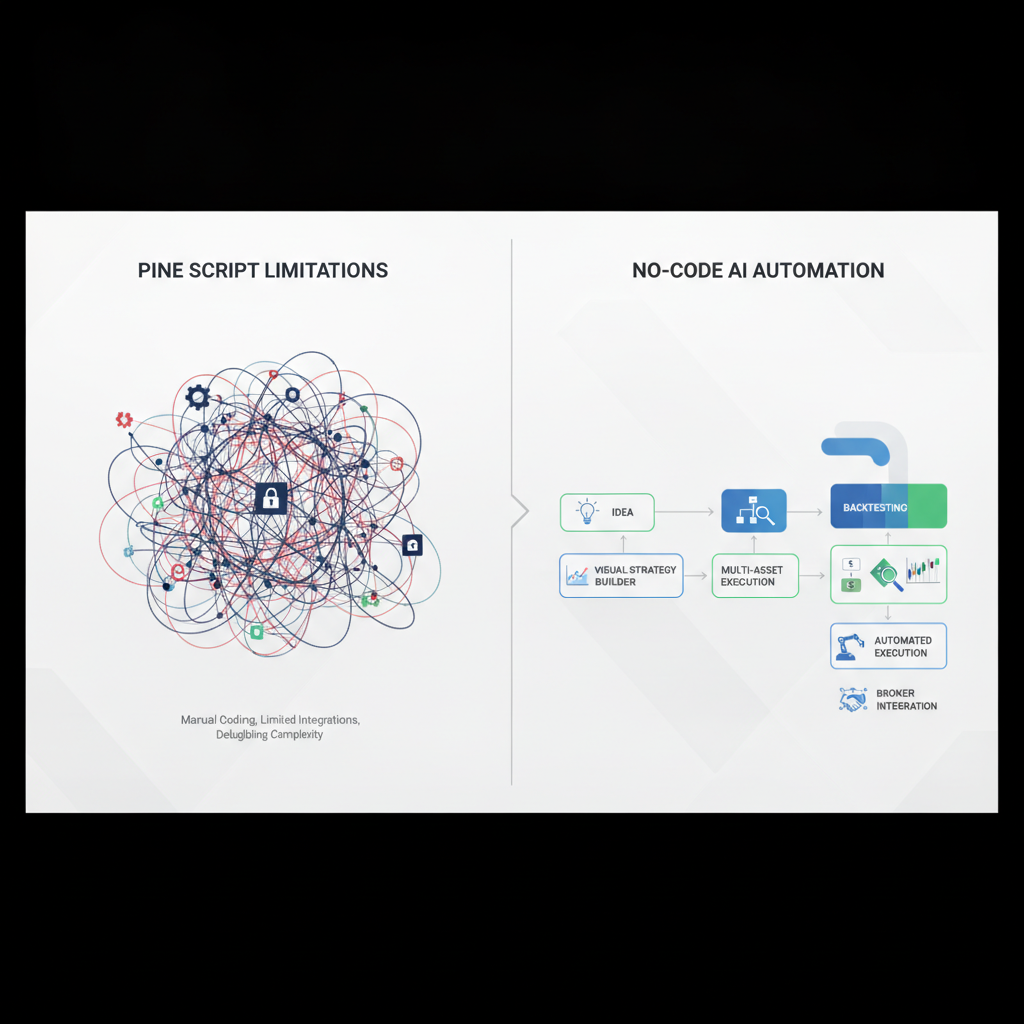
Pine Script, TradingView's proprietary scripting language, has gained significant traction for its relative ease of use in creating custom indicators and alerts. Its design philosophy prioritizes simplicity and accessibility, allowing even a beginner with no programming background to write a working indicator in an afternoon. The language's clean syntax, well-maintained documentation, and rapid feedback loop (write code, add to chart, see results) make it an ideal entry point for visually augmenting charts and generating basic alerts.
Moreover, Pine Script benefits from a vast and active community. TradingView's public script library boasts hundreds of thousands of open-source scripts, providing a rich resource for learning and adaptation. This extensive ecosystem, coupled with active forums on Reddit, Discord, and TradingView itself, ensures that answers to common problems exist and are readily accessible.
However, the simplicity and chart-centric nature of Pine Script introduce critical limitations for traders aspiring to fully automated, robust strategies. Fundamentally, Pine Script does not execute trades directly. While TradingView can send webhook alerts to third-party services, it lacks native brokerage execution. This means Pine Script is primarily an analysis and alerting tool, not a direct execution environment. For the non-coder, bridging this gap requires integrating with external services, adding layers of complexity, potential latency, and additional points of failure that undermine the goal of seamless automation.
For serious traders, the inability of Pine Script to natively execute trades transforms it from a powerful analytical tool into a bottleneck for true automated strategy deployment, requiring complex workarounds that demand technical expertise beyond typical charting.
The practical insight here is that while Pine Script excels at visual analysis and simple alerts for non-coders, it creates a significant hurdle when the objective shifts to direct, automated trading, pushing users towards external integration challenges.
The Algorithmic Divide: Where Pine Script Falls Short for Professional Automation

Beyond the execution gap, Pine Script presents several technical and functional limitations that hinder its utility for professional-grade algorithmic trading. These limitations become particularly acute for traders seeking to build sophisticated, data-intensive, and multi-asset strategies without coding expertise.
One primary constraint lies in its data access and historical depth. If TradingView does not offer the data you’re after, you’re out of luck. While TradingView boasts a comprehensive database, strategies involving obscure markets, alternative data feeds, or highly specific granular data might be impossible to implement. Furthermore, Pine Script has defined limits on historical data referencing, typically up to 5,000 bars for most series, with some built-in series like OHLCV extending to 10,000 bars. This constraint can severely impact the ability to conduct long-term backtests or strategies requiring extensive historical context.
Scaling complexity also quickly becomes an issue. Pine Script imposes limitations on script size and memory, including a maximum of 1,000 variables per scope and 100,000 elements for collections (arrays, matrices, maps). While these limits might seem generous for simple indicators, they become significant hurdles for developing advanced algorithms incorporating machine learning models, complex statistical analysis, or multi-faceted strategies across numerous assets. Debugging complex Pine Script can also be challenging for non-coders, despite some built-in error messages, as understanding the nuances of conditional logic and variable scopes often requires programming intuition.
When comparing Pine Script to other coding languages or dedicated platforms, its limitations for automated trading become even clearer:
Python-based platforms like QuantConnect offer unrestricted access to any data source, including APIs, databases, and alternative data providers. They also integrate directly with machine learning libraries like scikit-learn, TensorFlow, and PyTorch, capabilities Pine Script cannot match.
Platform-specific languages like ThinkScript (for Thinkorswim) or MQL4/5 (for MetaTrader) offer tighter broker integration and direct trade execution, albeit with vendor lock-in.
For a non-coder, the path from a basic Pine Script indicator to a robust, automatically executing, multi-asset strategy often involves a steep learning curve in programming, data management, and external integration. This "algorithmic divide" means that while Pine Script lowers the bar for chart analysis, it raises it significantly for true automated trading without coding expertise.
The technical limitations of Pine Script, such as its 5,000-bar history limit and 100,000-element collection size, fundamentally restrict the complexity and data depth necessary for serious, professionally-oriented algorithmic strategies, pushing non-coders into an advanced programming paradigm they sought to avoid.
The actionable insight for traders is to recognize that the pursuit of true automation and advanced strategy capabilities without coding requires moving beyond Pine Script's inherent constraints to platforms designed for comprehensive algorithmic development and execution.
The Imperative for No-Code AI in Algorithmic Trading
The desire to harness the power of algorithmic trading without the prerequisite of coding mastery has led to a burgeoning demand for no-code and low-code solutions. These platforms are designed to empower systematic thinkers—traders who possess keen market insights and strategy ideas—to translate their edge into automated systems directly, bypassing the complexities of programming languages like Pine Script, Python, or C#.
The core value proposition of no-code AI in this context is transformation: converting abstract trading ideas into executable algorithms with unprecedented speed and accessibility. Rather than spending countless hours learning syntax, debugging code, or wrestling with API integrations, traders can focus on strategy logic, risk management, and market analysis. For instance, some AI-powered tools specifically for Pine Script are lauded for enabling users with zero programming experience to create solid indicators within their first hour by describing strategies in plain English. This illustrates the immense potential for AI to bridge the knowledge gap.
However, even AI tools for Pine Script primarily focus on *generating indicators*, not on *deploying and managing comprehensive automated strategies*. The true power of no-code AI platforms extends beyond simple script generation. It encompasses the entire lifecycle of an algorithmic strategy: from idea generation and robust backtesting to live deployment and performance monitoring. These platforms aim to provide an institutional-grade experience without requiring a dedicated quant team.
The market is increasingly recognizing that the value is not in writing code, but in generating and validating profitable strategies. A platform that allows a non-coder to describe a strategy ("buy when the 20 EMA crosses above the 50 EMA") and then automatically translates it into an executable algorithm, complete with advanced backtesting and deployment features, represents a paradigm shift. This shift ensures that valuable trading insights are not lost due to a lack of programming proficiency.
The evolution of no-code AI in trading is fundamentally democratizing algorithmic strategy development, allowing systematic traders to focus solely on their market edge rather than the mechanics of coding, bypassing the typical learning curve of several months or years.
The practical takeaway is that for non-coders, leveraging dedicated no-code AI platforms designed for comprehensive algorithmic trading is a significantly more efficient and powerful path than attempting to force Pine Script into roles it wasn't designed for, or learning complex programming languages from scratch.
Beyond Charting: Institutional-Grade Requirements for Automated Trading
For serious traders, moving beyond basic indicators and alerts means demanding a level of robustness, flexibility, and analytical depth that charting languages like Pine Script cannot provide. Institutional-grade algorithmic trading platforms are built to meet these rigorous requirements, offering a comprehensive ecosystem for strategy validation and execution.
Key among these requirements is an advanced backtesting engine. While Pine Script offers a built-in strategy tester, its capabilities are often limited compared to professional platforms. Institutional-grade backtesting involves:
Out-of-Sample Backtesting: Ensuring a strategy performs well on data it hasn't "seen" during development, crucial for preventing overfitting.
Monte Carlo Simulation: Assessing strategy robustness under varying market conditions and sequences of events, providing a more realistic gauge of risk and potential outcomes.
Detailed Performance Metrics: Beyond simple profit/loss, metrics like Sharpe ratio, Sortino ratio, maximum drawdown, Calmar ratio, and hundreds of others are essential for a complete risk-adjusted performance analysis.
Heatmaps and Visualizations: To identify optimal parameter sets and understand strategy behavior across different market regimes.
Order Flow and Tick Data Simulation: Crucial for strategies sensitive to execution details, far beyond what traditional bar data backtesting offers. While Bookmap offers order flow visualization, direct backtesting on it is not its primary function, highlighting a gap for specific order flow strategies.
Another crucial element is multi-asset support. Professional traders often diversify across stocks, forex, cryptocurrencies, futures, and options. Platforms limited to a single asset class or data feed impose significant constraints. The ability to seamlessly integrate and trade across diverse markets from a single platform, with consistent execution and risk management, is non-negotiable.
Furthermore, secure and low-latency automated execution via direct broker integrations is paramount. Relying on webhooks to external services, as is common with Pine Script for automation, introduces latency and potential points of failure that can compromise strategy performance and risk management. A platform that directly connects to brokers ensures that orders are placed efficiently and reliably.
The shift from analytical charting to professional automated trading requires a fundamental upgrade in tools: from basic backtesting to Monte Carlo simulations, from single-asset indicators to multi-asset strategies, and from alert-based triggers to direct, low-latency broker execution.
The practical insight for non-coding systematic traders is that true operational scalability and robust risk management for algorithmic strategies necessitate a platform built with institutional-grade backtesting, multi-asset capabilities, and direct automated execution in mind, far exceeding the scope of Pine Script.
How Horizon Addresses This
Horizon Global Trade directly addresses the limitations of Pine Script for non-coding systematic traders by providing a comprehensive, institutional-grade AI-powered platform for automated trading. Unlike solutions that require coding or are limited to simple charting alerts, Horizon empowers users to:
Generate Strategies with AI, No Code Required: Leverage AI to transform market insights into custom trading strategies without writing a single line of code, overcoming the primary barrier faced by non-coders using tools like Pine Script.
Conduct Institutional-Grade Backtesting: Move beyond Pine Script's basic backtesting with Horizon's advanced engine, offering detailed performance metrics, out-of-sample testing, Monte Carlo simulations, and heatmaps to validate strategy robustness against historical market data.
Deploy and Automate Across Multiple Assets: Connect your broker and deploy strategies for live trading with automated execution across stocks, forex, crypto, futures, and options—a critical advantage over Pine Script's limited execution environment and often single-asset focus. Horizon’s advanced capabilities, for example, allow sophisticated order flow strategies and backtesting with granular data that Pine Script cannot handle.
Access and Contribute to a Strategy Marketplace: Discover, buy, copy, and customize community-built strategies, or sell access to your own proven strategies, fostering a performance-driven community that extends beyond simple indicator sharing.
Monitor Performance with Real-Time Analytics: Gain real-time insights into strategy performance, ensuring disciplined execution and continuous optimization, a feature integral to professional trading that goes far beyond Pine Script's alert capabilities.
Horizon is engineered for the professional trader in the middle—intelligent, capitalized, and ready to operate at the next level—bridging the gap between systematic thinking and disciplined, automated execution that Pine Script simply cannot span for non-coders.
Conclusion
While Pine Script has admirably served as an accessible entry point for non-coders to create custom indicators and alerts within the TradingView ecosystem, its architectural limitations ultimately fall short for serious traders aiming for full-fledged automated strategy development and deployment. The absence of native execution, constraints on data depth and complexity, and the lack of institutional-grade backtesting tools create a significant barrier for those seeking to transform their systematic edge into disciplined, automated trading. The rise of AI-powered no-code platforms represents a crucial evolution, offering a robust alternative that empowers non-coding systematic traders to compete at a professional level. By bridging the gap between innovative ideas and automated execution, these platforms democratize access to sophisticated algorithmic trading, ensuring that valuable market insights are not constrained by programming proficiency. Explore how Horizon can elevate your trading strategies from concept to automated reality. Visit horizon.trade today to discover a platform built for your next level of performance.