Published Jun 26, 2026
Binance Automated Trading: No-Code Bot Builders and API Strategies for the Serious Trader

Once the exclusive domain of institutional quants, automated trading now underpins a significant portion of global financial markets. Crypto, with its 24/7 nature and inherent volatility, is particularly ripe for automation. While retail platforms often promote a 'gambling' mentality, serious traders understand that systematic, disciplined execution is key to sustained success, especially on platforms like Binance, which offers deep liquidity and a vast array of trading pairs.
Key Takeaways
- Algorithmic trading accounts for a significant share of market volume, extending into crypto where it helps manage 24/7 operations and volatility.
- Building Binance trading bots traditionally involves Python, leveraging libraries like
python-binanceorccxtfor API interaction, demanding coding expertise and significant development time. - No-code bot builders offer a visual, drag-and-drop interface, enabling traders to create complex strategies, including Grid, DCA, and Signal bots, without writing a single line of code.
- Regardless of the approach, secure API key management, rigorous backtesting against historical data, and robust risk management are paramount for successful automated trading on Binance.
- Platforms like Horizon streamline the entire process, offering AI-powered strategy generation, institutional-grade backtesting, and automated deployment without coding, bridging the gap between sophisticated ideas and disciplined execution.
The Imperative of Automation in Modern Crypto Trading
The financial landscape has been irrevocably transformed by algorithmic trading. In traditional markets, automated strategies now account for an estimated 60% to 73% of US equity volume, a significant leap from just 20% in 2005. This trend has not bypassed the cryptocurrency market; in fact, the always-on, high-volatility nature of crypto makes automation even more compelling for traders seeking an edge. Binance, as one of the world's largest cryptocurrency exchanges, offers exceptional liquidity and a broad selection of trading pairs, making it a prime environment for automated strategies.
Traders gravitate towards automation on Binance for several reasons. The primary benefit is the ability to execute strategies 24/7 without emotional interference. Human traders are susceptible to fatigue, emotional biases, and delayed reactions, especially in fast-moving crypto markets. Bots, conversely, can execute pre-defined rules precisely and consistently, leveraging opportunities around the clock. Furthermore, automation allows for the implementation of complex strategies that would be impractical or impossible to manage manually, such as simultaneous arbitrage across multiple pairs or dynamic position sizing based on real-time market conditions. This systematic approach is critical for the serious trader aiming for disciplined execution rather than speculative gambling.
"Automated trading on Binance enables 24/7 execution, eliminating emotional biases and executing complex strategies with precision across its deep liquidity pools."
The sheer volume and diversity of assets on Binance mean that manual trading can quickly become overwhelming. Automating trades through a bot allows traders to monitor multiple assets and implement various strategies concurrently, optimizing capital deployment and risk exposure. This shift from manual to automated trading isn't just about efficiency; it's about adopting a professional, systematic methodology that aligns with the scale and speed of modern financial markets.
Practical Insight: For traders operating on Binance, automation is no longer a luxury but a strategic necessity to maintain competitiveness and capitalize on market opportunities with unparalleled consistency and speed.
Coding Your Own Binance Trading Bot: The Technical Path

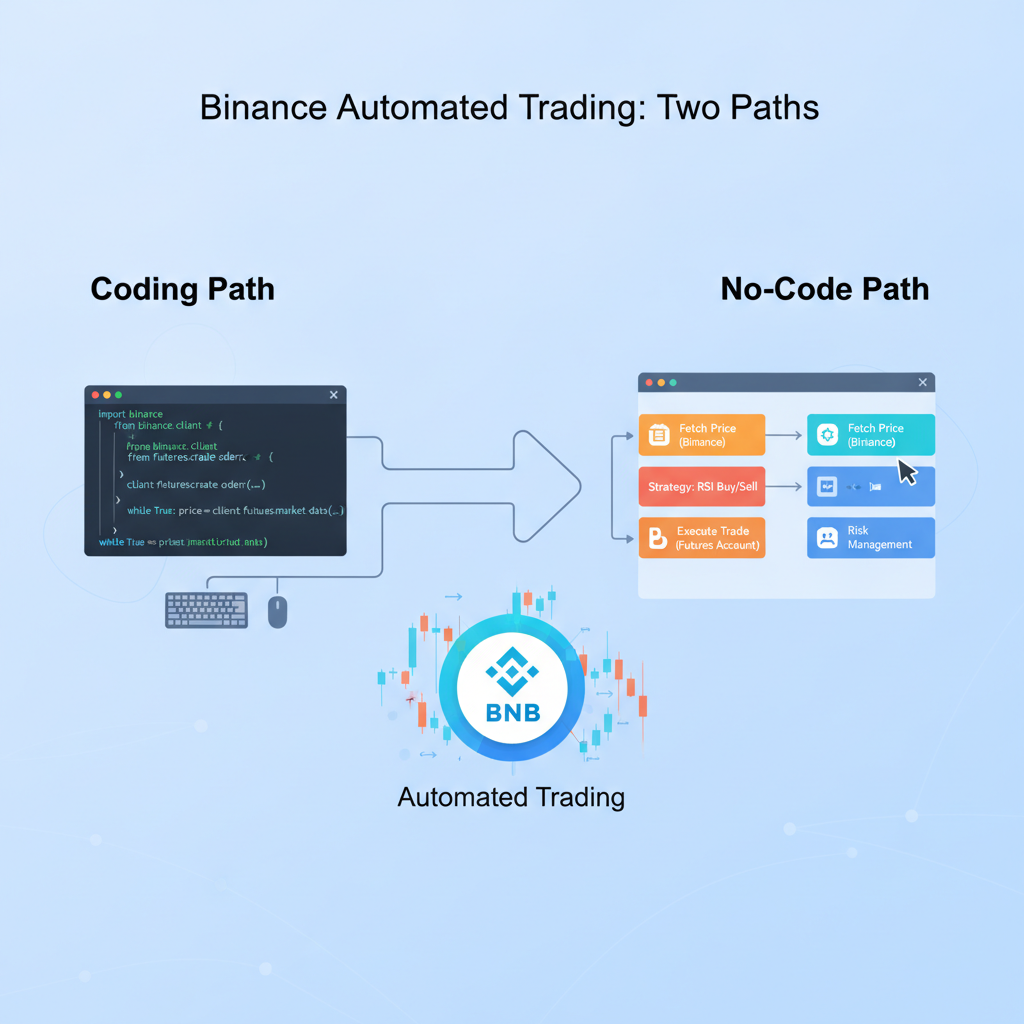
For those with programming expertise, building a custom Binance trading bot using its API offers the highest degree of flexibility and control. This approach typically involves Python, given its rich ecosystem of libraries for financial data analysis and API interaction. The core idea is to programmatically interact with Binance's servers to retrieve market data, analyze it, and place orders based on predefined rules.
The foundational step involves setting up a development environment and installing necessary libraries. A common choice is the python-binance library or ccxt, which act as wrappers around the Binance API, simplifying interactions. For instance, to install these, a trader would typically run pip install python-binance and pip install ccxt in their terminal. Once installed, these libraries allow direct access to various Binance functionalities, from retrieving historical candlestick data to placing complex order types.
A crucial component is the Binance API Key and Secret. These credentials, generated from the Binance account dashboard, authorize the bot to access specific account functionalities (e.g., read market data, trade, withdraw – although withdrawal permissions are generally disabled for trading bots for security). It's critical to store these keys securely, ideally using environment variables rather than hardcoding them directly into the script, as highlighted by numerous development guides. For example, a Python bot would load these as API_KEY = os.getenv('BINANCE_API_KEY') and API_SECRET = os.getenv('BINANCE_API_SECRET').
With API access established, the bot's structure typically involves:
- Data Retrieval: Fetching real-time or historical market data, such as OHLCV (Open, High, Low, Close, Volume) data for specific pairs like BTC/USDT. Methods like
client.get_historical_klines(frompython-binance) orexchange.fetch_ohlcv(fromccxt) are used for this. One source demonstrates retrieving 900 past candles with a 5-minute interval to perform technical analysis. - Strategy Logic: Implementing the trading rules based on technical indicators (e.g., RSI, MACD, Bollinger Bands) or other market conditions. For instance, a simple strategy might involve buying when the RSI drops below 30.
- Order Execution: Placing market or limit orders via API calls when strategy conditions are met. Functions like
client.order_market_buyorexchange.create_market_buy_orderhandle this. - Risk Management: Integrating stop-loss, take-profit, and position sizing logic to protect capital.
While coding offers unparalleled customization, it comes with significant challenges: a steep learning curve, substantial development time, debugging complexities, and ongoing maintenance. Furthermore, ensuring robust error handling, rate limit management, and secure deployment requires advanced programming skills. Many serious traders possess deep market insights but lack the specialized coding knowledge to translate their edge into an institutional-grade automated system.
Practical Insight: Coding your own Binance bot provides maximum control but demands significant technical proficiency and ongoing development effort, potentially diverting focus from market analysis to programming challenges.
The No-Code Revolution: Building Binance Trading Bots Without Programming
Recognizing the barrier to entry posed by coding, a new generation of platforms has emerged, democratizing automated trading through "no-code" bot builders. These platforms enable traders to design, test, and deploy sophisticated strategies on exchanges like Binance using intuitive visual interfaces, drag-and-drop tools, or even plain English descriptions, entirely bypassing the need for programming knowledge.
These no-code bot builders connect to Binance via its API, just like a custom-coded bot, but they abstract away the underlying code. Instead of writing lines of Python, traders interact with a graphical user interface to define their trading rules. This often involves selecting conditions (e.g., "RSI below 30," "price drops 5% in 2 hours") from dropdown menus and defining actions (e.g., "buy X quantity," "sell Y quantity"). One platform boasts that over 1.2 million rules have been created without coding, supporting more than 22 exchanges.
Common types of no-code bots available for Binance include:
- Grid Bots: Designed for sideways markets, these bots automatically place a series of buy and sell orders at predetermined price intervals within a defined range. As the price fluctuates, the bot continuously buys low and sells high, profiting from small price movements. Binance itself offers Spot Grid and Futures Grid bots to "buy low and sell high" and "automate your longs and shorts," respectively.
- DCA (Dollar-Cost Averaging) Bots: These bots automate the process of buying an asset at regular intervals or when the price drops by a certain percentage. This strategy reduces the impact of volatility by spreading purchases over time, aiming to lower the average entry price. Futures DCA bots, for instance, are highlighted for their ability to "auto-scale positions, turn losses to gains."
- Signal Bots: These bots execute trades based on external signals, often from technical analysis platforms like TradingView. Traders can set up alerts on TradingView based on their indicators, and the bot will automatically place orders on Binance when an alert is triggered, allowing for instant execution without manual order placement.
- Position Snowball: A strategy aiming for compounding growth with floating profits, as mentioned by Binance's own bot offerings.
These platforms often provide real-time monitoring dashboards, giving traders unified visibility into all their automated strategies across different exchanges and assets. This ensures strategy health and performance attribution, crucial for fine-tuning and risk management. The appeal is clear: professional-grade automation tools are now accessible to a broader audience of traders, allowing them to focus on strategy development rather than coding syntax.
"No-code bot builders remove the coding barrier, empowering traders to deploy sophisticated strategies like Grid and DCA bots on Binance with visual interfaces, democratizing institutional-quality automation."
The rise of AI-powered tools further simplifies this. Platforms are emerging that allow users to simply describe their trading idea in plain English, and the AI generates the corresponding trading code or logic, making strategy creation even more intuitive and rapid. This capability extends to integrating various technical indicators like MACD or Bollinger Bands without any manual configuration.
Practical Insight: No-code bot builders empower non-technical traders to leverage Binance's liquidity with advanced automated strategies, significantly lowering the barrier to entry for systematic trading.
Essential Considerations for Robust Binance Automated Trading
Whether coding a custom bot or utilizing a no-code builder, successful automated trading on Binance hinges on several critical considerations that extend beyond strategy creation.
API Security and Management
Connecting any external application to your Binance account requires API keys. These keys grant programmatic access, and their compromise can lead to significant financial loss. It is paramount to:
- Generate Restricted API Keys: Only grant the necessary permissions (e.g., enable Spot & Margin Trading, enable Futures). Crucially, never enable withdrawal permissions for a trading bot.
- Secure Storage: Avoid embedding API keys directly into code or sharing them publicly. Environment variables are a standard, secure method.
- IP Whitelisting: If supported by Binance or your platform, whitelist specific IP addresses that can use your API keys, adding an extra layer of security.
Binance itself provides robust API access, but users are responsible for managing their keys securely. The system uses request-weight based rate limits to prevent abuse, which bots must respect to avoid temporary bans.
Rigorous Backtesting and Simulation
A trading strategy, no matter how brilliant in theory, must prove itself against historical data before risking real capital. Backtesting involves running a strategy against past market movements to evaluate its hypothetical performance, including metrics like return, drawdown, Sharpe ratio, and win rate. This process helps identify potential flaws, optimize parameters, and understand a strategy's robustness under various market conditions.
Effective backtesting requires:
- High-Quality Data: Access to granular, tick-level historical data is crucial for accurate simulations. Platforms can offer terabytes of tick data, allowing simulations of five years in minutes with millisecond resolution.
- Realistic Modeling: Simulating real-world trading conditions, including slippage, commission fees, and market impact, is vital.
- Out-of-Sample Testing: To avoid overfitting, strategies should be tested on data periods not used during development.
- Monte Carlo Simulations: Running multiple simulations with randomized parameters helps assess a strategy's stability and sensitivity to changes.
Without thorough backtesting, deploying a bot is akin to gambling. "Running simulations on historical data (backtesting)" is cited as a critical step to ensure "logic is sound, risk is controlled and the bot performs as expected under various conditions."
Comprehensive Risk Management
Automation does not eliminate risk; it necessitates proactive risk management integrated directly into the strategy. Key aspects include:
- Stop-Loss Orders: Automatically closing a position if the price moves against the trade beyond a predefined threshold.
- Position Sizing: Limiting the capital allocated to any single trade to prevent outsized losses.
- Drawdown Limits: Capping the maximum acceptable loss for the entire portfolio or strategy before temporarily halting it.
- Market Context: Understanding that strategies optimized for certain market regimes (e.g., trending, sideways) may fail in others.
Many no-code platforms and custom bots offer built-in risk management tools, including take-profit and trailing stop-loss orders. The goal is to ensure that "emotional trading, missed trades, poor risk management" are addressed, keeping the trader's edge sharp.
Continuous Monitoring and Adjustment
Deployed bots require ongoing monitoring. Market conditions evolve, and a strategy that performed well last month might underperform this month. Real-time dashboards showing active positions, performance metrics, and recent signals are essential. Traders should regularly review their bot's performance and be prepared to adjust parameters or even halt a strategy if it deviates from expected behavior or market conditions shift significantly. Some platforms facilitate organization through Binance sub-accounts, allowing traders to separate bots by strategy or risk level.
Practical Insight: Automating trades on Binance is a multi-faceted endeavor that demands a disciplined approach to security, rigorous testing, embedded risk controls, and continuous oversight to ensure sustained profitability and capital preservation.
How Horizon Addresses This
For serious traders who understand the power of systematic execution but are constrained by coding complexities or the limitations of retail-grade bot builders, Horizon Trade offers an institutional-grade solution designed to transform ideas into automated, disciplined execution on platforms like Binance. While traditional coding demands significant technical prowess and off-the-shelf no-code solutions often lack depth, Horizon bridges this gap.
Instead of manually coding a Binance bot, Horizon allows you to generate custom trading strategies using AI with no coding required. This means your market edge, whether proven or in progress, can be rapidly prototyped. When it comes to the critical step of validation, Horizon's institutional-grade backtesting engine goes beyond basic simulations, offering detailed performance metrics, out-of-sample backtesting, Monte Carlo simulations, and heatmaps to genuinely assess your strategy's robustness. This directly addresses the need for rigorous testing highlighted in this article, offering far more depth than many simple bot builders. Once validated, you can seamlessly connect your broker (including Binance) and deploy strategies for live trading with automated execution, ensuring your rules are followed precisely 24/7. Horizon further empowers traders by providing a marketplace of community-built strategies, allowing you to buy, copy, and customize proven approaches, or even sell access to your own strategies, showcasing your real reputation and performance. With real-time analytics, you can continuously monitor your strategies' performance, ensuring adherence to your risk management principles and making informed adjustments, all without the need for complex programming or piecing together disparate tools.
The Future of Disciplined Trading on Binance
The journey from a trading idea to a fully automated, disciplined system on Binance has never been more accessible. Whether through painstaking custom code or the burgeoning simplicity of no-code bot builders, the ability to execute strategies without emotional bias, 24/7, and with surgical precision offers a distinct advantage in the competitive crypto landscape. However, accessibility does not negate the need for rigor: secure API management, comprehensive backtesting, robust risk controls, and continuous monitoring remain the pillars of successful automated trading.
As the market continues to evolve, the tools for serious traders must keep pace. Platforms that synthesize the power of AI with institutional-grade analytical capabilities, all within a no-code environment, are redefining what's possible. They allow traders to focus on strategy and market insight, knowing that the execution infrastructure is robust and reliable. To explore how this advanced approach can elevate your trading on Binance and beyond, discover the capabilities of Horizon's AI-powered algorithmic trading platform today. Visit Horizon Trade to transform your trading ideas into automated realities.
Sources
- Binance Trading Bot - Automate Your Crypto Trading
- Best No Code Bots
- How To Build a Trading Bot with Python & the Binance API? - YouTube
- GitHub - ccxt/binance-trade-bot: Automated cryptocurrency trading bot · GitHub
- Extra Cash by Creating Trading Bot with Binance API
- How to build an AI crypto trading bot with custom GPTs
- Trading Bots | Binance
- AlgoBuilder - Build Automated Trading Strategies in Plain English