Published Jun 26, 2026
E-Trade Algorithmic Trading: Navigating Automated Portfolios and API Bot Limitations
Algorithmic trading has fundamentally reshaped financial markets, with automated strategies now executing a substantial portion of daily trading volume. For instance, algorithmic trading accounts for upwards of 60-73% of US equity volume, a dramatic increase from approximately 20% in 2005. This rise has fueled a demand among retail and professional traders alike for similar automation capabilities, prompting many to explore how to leverage platforms like E-Trade for algorithmic execution. However, the path to fully automated, custom algorithmic trading on traditional retail brokerage platforms presents unique challenges, often necessitating a re-evaluation of what "automation" truly entails in this context.
Key Takeaways
- E-Trade primarily offers "guided automation" via its Algo Wheel and "passive automation" through robo-advisors and recurring investments, not direct API access for complex custom bots.
- Efforts to build fully custom, Python-based trading bots for E-Trade, such as the open-source `ETradeBot` project, have been deprecated as of February 22, 2024, due to the platform's manual authentication requirements.
- Achieving robust, fully automated trading often requires platforms with flexible authentication and comprehensive API support, leading some developers to pivot to alternatives like Alpaca.
- While third-party services like TradersPost can facilitate strategy automation on E-Trade by converting alerts into orders, this differs from direct, code-driven API bot integration for deep customization.
- Professional-grade algorithmic trading platforms, such as Horizon, address these limitations by providing AI-powered strategy generation, institutional-grade backtesting, and automated execution via brokers designed for comprehensive API interaction, circumventing manual hurdles.
The Disconnect: Algorithmic Trading Aspirations vs. Traditional Broker Realities
The allure of algorithmic trading lies in its promise of emotionless, disciplined execution, leveraging quantitative strategies to capitalize on market inefficiencies. Many serious traders, regardless of their coding proficiency, seek to transform their market edge into automated systems. This ambition often leads them to explore brokers they already use, like E-Trade, hoping to integrate custom bots or deploy complex strategies. However, the architectural design of traditional retail brokers, prioritizing user-friendliness and security for manual trading, frequently clashes with the demands of continuous, programmatic automation.
Building a proprietary trade algo bot requires defining precise entry and exit logic, selecting appropriate data inputs, and writing scripts to execute trades automatically. Many traders gravitate towards Python scripts due to the language's flexibility and extensive financial libraries. Yet, even with the technical expertise, the effectiveness of such bots is contingent on the broker's underlying infrastructure and, critically, its API capabilities. This fundamental dependency often creates a significant hurdle for traders looking to move beyond manual intervention.
"The right automated trading platform integrates your algorithmic trading strategy, backtesting engine, order execution, and risk management into a single system, ensuring your algorithms trade reliably." — GoatFundedTrader
The core insight here is that true algorithmic trading demands an integrated ecosystem. Without seamless connectivity for strategy deployment, robust backtesting capabilities, and real-time performance monitoring, even the most brilliant strategy remains confined to manual execution or theoretical exploration. For platforms like E-Trade, which have a different primary operational focus, providing this level of open API access for custom, fully automated bots has not historically been a central priority.
E-Trade's Approach to Automation: Robo-Advisors and the Algo Wheel

While E-Trade may not fully support custom algorithmic trading bots in the way a developer might envision, it offers several avenues for automation designed to simplify investing for different user segments. These offerings cater to investors seeking guided or passive management, rather than active, custom-coded strategy deployment.
Core Portfolios and Robo-Advisors
E-Trade's Core Portfolios function as a robo-advisor service. This automated investment management solution builds, manages, and rebalances diversified ETF portfolios for users. Investors select an asset allocation (conservative, moderate, or aggressive) based on their risk tolerance, and an algorithm automatically invests and manages their assets. This service comes with an annual advisory fee of 0.30% and a $500 minimum. It's an appealing option for new investors or those who prefer to delegate their investing decisions, providing diversification and lower entry points with automated rebalancing.
Similarly, E-Trade offers general "Automatic Investing" plans, allowing users to set up recurring contributions to brokerage or retirement accounts. This promotes consistent saving and leverages the power of compounding, but it is distinct from dynamic algorithmic trading based on market conditions.
The practical insight here is that E-Trade's robo-advisor and automatic investing features are excellent for passive, long-term portfolio management and dollar-cost averaging. They excel at simplifying traditional investing by automating routine decisions and rebalancing. However, they are not designed for the active, strategy-driven, short-to-medium term automated trading that characterizes algorithmic bot usage.
E*TRADE's Algo Wheel: Guided Automation for Order Routing
For more active traders, E-Trade provides its Algo Wheel. This feature offers a more structured, "guided automation" approach to order execution. Instead of requiring users to code their own strategies, the Algo Wheel presents a selection of ready-made algorithmic choices. These choices are typically aligned with individual preferences, such as risk appetite or specific objectives like capital appreciation or steady returns.
The Algo Wheel simplifies the process for non-technical users by allowing them to select from preset algorithmic templates. The system then automatically applies the chosen approach to route and execute orders, dynamically adjusting to market conditions while adhering to predefined guidelines for entry, management, and exit. Its key features include pre-configured algorithmic selections for quick setup, a simplified interface, and automated order routing within E-Trade's infrastructure.
The takeaway is that the Algo Wheel offers a valuable tool for traders who want to leverage sophisticated order routing strategies without needing to code. It provides an accessible entry point to algorithmic execution, focusing on the "how" of order placement rather than the "what" of custom strategy definition. However, it still falls short for traders who wish to define and deploy entirely custom, programmatic trading logic that goes beyond E-Trade's pre-defined algorithms.
The Challenge of Custom E-Trade Algorithmic Trading Bots and API Access
For traders seeking to deploy fully custom algorithmic trading strategies, direct API access and robust automated authentication are paramount. This is where E-Trade, like many traditional brokers, presents significant limitations for independent developers.
The Deprecation of ETradeBot: A Case Study in Authentication Hurdles
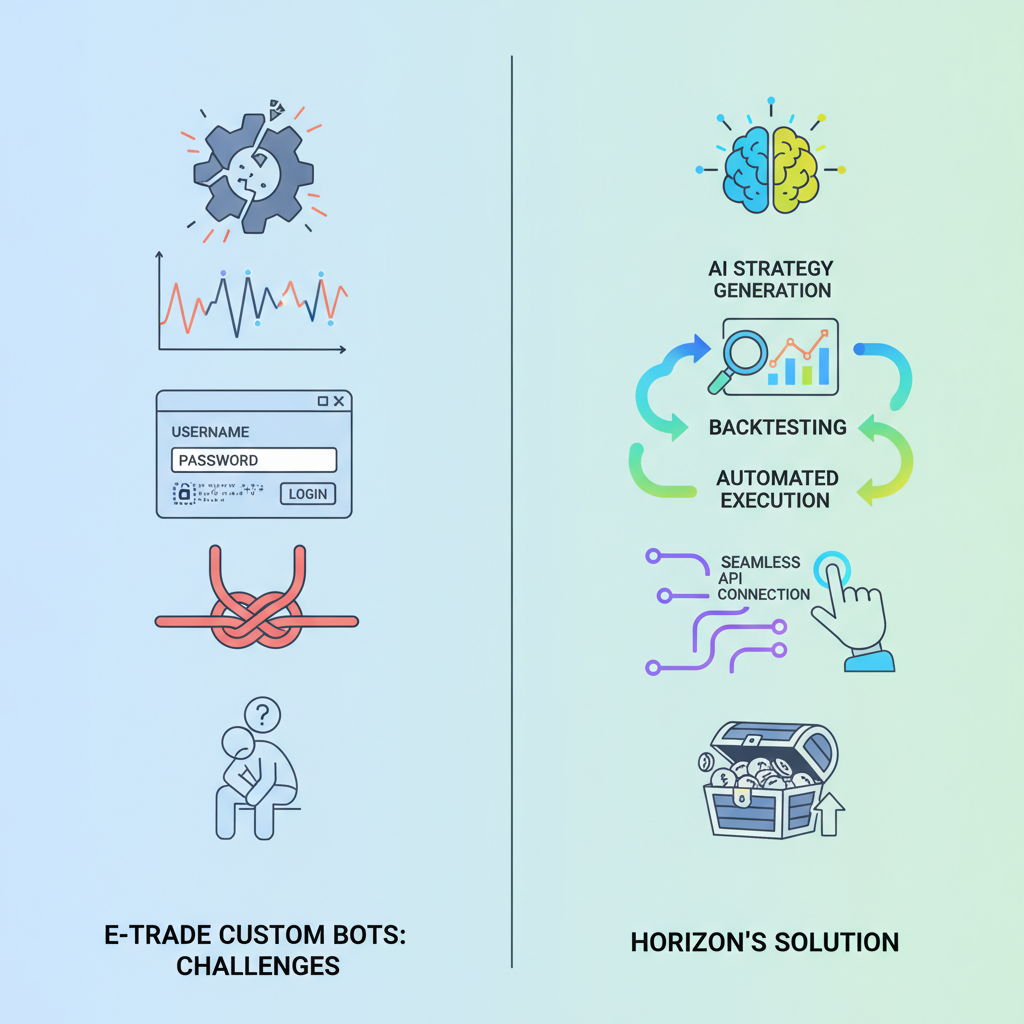
A stark illustration of these challenges comes from the `ETradeBot` project on GitHub. This open-source software, written in Python, was designed to enable automated trading on E-Trade accounts based on custom strategies. However, as of February 22, 2024, `ETradeBot` was officially deprecated. The reason? "Limitations imposed by E-Trade, particularly regarding automated authentication." The developer explicitly stated that E-Trade's "current requirement for manual login with each execution significantly hinders the effectiveness of automated trading strategies, making it impractical for users seeking fully automated solutions."
This finding is critical for anyone exploring E-Trade API bots. A fully automated system cannot reliably function if it requires manual intervention for every login or session renewal. The project's developer shifted development focus to platforms like Alpaca, citing its "more accommodating environment for automated trading, including more flexible authentication mechanisms." This highlights a core issue: without seamless, programmatic authentication, the concept of a "fully automated E-Trade bot" for custom strategies remains largely theoretical or highly impractical.
The practical implication is clear: while E-Trade offers robust security, its design choices around authentication significantly impede the development and deployment of truly autonomous, custom trading bots. Traders looking for full control and continuous operation of their own algorithms will likely encounter insurmountable operational friction directly through E-Trade's API.
Third-Party Solutions and Beta Integrations: Workarounds with Caveats
Despite direct API limitations, some third-party platforms offer solutions that provide a degree of automation for E-Trade users. For instance, TradersPost allows users to automate strategies built on platforms like TradingView or TrendSpider by sending alerts as orders to their E-Trade account. This service claims to help users "Save up to 8h per week" and "Execute 100s of trades 100% automatically". Similarly, StockHero, an AI trading bot platform, mentions "beta integration with E-Trade from Morgan Stanley" among its supported brokers for connecting bots via API.
While these platforms provide valuable services, it's essential to understand their nature. Solutions that rely on converting alerts into orders typically operate as a bridge rather than providing direct, deep API control for custom coding. "Beta integration" also implies that the functionality may not be as robust, comprehensive, or stable as direct, fully supported API access on platforms specifically designed for algorithmic trading. These workarounds can automate trade execution based on external signals but may not offer the granular control, extensive data access, or the ability to deploy complex, self-contained algorithms that institutional-grade platforms provide.
The actionable insight is that while these third-party integrations offer a pathway to automate some aspects of trading on E-Trade, they may introduce an additional layer of complexity or limit the full scope of custom algorithmic strategy development. Traders must carefully evaluate if these solutions meet their specific needs for customization, reliability, and full automation, especially when dealing with advanced strategies.
How Horizon Addresses This
How Horizon Addresses This
The challenges of integrating custom algorithmic trading bots with brokers like E-Trade underscore a significant gap for serious traders: the need for institutional-grade automation without the prerequisite of advanced coding skills or struggling with broker-specific API limitations. Horizon Trade directly addresses this pain point by offering a comprehensive, AI-powered algorithmic trading platform designed for systematic traders.
Unlike attempting to build a custom bot for E-Trade that struggles with manual authentication, Horizon allows traders to generate custom trading strategies using AI, requiring no coding whatsoever. This bypasses the Python scripting and development overhead highlighted by open-source bot builders. Furthermore, Horizon provides an institutional-grade backtesting engine, enabling robust validation of strategies against historical market data with detailed metrics like Sharpe ratio, out-of-sample testing, Monte Carlo simulations, and heatmaps to ensure strategies are truly robust.
When it comes to execution, Horizon integrates with a wide array of brokers that offer flexible and robust API access, overcoming the authentication hurdles faced by platforms like E-Trade for custom bots. This allows traders to deploy strategies for live trading with automated execution across multi-asset classes including stocks, forex, crypto, futures, and options. Traders can monitor strategy performance with real-time analytics and even access a marketplace of community-built strategies, fostering a collaborative and professional trading environment. Horizon is built for the professional in the middle: intelligent, capitalized, and ready to operate at the next level, transforming your edge into automated, disciplined execution, regardless of your chosen broker's specific API limitations for direct bot integration.
Conclusion
The pursuit of algorithmic trading on platforms like E-Trade reveals a nuanced landscape. While E-Trade offers valuable automated investment services through its robo-advisors and the Algo Wheel for guided order execution, it presents considerable hurdles for traders aiming to deploy fully custom, continuously automated trading bots due to its authentication architecture. The deprecation of projects like `ETradeBot` serves as a cautionary tale, emphasizing that robust API access and seamless authentication are non-negotiable for true algorithmic trading. For traders who demand institutional-grade automation, advanced backtesting, and the ability to convert their unique trading ideas into live, disciplined execution without the burden of coding or managing complex API integrations, platforms specifically designed for this purpose become essential. Explore how Horizon empowers serious traders to achieve their algorithmic trading ambitions, offering a pathway to advanced automation beyond the limitations of traditional brokerage platforms. For more insights into advanced trading strategies and platform capabilities, consider exploring articles within the Horizon sitemap.
Sources
- GitHub - nathanramoscfa/etradebot: Tools for automated trading on E-Trade
- Top Trading Algo Bots: Automating Your Trading Strategy - Bookmap
- 8 Best Automated Trading Platforms Every Trader Should Know
- E*TRADE Automated Trading Bots | TradersPost
- 3 Best AI Trading Bots for 2026 - StockBrokers.com
- How Robo-Advisors Work: ETF Portfolios & Fees | E*TRADE
- Automatic Investing: How It Works & Benefits | E*TRADE