Published Jul 04, 2026
Horizon vs. Pine Script: Key Differences in Building and Automating Strategies

The landscape of quantitative trading has shifted dramatically, with algorithmic strategies now accounting for a significant majority of market activity. In US equity markets, automated systems are responsible for an estimated 60% to 73% of daily trading volume, a stark increase from less than 20% in 2005 Source: Bloomberg/The Economist. This paradigm shift demands tools that are not only powerful for analysis but also streamlined for robust strategy development and automated execution. While scripting languages like Pine Script have empowered a generation of traders to visualize and test ideas, the next frontier requires moving beyond manual coding to fully automated, institutional-grade solutions.
Key Takeaways
Pine Script excels in visualizing market data and developing custom indicators within TradingView, but requires explicit coding and external solutions for live trade automation.
Traditional scripting demands significant time investment for strategy development, optimization, and debugging, often requiring a "comfortable with code" proficiency level.
Robust strategy deployment necessitates advanced backtesting metrics, including out-of-sample testing, Monte Carlo simulations, and detailed risk management, which are often complex to implement manually in scripting languages.
Platforms like Horizon address the critical pain points of coding barriers and fragmented execution by offering AI-powered strategy generation and direct broker integration for automated live trading.
The future of systematic trading leans towards no-code/low-code solutions that combine sophisticated analytics with seamless automation, catering to serious traders seeking disciplined execution without the overhead of programming.
Pine Script: Strengths and Limitations for Chart Analysis and Strategy Development
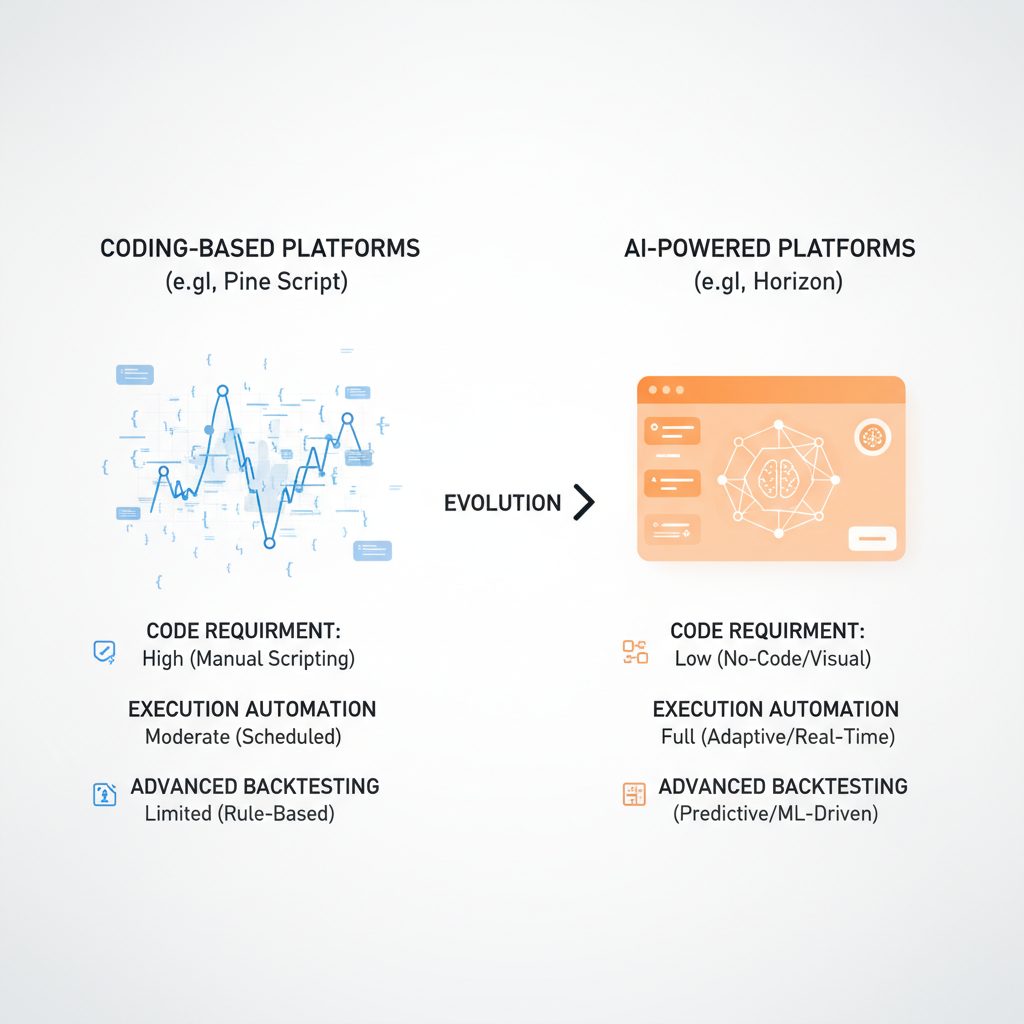
Pine Script, a proprietary language developed for the TradingView platform, has carved out a significant niche among retail traders for its intuitive integration with charting tools. Its primary strength lies in enabling traders to create custom indicators, alerts, and strategy scripts directly on charts, facilitating real-time market analysis and visualization. For instance, traders can design sophisticated indicators with complex logic, such as those combining trend identification with ATR-based risk management, directly within the TradingView environment Source: TradingView.
The language is particularly well-suited for technical analysis, allowing users to overlay custom visualizations, identify trends, and develop signals for potential trade entries or exits. This capability makes Pine Script an invaluable tool for those who prioritize chart analysis and visual backtesting of strategies. A typical Pine Script strategy might involve defining buy signals when the closing price crosses above a 200-period Exponential Moving Average, with green triangles plotted on the chart to indicate potential buy actions Source: Fusion Markets.
However, despite its strengths in analysis and visualization, Pine Script faces notable limitations when it comes to fully automated, robust strategy deployment. Crucially, Pine Script does not natively support live trade execution. While it allows for the development of strategies that can be backtested and optimized, deploying these strategies for automated trading typically requires external services, such as webhooks, to connect with a broker Source: TradersPost.io. This adds layers of complexity, potential latency, and additional points of failure, diverging significantly from the direct, integrated execution offered by purpose-built algorithmic platforms.
"Pine Script strategies only run on TradingView, but TradingView connects to dozens of brokers through its native integration and hundreds more through TradersPost webhooks. Platform-specific languages run on exactly one platform but execute trades directly without webhook latency." Source: TradersPost.io
Furthermore, while Pine Script is considered easier to learn than languages like Python for those with "some coding experience," it still presents a barrier for traders with no programming background Source: TradersPost.io. Developing and debugging even moderately complex strategies can be time-consuming, as observed in a case study where generating a specific strategy required "many, many times" of prompting and corrections, highlighting the iterative and often frustrating nature of script-based development Source: YouTube. This manual effort contrasts sharply with the growing demand for no-code solutions that accelerate strategy ideation and deployment.
Actionable Takeaway: For traders focused exclusively on chart-based analysis and visual backtesting within TradingView, Pine Script offers considerable flexibility. However, those aiming for fully automated, low-latency live trading or who lack coding proficiency will encounter significant hurdles and a steeper learning curve.
The Evolving Landscape: Beyond Scripting to AI-Powered Automation
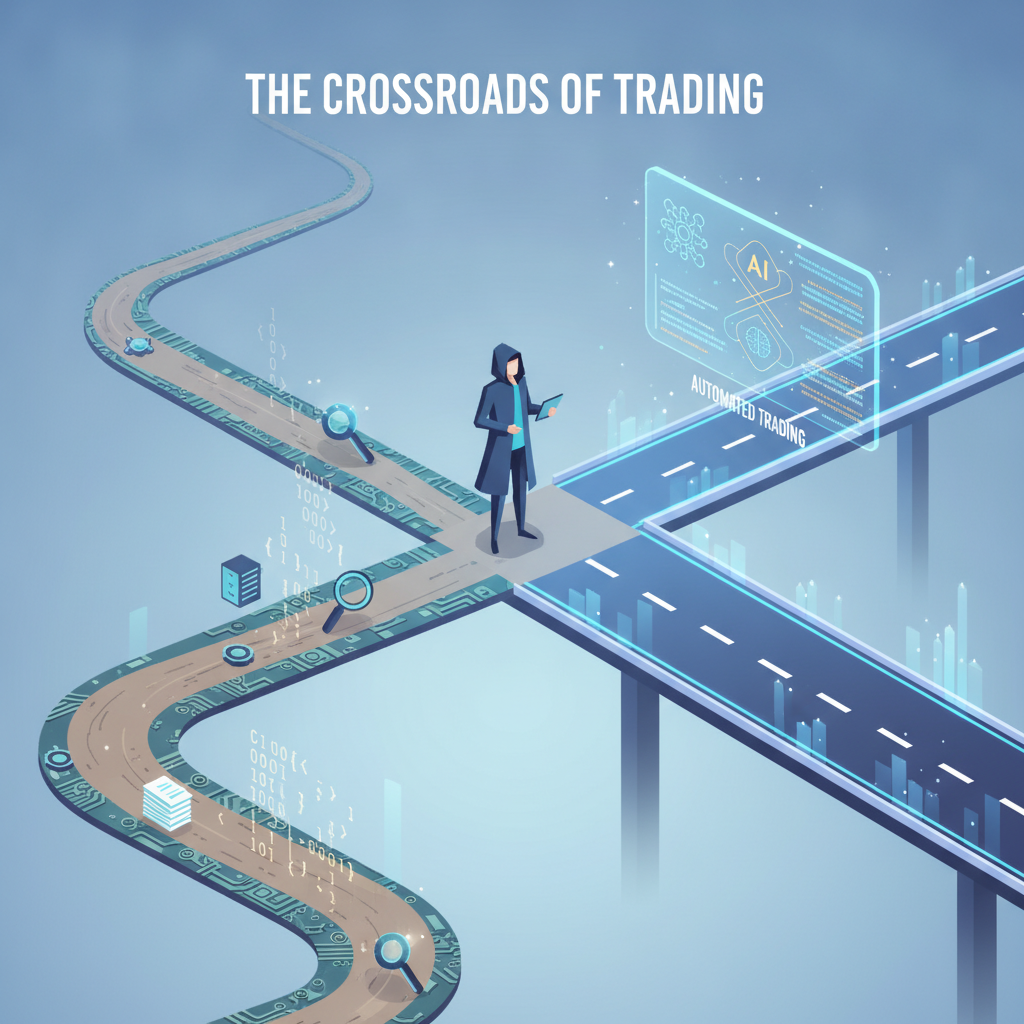
The traditional approach to algorithmic trading has long been rooted in programming languages, with Python often touted for its flexibility and extensive libraries, and platform-specific languages like MQL5 for Forex. However, the rise of artificial intelligence and advancements in user-friendly interfaces are democratizing access to sophisticated trading automation, moving beyond the confines of code-heavy environments.
For individuals without a programming background, or those seeking to accelerate their strategy development cycle, the need for no-code and low-code alternatives has become paramount. While platforms built around Pine Script still demand a baseline level of coding proficiency, a new class of tools is emerging to cater to traders who think systematically but cannot code Source: TradersPost.io. These platforms recognize that an "edge" in trading is often derived from unique insights and hypotheses, not necessarily from coding prowess.
The shift is driven by several factors:
Accelerated Development: Manually coding, debugging, and optimizing strategies, even in a "simpler" language like Pine Script, can consume considerable time. Parameter optimization alone requires systematic testing on historical data to find robust values, a process that can be iterative and prone to overfitting without careful methodology Source: TradersPost.io. AI-powered platforms can rapidly generate and test variations, significantly reducing development cycles.
Accessibility: The barrier to entry for algorithmic trading has historically been high, requiring either a strong programming background or a dedicated quant team. No-code solutions empower a broader range of intelligent, capitalized traders to translate their ideas directly into automated systems.
Robustness and Validation: Modern algorithmic trading demands more than just basic backtesting. Professional quantitative finance emphasizes "institutional-grade math," treating trading as a game of probabilities rather than certainties Source: TradingView Featured Scripts. This includes rigorous validation methods like out-of-sample backtesting, Monte Carlo simulations, and sensitivity analysis to ensure a strategy's resilience across diverse market conditions. Implementing such advanced techniques efficiently within scripting environments can be challenging and resource-intensive.
The tradeoff for the deep flexibility of Python, for example, is significant "setup complexity," including environment configuration, data management, and infrastructure decisions Source: TradersPost.io. While Pine Script offers a working charting environment and backtester quickly, its limitations in execution and advanced validation push traders towards more integrated, powerful solutions for serious automation.
Actionable Takeaway: Traders looking to move beyond manual coding and integrate advanced validation methods into their strategy development should explore platforms that offer AI-driven generation and comprehensive, institutional-grade backtesting capabilities to streamline their workflow and enhance strategy robustness.
Bridging the Gap: Automated Execution and Institutional-Grade Backtesting
The journey from a promising strategy idea to consistent, disciplined execution in live markets is fraught with challenges. While Pine Script excels at the conceptualization and preliminary backtesting stage within TradingView, the practicalities of automated execution introduce several complexities that highlight the need for more integrated platforms.
One of the most critical distinctions lies in how strategies connect to live brokerage accounts. Pine Script's reliance on webhook integrations for automated execution, as opposed to direct API connections, can introduce latency and requires additional setup and maintenance. This multi-layered approach means that risk management, which should operate at both the strategy and broker connection levels, becomes more complex to implement comprehensively Source: TradersPost.io. In contrast, platforms designed for automated execution typically offer direct, low-latency broker integrations, ensuring that orders are executed precisely as intended and risk controls are seamlessly applied.
Beyond execution, the sophistication of backtesting is a defining characteristic of professional-grade trading. A simple backtest showing a high percentage return is often insufficient to truly validate a strategy's robustness. Systematic traders require detailed performance metrics that go far beyond basic returns:
Sharpe Ratio: A measure of risk-adjusted return, indicating how much excess return you receive for the extra volatility you endure.
Max Drawdown: The largest peak-to-trough decline in an investment, crucial for understanding potential capital loss.
Out-of-Sample Backtesting: Testing a strategy on data it has not "seen" during its development or optimization phase, vital for identifying overfitting and confirming generalizability. This is a critical component of robust strategy validation.
Monte Carlo Simulation: A technique that runs multiple simulations of a strategy's performance under various random market scenarios, providing a probability distribution of potential outcomes rather than a single, deterministic result. This helps assess the strategy's stability and risk under diverse conditions.
Heatmaps: Visual tools for analyzing how strategy parameters interact and impact performance, helping to identify stable zones of profitability and avoid parameter sensitivity.
While Pine Script offers parameter optimization features, systematically testing parameter combinations and avoiding overfitting through out-of-sample validation requires a high degree of manual diligence and expertise Source: TradersPost.io. Integrating advanced techniques like Monte Carlo or comprehensive heatmaps directly into a Pine Script environment for robust, institutional-grade analysis is significantly more challenging compared to platforms where these features are built-in.
Furthermore, the ability to manage multiple positions, handle partial fills, and implement dynamic stop losses and take profits effectively within an automated system is paramount Source: TradersPost.io. While Pine Script provides built-in functions for some of these, a dedicated algorithmic trading platform offers a more holistic and robust framework for comprehensive position and risk management across various asset classes.
Actionable Takeaway: Serious traders transitioning from conceptual strategy development to reliable automated execution and rigorous validation need platforms that offer integrated broker connectivity, comprehensive risk management, and advanced backtesting capabilities beyond basic metrics, ensuring strategies are truly robust and ready for live markets.
How Horizon Addresses This
Horizon (horizon.trade) is engineered precisely for the professional trader who thinks systematically but wishes to transcend the limitations of manual coding and fragmented execution. While Pine Script empowers those with programming aptitude within the TradingView ecosystem, Horizon offers a holistic solution that bridges the gap between idea generation and institutional-grade automated trading.
Horizon’s core value proposition lies in its AI-powered strategy generation, enabling traders to create custom trading strategies without writing a single line of code. This directly addresses the "no coding required" pain point inherent in Pine Script, allowing traders to transform their unique edge or ideas into automated logic instantly. Instead of spending hours debugging syntax or struggling with prompt interpretation, users can leverage advanced AI to quickly iterate and refine strategies.
For backtesting, Horizon moves far beyond the foundational capabilities of Pine Script. It provides an institutional-grade backtesting engine that includes critical metrics like Sharpe ratio, max drawdown, and crucially, out-of-sample backtesting, Monte Carlo simulations, and heatmaps. This suite of tools helps traders rigorously assess strategy robustness, identify potential overfitting, and truly understand the probabilistic nature of their edge—a level of depth often complex to achieve manually or with basic scripting environments.
Once a strategy is validated, Horizon facilitates automated execution by allowing seamless integration with your broker. This eliminates the need for external webhooks or fragmented setups, providing direct, low-latency deployment for live trading across multi-asset classes (stocks, forex, crypto, futures, options). Furthermore, traders can monitor strategy performance with real-time analytics and engage with a marketplace of community-built strategies, fostering collaboration and providing alternative income streams by selling access to proven strategies.
Horizon is designed for the intelligent, capitalized trader ready to operate at the next level, offering a comprehensive platform that delivers disciplined, automated execution without the coding overhead typical of Pine Script or the complexity of managing a full quant team.
Conclusion
The shift towards algorithmic trading is undeniable, demanding tools that are both sophisticated and accessible. While Pine Script remains a valuable asset for chart-based analysis and indicator development within TradingView, its limitations in native automated execution and advanced backtesting methodologies highlight the evolving needs of serious traders. The future favors platforms that empower systematic thinkers to rapidly convert ideas into robust, automated strategies without the burden of code. By combining AI-driven strategy generation with institutional-grade backtesting and direct automated execution, platforms like Horizon are redefining what’s possible for traders seeking a disciplined, efficient, and professional approach to the markets. To explore how Horizon can transform your trading approach, visit horizon.trade and discover the power of AI-powered algorithmic trading.