Published Jun 21, 2026
How to Build a Strategy to Pass Prop Firm Evaluations with Strict Drawdown Rules Using Horizon Trade

In the high-stakes world of proprietary trading firms, the odds are often stacked against aspiring traders. Despite demonstrating profitable trading ideas, a staggering number fail to pass evaluation challenges, with one of the primary culprits being the inability to consistently adhere to strict drawdown rules. It's a common misconception that passing these evaluations is solely about finding winning trades; in reality, it's a test of disciplined risk management and emotional control, often under tight constraints.
Key Takeaways
Prop firm evaluations are primarily risk management tests, not just trading tests, with up to 95% of traders failing due to drawdown breaches according to some estimates, highlighting the criticality of strict risk controls.
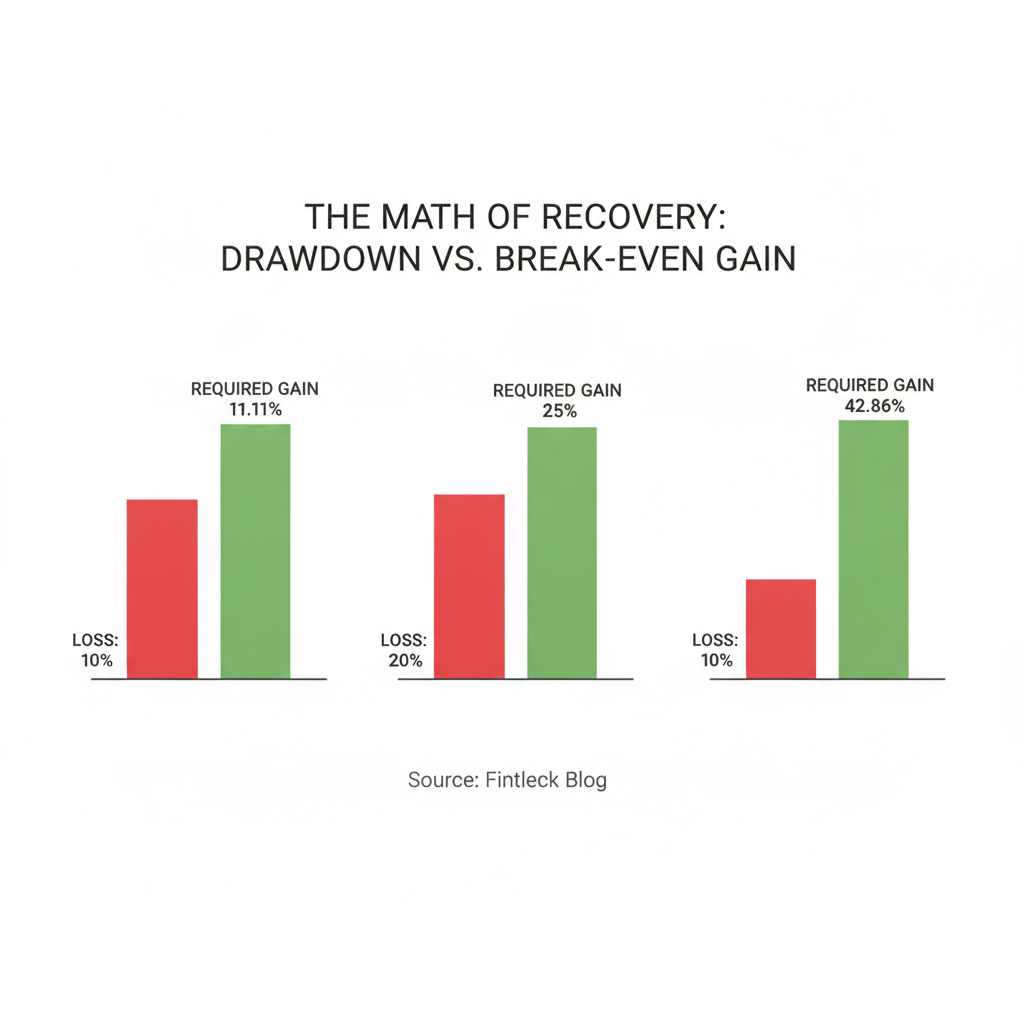
A 10% drawdown requires an 11.1% gain to recover, while a 30% drawdown demands a 42.9% gain, underscoring the mathematical imperative of preserving capital and adhering to personal loss limits that are even stricter than the firm’s rules.
Position sizing is paramount; dividing the maximum drawdown by 20 potential trades (e.g., $3,000 drawdown / 20 = $150 risk per trade) can significantly reduce the risk of ruin and provide a crucial safety net.
Rigorous backtesting across 100+ statistically significant trades, including out-of-sample data and Monte Carlo simulations, is essential to validate a strategy's resilience against varying market conditions and drawdown events.
Horizon Trade’s AI strategy generation and institutional-grade backtesting, combined with its unique "Risk Guard" feature, provide a powerful framework for traders to automate the enforcement of prop firm-specific drawdown rules and psychological guardrails.
Understanding Strict Drawdown Rules in Prop Firm Evaluations
Proprietary trading firms offer access to substantial capital, but their core objective is to identify traders who can manage risk effectively, not merely generate large profits. This emphasis translates into stringent drawdown rules that many traders underestimate. As noted by Tradezella, "Prop firm challenges are risk management tests, not trading tests. Passing isn't about finding winning trades; it's about surviving the rules long enough to prove your edge."
A 10% loss demands an 11.1% gain to recover, while a 30% drawdown requires a staggering 42.9% gain just to break even, illustrating the steep challenge of recovering from significant drawdowns. For Traders emphasizes this mathematical reality.
The most common drawdown rules include Daily Loss Limits, Maximum Trailing Drawdowns, and Static Drawdowns. Daily loss limits typically range from 4-5%, while maximum drawdown caps often fall between 8-12% of the initial or peak equity. Understanding the nuances of each is crucial for success.
Daily Loss Limit: This is a hard stop, preventing a trader from losing more than a set percentage or dollar amount within a single trading day, calculated from the day's starting balance or equity. For instance, a 5% daily limit on a $100,000 account means trading ceases if losses reach $5,000.
Trailing Drawdown: Often considered the "biggest killer" by experts like Ian Coleman, as highlighted in the Prop Firm Trading Series. This limit adjusts upwards with your peak equity. If your account reaches $105,000 and the maximum drawdown is 8%, your account cannot drop below $97,000 ($105,000 - 8%). This dynamic ceiling means profits must be actively protected.
Static Drawdown: The most trader-friendly, this limit is fixed from the initial account balance. A $100,000 account with an 8% static drawdown can never fall below $92,000, regardless of how high your equity climbs.
Many firms also impose consistency rules, for example, prohibiting any single day's profit from exceeding a specific percentage (e.g., 30%) of total accumulated profit to prevent "gambling" and promote steady growth, as mentioned by AronGroups. Additionally, news trading restrictions or holding limits (no overnight/weekend positions) are common, requiring strategies that comply with these parameters.
Actionable Takeaway: Before attempting any challenge, thoroughly review a prop firm's specific rules. Develop a clear understanding of how drawdowns are calculated and what restrictions apply to your chosen trading style. Implement personal loss limits that are even stricter than the firm's to provide an added buffer and maintain psychological control.
Crafting a Prop Firm Strategy: Building Robust Risk Management Frameworks
The foundation of any successful prop firm strategy isn't market analysis, but a robust risk management framework. This involves not only understanding the firm's rules but embedding them into your strategy at every level, often with even tighter personal controls. AronGroups advises traders to set "personal loss limits that are stricter than the prop firm's rules to maintain emotional control." For instance, if a firm allows a 5% daily drawdown, a trader might cap themselves at 3%.
One critical aspect is precise position sizing. According to a world record holder in prop firm evaluations, a powerful technique is to divide your maximum drawdown by a safety buffer of trades, typically 20 attempts. For a $3,000 max drawdown on a $100,000 account, this would mean a maximum risk of $150 per trade. This seemingly small risk per trade drastically lowers the "risk of ruin" by allowing for losing streaks (e.g., 5-7 consecutive losses) without breaching the account. The rationale is that most traders fail not due to strategy but due to improper drawdown management, often by oversizing positions.
A structured approach to trading phases can also be highly beneficial. Tradezella outlines three distinct phases:
Setup Phase (Days 1-5): Focus on building a small buffer by taking low-risk, high-probability trades. The goal isn't massive profit but establishing a positive equity curve and avoiding early drawdown hits.
Survival Phase (Days 6-20): Protect the established buffer. Continue disciplined trading, prioritize rule compliance, and keep position sizes conservative. This phase tests patience and consistency.
Execution Phase (Days 21+): With a buffer and proven consistency, you can potentially increase position sizing slightly to reach the profit target, but always within strict risk parameters.
Furthermore, an Equity Checkpoint Protocol, as described by AronGroups, is crucial for trailing drawdown challenges. Once accumulated profits reach a certain threshold (e.g., up +5%), risk should be reduced so that a single bad day cannot erase more than 30% of those accumulated profits. This proactive measure converts floating profits into protected capital, a critical factor for firms with trailing drawdown rules.
Actionable Takeaway: Develop a personal risk grid that defines maximum risk per trade based on a drawdown-to-trade ratio. Incorporate phased trading targets and implement gain-locking protocols. For example, use a 1:2 or better risk-to-reward ratio to ensure profitability even with win rates below 50%, as long as survival is prioritized.
Backtesting Prop Firm Strategies for Drawdown Resilience with Horizon Trade
Before ever risking capital in a prop firm challenge, thorough validation of your strategy's resilience to drawdown rules is non-negotiable. Funding Frontier states that "thoroughly backtest and forward test your strategy using historical data and demo accounts. Your strategy should demonstrate profitability over a statistically significant sample size (generally 100+ trades) across varying market conditions." This means going beyond simple historical performance and stress-testing your strategy against the very rules that could lead to failure.
A critical step in validating a prop firm strategy is to simulate the exact conditions and rules of the challenge. This includes mirroring the firm's starting capital, leverage ratios, available instruments (stocks, forex, crypto, futures, options), and, most importantly, the specific drawdown limits. As For Traders advises, "Set up your demo account to mimic the conditions of your prop firm challenge. Use the same starting capital, leverage ratios, and currency pairs."
Traditional backtesting often overlooks the dynamic nature of trailing drawdowns or the abrupt halt caused by daily loss limits. A strategy might show excellent overall returns, but if it experiences a few consecutive losing trades that breach a 4% daily limit, it fails the evaluation. Therefore, backtesting needs to specifically account for these firm-specific constraints.
Advanced backtesting capabilities are essential here. A robust backtesting engine should allow you to define custom risk parameters that precisely replicate prop firm rules. This includes:
Setting a maximum daily loss threshold (e.g., -4.5% from the daily open equity, stricter than the firm's 5%).
Implementing a trailing maximum drawdown limit (e.g., -7.5% from the peak equity, stricter than the firm's 8%).
Testing different position sizing methodologies (e.g., fixed percentage of equity, fixed dollar amount per trade) and their impact on drawdown curves.
Running Monte Carlo simulations to understand the probability of ruin under various market conditions and losing streaks.
Performing out-of-sample backtesting to ensure the strategy is not over-optimized to historical data but performs robustly on unseen data.
For example, Thomas, an equity trader, discovered through six weeks of backtesting that his standard position sizing would occasionally breach a 5% drawdown limit during volatile periods, allowing him to adjust his approach proactively, as described by Funding Frontier. This pre-validation is precisely what prevents costly evaluation failures.
Actionable Takeaway: Utilize a backtesting engine that allows for granular control over risk parameters, enabling you to simulate prop firm drawdown rules directly. Prioritize out-of-sample testing and Monte Carlo simulations to assess the strategy's true robustness against varied market conditions and the probability of hitting specific drawdown thresholds.
Optimizing Position Sizing and Execution for Prop Firm Success
The path to passing a prop firm challenge hinges significantly on meticulous position sizing and flawless execution, particularly concerning drawdown rules. Oversizing for speed is one of the "four challenge killers," warns Tradezella. Instead, the focus should be on trading small enough to allow variance and statistics to play out, as emphasized by the world record holder, who suggests risking only $150 per trade on a $3,000 drawdown to allow for 20 attempts.
Automated execution ensures that your predefined risk parameters are adhered to without emotional interference. Revenge trading, a common psychological pitfall, often leads to oversized positions after a loss, quickly breaching daily or maximum drawdown limits. An automated system, however, cannot "revenge trade"; it simply follows the rules. This behavioral consistency is paramount.
Tracking key performance indicators in real-time is also vital. Tradezella recommends monitoring:
Daily P&L vs. Daily Limit: Compare your net profit or loss daily against your personal and the firm's daily limits. If you're frequently hitting your limit (more than once a week), your position sizing might be too aggressive.
Peak Equity and Current Drawdown: Track this weekly. Knowing your current drawdown relative to your peak equity helps assess risk tolerance. If you're at a 10% drawdown with a 12% max allowed, it's time to reduce size.
Profit Target Progress: This ensures you're on track to meet the firm's profit target within the allotted time.
For traders employing low-risk methods like day trading, scalping, or conservative swing trading, automated execution can enforce strict entry/exit criteria and stop-loss orders. Blue Guardian highlights these methods as particularly suitable for staying within drawdown limits while hitting profit targets, especially for day trading to avoid overnight exposure and its associated risks.
The "three essential numbers that form your survival dashboard" as detailed in the Prop Firm Trading Series — current equity, daily loss used, and total drawdown from peak — can be meticulously monitored and managed through an automated platform. This allows for proactive flattening of positions before critical limits are breached.
Actionable Takeaway: Employ an algorithmic trading platform to automate trade execution based on strict position sizing rules, daily loss caps, and profit protection protocols. Regularly review your real-time performance against personal and prop firm drawdown limits, adjusting strategy and sizing as needed based on objective data rather than emotion.
How Horizon Addresses This
Horizon is engineered precisely for serious traders seeking to navigate complex challenges like prop firm evaluations with precision and discipline. Our platform transforms your trading ideas into automated, rigorously managed strategies, directly addressing the core pain points of strict drawdown rules.
Firstly, with Horizon's AI strategy generation, traders can intuitively design complex trading algorithms without writing a single line of code. This allows for the rapid creation of strategies specifically tailored to the low-risk, consistent profit generation required by prop firms. You can input parameters that prioritize small, consistent gains over high-variance trades, and our AI will help structure the logic.
Secondly, Horizon's institutional-grade backtesting engine is mathematically perfect for stress-testing strategies against prop firm rules. You can define custom risk parameters, replicating precise daily loss limits, maximum trailing drawdowns, and even consistency rules. The platform's advanced metrics, including out-of-sample backtesting, Monte Carlo simulations, and heatmaps, provide an unparalleled depth of analysis to confirm your strategy's robustness. This allows you to validate your personal risk grid, ensuring your strategy can endure losing streaks and market volatility without breaching the critical thresholds.
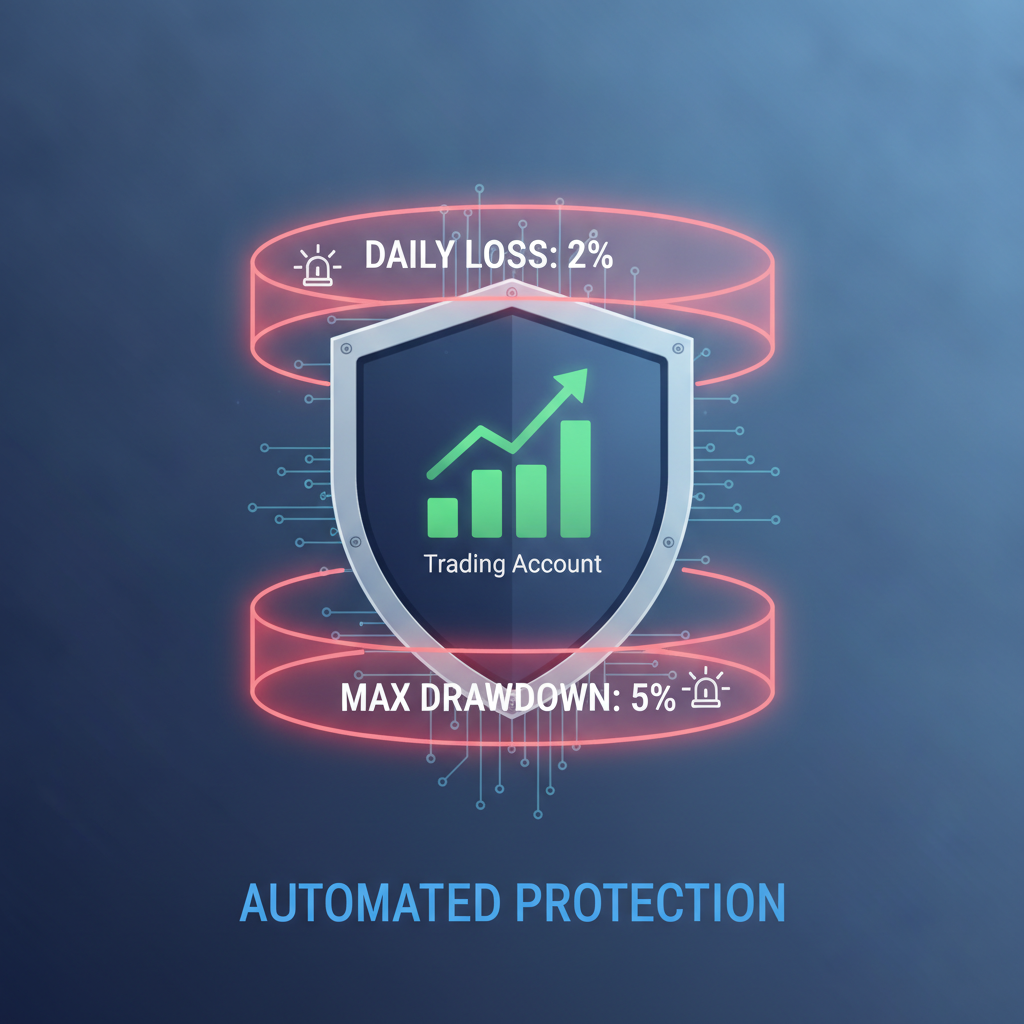
Crucially, Horizon's unique "Risk Guard" feature is designed to act as your ultimate safeguard against prop firm failures. Risk Guard enables traders to set immutable, automated stop rules for daily drawdown, maximum drawdown, and even profit lock-ins. For example, if a prop firm has a 5% daily drawdown, you can configure Risk Guard to halt all trading at 4.5% loss for the day, providing that critical buffer and eliminating emotional decision-making. This automated enforcement of your personal, stricter risk limits ensures mathematical adherence to the rules, a common failure point for manual traders.
Finally, once validated, strategies can be deployed for live trading with automated execution via broker integrations. This ensures that your meticulously designed, drawdown-compliant strategy is executed consistently, unemotionally, and without deviation, allowing you to focus on continuous learning and strategy refinement rather than manual oversight. Explore further articles on algorithmic trading on our sitemap.
Conclusion
Passing a prop firm evaluation with strict drawdown rules is less about market prediction and more about an unwavering commitment to risk management. The mathematical realities of drawdown recovery underscore the need for strategies built on capital preservation and disciplined execution. By understanding the nuances of daily and trailing drawdowns, constructing robust personal risk frameworks, and diligently backtesting these frameworks against real-world conditions, traders can significantly increase their chances of success. Platforms like Horizon Trade empower serious traders to operationalize these principles through AI-driven strategy generation, institutional-grade backtesting, and automated risk enforcement, transforming a challenging evaluation into a systematic, achievable goal. Embrace the power of systematic trading to not just survive, but thrive in the prop firm landscape and unlock new levels of capital and opportunity.
Sources
Prop Firm Passing Strategy: Survival, Probability & Risk Math
5 Proven Strategies to Pass a Prop Firm Challenge | For Traders
How to Pass a Prop Firm Challenge: Risk Management Framework ...
7 proven strategies to pass prop firm challenge 2026 | Blue Guardian
Prop Firm Trading Series: Master these 6 Drawdown Rules to Save Your Funded Account [Part 5]
Prop Firm Challenges: The Complete Guide to Trading Evaluations - Funding Frontier