Published Jun 26, 2026
MACD Crossover Trading Bots: Automation and Robust Backtesting

The relentless pursuit of market edge has driven traders from manual execution to automated systems, especially as market dynamics demand speed and precision. While the Moving Average Convergence/Divergence (MACD) indicator has long been a staple for identifying momentum and trend changes, its effective deployment in today's markets increasingly relies on automation. The manual interpretation and execution of MACD crossovers, particularly across multiple assets or high-frequency timeframes, often leads to missed opportunities or emotional errors, making the case for a robust MACD crossover trading bot undeniable.
Key Takeaways
- Automating MACD crossover trading bots significantly enhances efficiency, allowing for simultaneous monitoring of multiple assets and disciplined execution without human intervention.
- Rigorous backtesting is critical for validating MACD strategies, with some studies showing that strategies claiming an 80% win rate often require systematic verification against historical data.
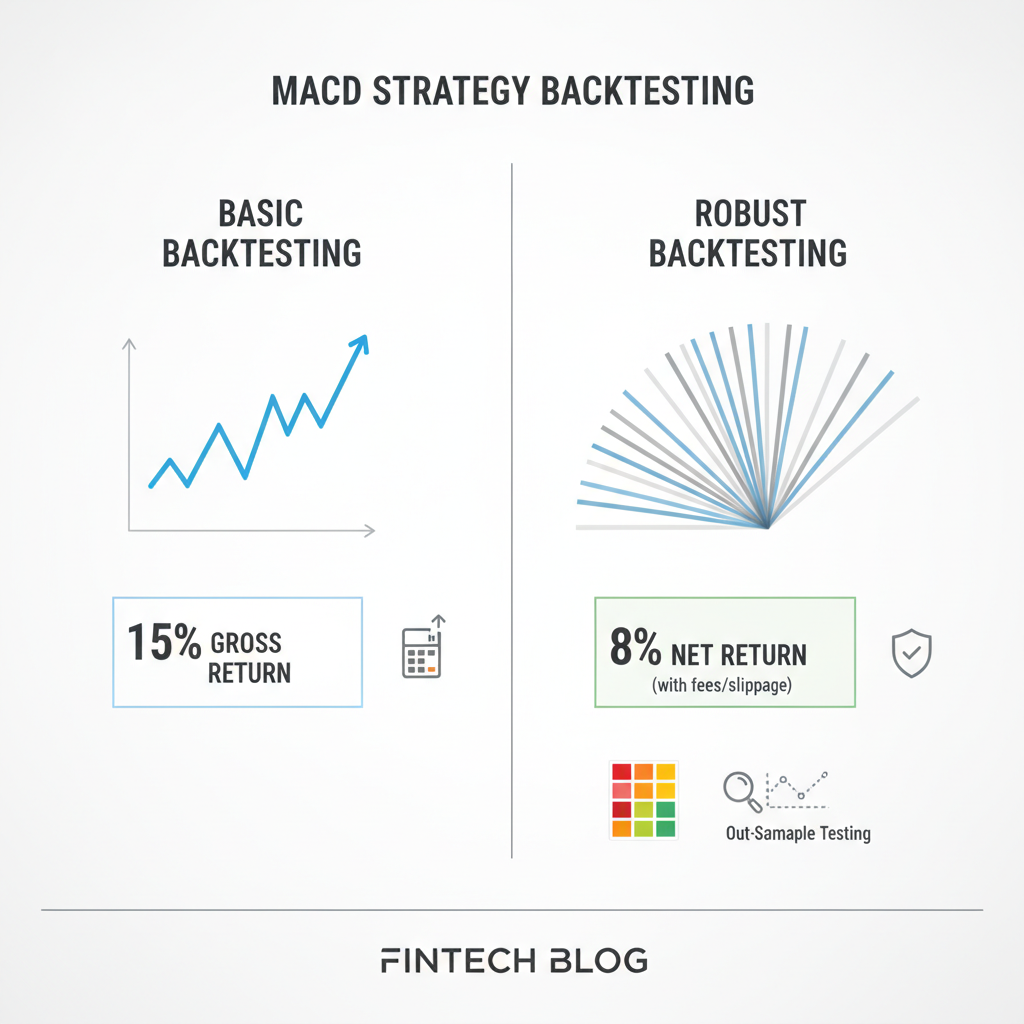
- Effective backtesting must account for real-world trading costs, as a strategy showing 15% returns can drop to 8% after factoring in fees, slippage, and spread.
- Combining MACD with other indicators, such as a 200-period Exponential Moving Average (EMA) for trend filtering, can improve strategy robustness and reduce false signals in choppy markets.
- Advanced platforms democratize access to institutional-grade backtesting tools, offering features like out-of-sample testing, Monte Carlo simulations, and heatmaps to ascertain true strategy resilience.
The Enduring Appeal of MACD in Automated Momentum Trading
The Moving Average Convergence/Divergence (MACD) indicator, developed by Gerald Appel, remains a cornerstone of technical analysis, particularly for traders focused on momentum. It uses three exponential moving averages—a short-term, a long-term, and the average difference between them (the signal line)—to visualize price momentum and identify shifts in trend strength. This structure makes it highly effective for identifying potential entry and exit points, especially when the MACD line crosses its signal line, signaling a change in momentum or direction.
For traders seeking automated momentum trading, the MACD crossover serves as a clear, quantifiable signal. A bullish crossover, where the MACD line crosses above the signal line, often indicates increasing upward momentum, while a bearish crossover suggests strengthening downward momentum. Automating these signals transforms a labor-intensive analytical process into a systematic, rule-based execution. As noted by Option Alpha, automating a MACD reversion strategy "allows you to offload the process of finding overbought or oversold conditions for different tickers and entering multiple trades," managing positions dynamically across various symbols like SPY, GLD, XOP, and TLT.
The primary advantage of MACD automation lies in its ability to scan markets and dynamically monitor positions, freeing traders from constant vigilance while ensuring consistent application of defined entry and exit parameters.
However, the simplicity of MACD also presents challenges. Alpaca highlights several risks associated with MACD crossovers, including "false signals" in range-bound markets and "lag" because the indicator is derived from moving averages, inherently delaying signals relative to actual price changes. This underscores the need for not just automation, but intelligent, carefully designed automation, often combining MACD with other indicators to filter out noise.
Actionable Takeaway: When designing an automated MACD strategy, consider combining it with a longer-period moving average, such as a 200 EMA, to confirm the overarching trend and minimize false signals in non-trending environments, as suggested by CodeTrading's Python backtesting experiment.
Building a MACD Crossover Trading Bot: From Concept to Disciplined Execution
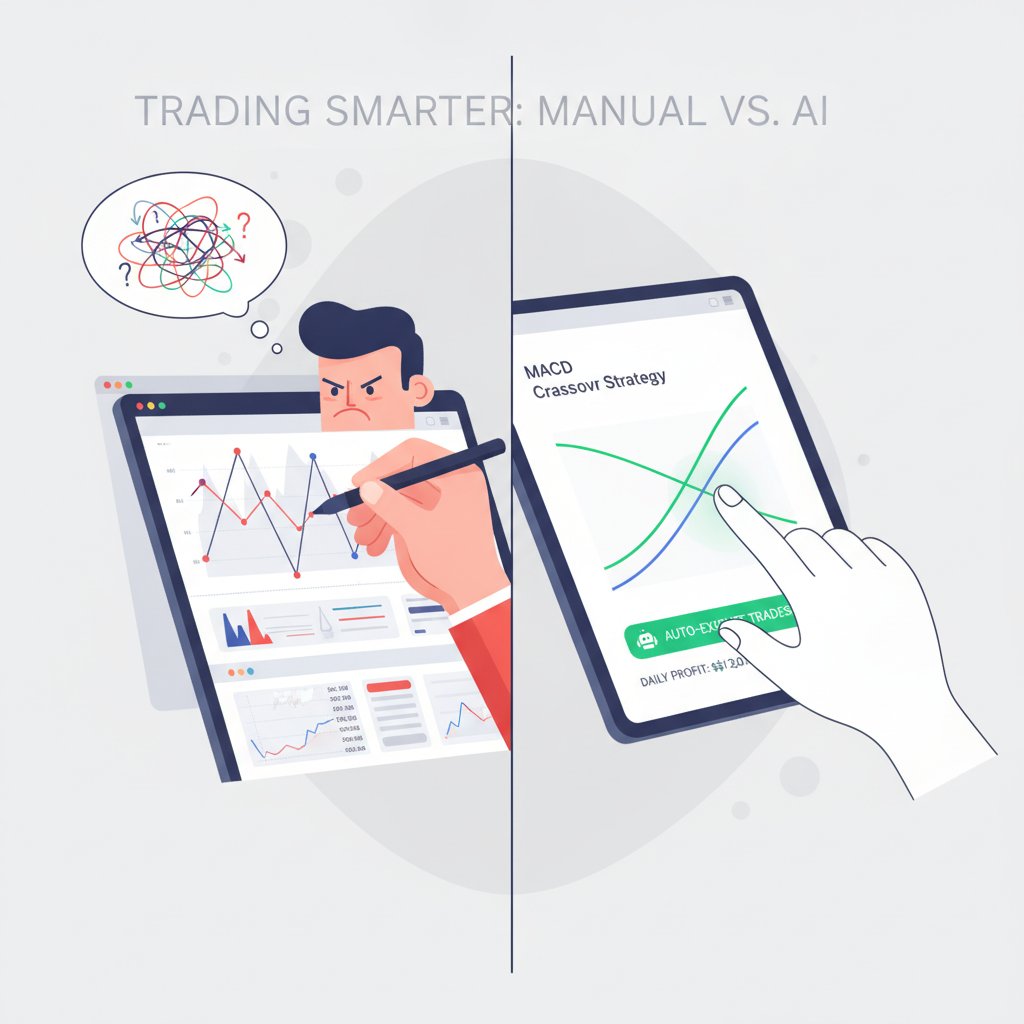
The journey from a trading idea to a fully functional macd crossover trading bot involves several critical steps, whether you're coding from scratch or utilizing no-code platforms. The core objective is to translate the MACD's crossover logic into precise, executable instructions for market interaction. For instance, a common strategy might involve buying when the MACD line crosses above its signal line and selling when it crosses below, possibly with additional filters.
Platforms like Alpaca's Trading API demonstrate how traders can programmatically fetch historical data, compute MACD in languages like Python, detect crossover events, and submit orders. This process, while powerful, requires coding proficiency. For many serious traders who think systematically but lack coding skills, this creates a significant barrier to entry for moving average automation.
Sophisticated trading bots often go beyond simple crossover detection. For example, some strategies integrate momentum indicators like the MACD with directional indicators like the DMI (Directional Movement Index) to enhance signal reliability, as seen in some crypto trading bots. These systems often aim to optimize entry and close trades once a pre-set profit level is reached, addressing typical limitations of basic trend-following systems. The ability to monitor multiple indicators across various tickers simultaneously is a key benefit of automation, preventing the overwhelm of manual tracking.
A well-designed MACD bot can scan a diverse portfolio of assets, from stocks to cryptocurrencies, ensuring that potential opportunities are identified and acted upon instantly, based on pre-defined criteria.
Furthermore, risk management is integral to bot design. Strategies often incorporate automated stop-loss and take-profit mechanisms. For example, a TradingView MACD strategy for BTCUSDT Futures emphasizes a default 3% risk per trade and a 3:1 risk:reward ratio, with a trailing stop-loss that adjusts as the price moves favorably. Such features ensure that capital is protected and profits are locked in, even when the trader is not actively monitoring the market.
Actionable Takeaway: When building your bot, ensure clear, specific entry and exit rules. Incorporate robust risk management parameters, such as automated stop-losses and take-profits, to protect capital and discipline your trading approach, especially when venturing into high-frequency markets like the 1-minute BTCUSDT timeframe.
The Imperative of Robust Backtesting for MACD Strategies
Developing an automated momentum trading strategy, especially one centered on MACD crossovers, is only half the battle. The true test of a strategy's viability lies in its performance against historical data—a process known as backtesting. Without rigorous backtesting, even the most intuitive MACD strategies can lead to significant losses in live trading. The YouTube channel CodeTrading, for instance, undertook a systematic backtesting experiment for a MACD strategy claiming an "80% win rate" online, highlighting the critical need to verify such claims empirically.
A superficial backtest, however, is insufficient. Many platforms offer a "free backtesting platform" experience, but the depth and accuracy of the simulation vary wildly. A robust backtest must simulate real-world trading conditions as closely as possible, including:
- Realistic Trading Costs: Exchange fees, slippage, and bid-ask spread can significantly erode profits. As Coinrule emphasizes, a strategy showing 15% returns in a basic backtest might drop to 8% or less after accounting for these costs. Ignoring these can lead to a disastrous disconnect between backtested performance and live results.
- Out-of-Sample Testing: Optimizing a strategy too heavily on historical data can lead to "curve fitting," where the strategy performs excellently on past data but poorly on new, unseen data. True robustness is validated by testing the optimized strategy on a separate, "out-of-sample" dataset.
- Lag and False Signals: MACD's inherent lag means signals are delayed. Moreover, in non-trending, choppy, or range-bound markets, MACD crossovers can generate "false signals" that do not result in sustained price movements. Alpaca specifically warns against these limitations, stating that strategies performing well in trending markets may underperform or generate losses in sideways markets. A comprehensive backtest should reveal these vulnerabilities.
- Stress Testing and Monte Carlo Simulations: Understanding how a strategy performs under various adverse conditions—such as market crashes or prolonged sideways movement—is crucial. Monte Carlo simulations can randomly reorder historical price data or parameters to assess the strategy's sensitivity and potential range of outcomes, providing a more realistic expectation of performance.
The difference between a theoretically profitable strategy and a practically viable one often hinges on the quality and comprehensiveness of its backtesting, which must reveal vulnerabilities like slippage and sensitivity to market conditions.
Backtesting tools that allow for granular control over parameters, provide detailed performance metrics (Sharpe ratio, max drawdown, profit factor), and visualize trade executions are invaluable. The ability to "adjust strategy parameters like RSI levels or moving average periods then re-run backtests to see impact on performance" is essential for finding optimal settings for various assets and market conditions, as explained by Coinrule.
Actionable Takeaway: Prioritize backtesting platforms that incorporate realistic trading costs, offer out-of-sample testing capabilities, and provide comprehensive performance analytics beyond simple win rates. This depth ensures your MACD crossover trading bot is truly robust, not just historically lucky.
Elevating Automated Momentum Trading with Advanced Tools
While the fundamental logic of moving average automation, particularly with indicators like MACD, remains consistent, the tools available for strategy development and deployment have evolved dramatically. The shift is towards platforms that empower serious traders to operationalize their systematic ideas without requiring deep programming expertise. These advanced platforms bridge the gap between conceptual trading edge and automated, disciplined execution, addressing the "automation risk" that faulty logic can amplify losses, as highlighted by Alpaca.
Modern platforms offer a holistic environment where traders can:
- Generate strategies with AI: Moving beyond manual rule definition, AI-powered tools can assist in discovering optimal MACD parameters or even generate entirely new strategies based on market objectives, vastly accelerating the development cycle.
- Utilize institutional-grade backtesting: This includes not just basic backtesting but advanced features like Monte Carlo simulations, out-of-sample testing, and heatmaps to visualize parameter sensitivity. These tools provide a far more robust assessment of a strategy's resilience across various market scenarios, ensuring a MACD strategy isn't merely optimized for a narrow historical window.
- Access multi-asset support: An effective automated system should be capable of deploying strategies across stocks, forex, crypto, futures, and options. This multi-asset capability allows a single MACD strategy to be adapted and applied to diverse market opportunities, rather than being confined to a single asset class.
- Deploy with integrated broker connections: Seamless integration with brokers for automated execution removes manual intervention, reducing latency and execution risk (slippage) that can particularly impact high-frequency MACD strategies, like those tested on 1-minute BTCUSDT Futures.
- Benefit from a community and marketplace: The ability to explore, copy, and customize community-built strategies, or even sell access to your own proven MACD bots, fosters collaborative improvement and provides a real-world reputation mechanism based on actual performance.
These capabilities move beyond simple API integrations or basic scripting, providing a comprehensive ecosystem for traders who demand precision, flexibility, and robust validation for their automated momentum trading approaches. The focus shifts from merely "how to implement MACD" to "how to implement, validate, and scale an effective MACD strategy reliably."
Actionable Takeaway: Seek platforms that offer a complete suite of tools for the entire algorithmic trading lifecycle, from AI-assisted strategy generation and institutional-grade backtesting to multi-asset deployment and a supportive trading community. This holistic approach significantly enhances the probability of success for MACD crossover trading bots.
How Horizon Addresses This
For serious traders who recognize the power of systematic thinking but are often limited by coding requirements, Horizon offers a transformative solution for MACD crossover trading bots and automated momentum trading. Our AI-powered platform allows you to generate custom MACD strategies with no coding required, transforming your market ideas into precise, automated rules. Horizon's institutional-grade backtesting engine empowers you to rigorously validate these strategies against historical market data, providing detailed performance metrics, out-of-sample backtesting, Monte Carlo simulations, and heatmaps to reveal true robustness. Unlike basic "free backtesting" tools, Horizon ensures your backtests account for realistic trading costs and market conditions, giving you confidence in your strategy's real-world potential. With multi-asset support, you can deploy your MACD strategies across stocks, forex, crypto, futures, and options, and connect directly to your broker for automated execution. Furthermore, the Horizon marketplace allows you to explore, copy, or even sell access to your high-performing MACD strategies, fostering a community built on proven results and transparency.
Conclusion
The transition from manual MACD analysis to a sophisticated MACD crossover trading bot represents a significant leap forward for systematic traders. While the underlying indicator remains potent, its effective application in today's dynamic markets hinges on intelligent automation, disciplined execution, and, critically, robust backtesting. The challenges of false signals, lag, and realistic cost accounting demand a rigorous approach that goes beyond basic scripting or superficial simulations. By leveraging platforms that offer AI-powered strategy generation, institutional-grade backtesting, and seamless automated deployment, traders can transform their systematic edge into a consistent, performance-driven reality. Explore how Horizon empowers you to build, validate, and deploy your automated momentum trading strategies with unparalleled precision and confidence.
Sources
- How to Automate a MACD Trading Strategy | Option Alpha
- Crypto MACD/DMI Trading Bot | Coinrule
- How to Implement MACD Crossovers With Alpaca's Trading API | Alpaca
- Résultats de recherche de scripts pour "macd strategy" — TradingView
- Free Backtesting Platform | Coinrule
- How to Backtest MACD Strategies For Algorithmic Trading | YouTube (CodeTrading)