Published Jun 08, 2026
No-Code AI Trading Bots: Building & Backtesting Strategies for Forex & Binance

Once the exclusive domain of quantitative hedge funds, algorithmic trading has rapidly democratized, putting sophisticated automation within reach of serious retail traders. The landscape has shifted dramatically; what was once a complex endeavor requiring deep coding knowledge is now accessible through intuitive, no-code AI platforms. This evolution allows traders to transform their market insights into automated strategies for high-frequency markets like Forex and Crypto, particularly on major exchanges like Binance.
Key Takeaways
- No-code AI platforms have democratized algorithmic trading, shifting advanced automation from institutional to retail traders across stocks, forex, and crypto markets.
- Building AI trading bots now involves a streamlined workflow: connecting exchanges, using visual or AI prompt interfaces, rigorous backtesting, and automated deployment, often starting with simple strategies like grid bots for beginners.
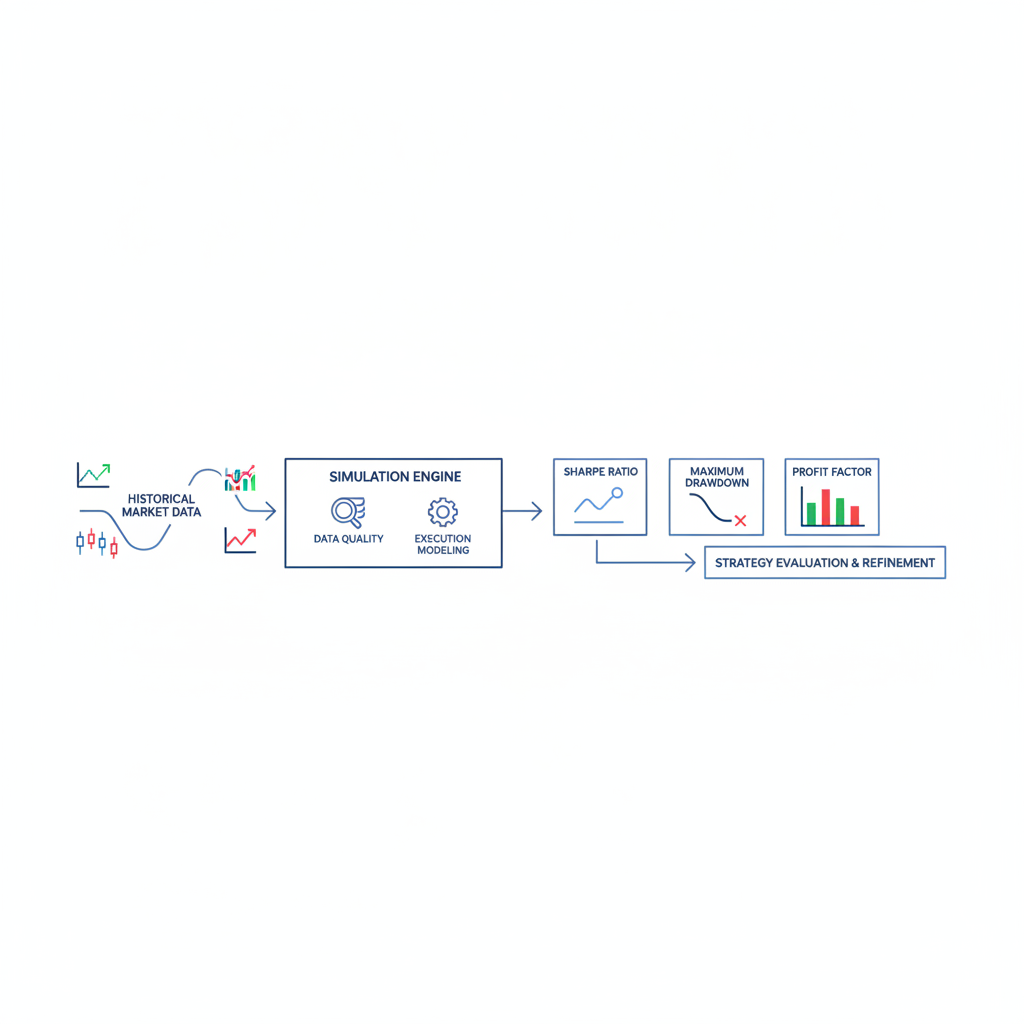
- Institutional-grade backtesting is crucial, requiring not just historical price data but also execution modeling that accounts for fees, spread, and slippage, alongside detailed metrics like Sharpe Ratio and Maximum Drawdown.
- Effective risk management and continuous monitoring are paramount for live deployment, with many traders adhering to a 1-2% rule to limit exposure per trade, adapting strategies to changing market conditions.
- Platforms like Horizon bridge the gap between strategic ideas and disciplined execution, offering AI-powered strategy generation and institutional-grade backtesting for multi-asset trading without requiring any coding expertise.
The Democratization of Algorithmic Trading for Forex and Crypto
The barrier to entry for algorithmic trading has significantly lowered, empowering retail traders to engage with strategies previously reserved for well-funded institutions. Historically, automated trading tools were predominantly utilized by quantitative firms and technically proficient traders, demanding extensive coding skills to develop and deploy strategies. However, the rise of AI-powered no-code platforms has fundamentally altered this dynamic. As early as 2026, the landscape is projected to show a marked increase in retail traders adopting bots, AI signals, and automated scanners to systemize their approach to markets like Forex and cryptocurrencies on platforms such as Binance (Ventureburn).
The shift towards accessible AI trading tools means that more retail traders are now leveraging automation, with platforms designed to reduce manual analysis and facilitate structured trading decisions (Ventureburn).
This paradigm shift is driven by the ability of no-code platforms to translate complex trading logic into automated instructions without requiring users to write a single line of code. Such platforms enable traders to bypass the steep learning curve of programming languages like Python or C++, directly converting strategic concepts into functional algorithms. This accessibility is particularly impactful in volatile markets such as crypto and Forex, where rapid execution and disciplined strategy adherence can be critical (Switch Markets).
The practical insight here is that an "edge" in trading is no longer solely about analytical prowess but also about efficient and systematic execution. No-code AI trading bots provide the infrastructure for individuals to apply their market insights with the speed and consistency typically associated with institutional players, fundamentally changing how strategies are developed and deployed in modern financial markets.
Building No-Code AI Trading Strategies for Forex & Binance

The core promise of no-code AI trading platforms is to allow anyone to build and customize automated strategies with ease. This capability is particularly beneficial for traders focused on the Forex market, where many strategies are inherently rule-based, and for crypto enthusiasts operating on exchanges like Binance, where speed and precision are paramount. The process typically involves a straightforward workflow that eliminates the need for programming expertise.
A typical workflow for building a no-code AI trading bot starts with account creation and connecting to supported exchanges, including major players like Binance (WunderTrading). Once connected, traders use a visual interface or an AI prompt to articulate their desired strategy. This could involve defining conditions based on price movements, technical indicators (like MACD or Bollinger Bands), volatility metrics, or specific market events (AlgoBuilder). For instance, a Forex trader might describe a strategy that buys EUR/USD when the RSI crosses above 30 and the MACD forms a bullish crossover, without needing to translate these conditions into Python or MQL4.
Many platforms excel at turning plain English descriptions into executable trading rules. This natural language processing capability means users can simply "describe it, the AI handles the syntax" (AlgoBuilder). The AI can then convert these instructions into a structured bot configuration, streamlining the process of strategy generation. For beginners, exploring options like a grid bot strategy can be an excellent starting point, offering a simpler entry into automated trading.
Beyond initial setup, some platforms offer sophisticated AI assistants that can analyze millions of pre-tested strategies and match them to a user's specific risk and return preferences (For Traders). These tools can even create machine learning models, like KNN or Random Forest, tailored to specific trade horizons, generating predictive signals and converting them into automated bots. This level of automation and AI assistance means that strategy ideation and implementation become a collaborative process between the trader and the platform, maximizing efficiency.
The actionable takeaway for traders is to focus on clearly articulating their trading logic and risk parameters. The power of no-code platforms lies in their ability to precisely execute these defined rules, whether for simple trend-following strategies on a Forex pair or complex arbitrage opportunities across crypto assets on Binance. The key is clear strategy definition, as "if something is vague, it cannot be tested" (3Commas).
The Critical Role of Institutional-Grade Backtesting for Robustness
Before any capital is committed, a trading strategy must undergo rigorous validation against historical market data. This process, known as backtesting, is not merely a formality but a critical filter for identifying robust strategies and eliminating weak ideas before they incur real losses (3Commas). The effectiveness of backtesting is directly proportional to the quality and granularity of the data used and the sophistication of the simulation.
A truly meaningful backtest requires high-quality historical price data. Daily candles are often insufficient for serious algorithmic work, especially in fast-moving markets like Forex and crypto. Instead, minute-level or even tick-level data, covering numerous assets and exchanges, is essential to accurately capture market behavior (3Commas). Some platforms boast access to extensive datasets, such as 3.8 terabytes of tick-data, enabling simulations of five years of market activity in just minutes, complete with millisecond resolution (AlgoBuilder).
Beyond data volume, accurate execution modeling is paramount. A naive backtest often assumes perfect fills, which is unrealistic in live trading. Robust backtesting must account for real-world market frictions, including trading fees, bid-ask spread, slippage, and even partial fills. Neglecting these factors can lead to inflated performance metrics in backtests that significantly diverge from live results (3Commas). For instance, a strategy backtested without slippage modeling on a highly liquid Forex pair might show excellent returns, but fail dramatically when deployed live due to unexpected price deviations at execution.
A proper backtest is about filtering out weak ideas before they cost real money, providing answers to crucial questions about historical performance across varied market conditions (3Commas).
Key metrics to monitor during backtesting include Sharpe Ratio, Maximum Drawdown, Win Rate, and Profit Factor. Visual dashboards make it easy to compare different strategy variations and understand their risk-adjusted returns (WunderTrading). Furthermore, it's vital to test strategies across different market phases—bull, bear, and sideways—to ensure their robustness. A strategy performing well in a bull market might falter under bearish or ranging conditions (WunderTrading).
While some platforms excel in simplifying backtesting through natural language processing, allowing traders to define criteria using plain English prompts, the underlying engine must be powerful. The actionable insight here is that traders must seek platforms offering comprehensive, high-fidelity backtesting environments. This means going beyond basic price data to include sophisticated execution modeling, multi-asset data coverage (including Forex pairs and Binance crypto assets), and the ability to simulate real market conditions like order flow for true strategy validation.
Deploying and Managing No-Code AI Bots for Forex & Crypto
The transition from a well-backtested strategy to live automated trading requires a disciplined approach to deployment and continuous risk management. While no-code platforms make strategy execution more accessible, they do not eliminate inherent market risks. Therefore, a cautious and systematic approach is essential, especially when dealing with the high volatility and leverage often found in Forex and crypto markets.
A fundamental principle for deployment is to start small and scale up gradually. Traders should begin by deploying their bots on a demo account or with a minimal amount of capital in a live account. This probationary period allows the bot to prove its performance in real market conditions before significant capital is committed. Monitoring actual trading results and gathering live data is crucial for making informed decisions about scaling (Switch Markets).
Risk management is paramount. Many seasoned traders adhere to the 1-2% rule, never risking more than that percentage of their portfolio on a single trade (WunderTrading). This rule helps protect capital from unforeseen market movements or strategy underperformance. Additionally, keeping the strategy logic simple and robust often yields better long-term results than overly complex systems (Switch Markets). Focus on clear entry and exit points, along with easily definable position sizing and risk limits.
Continuous monitoring is non-negotiable, even for fully automated bots. Market conditions are dynamic, and a strategy that performed well in one environment might become ineffective in another. Regular reviews ensure the strategy remains relevant and responsive to changing volatility, liquidity, or fundamental drivers in Forex and crypto markets (Switch Markets). This means keeping an eye on performance dashboards, understanding drawdowns, and being prepared to pause or adjust the bot if necessary.
For example, a Forex strategy designed for trending markets might struggle during periods of consolidation, or a crypto bot optimized for a bull run on Binance might face significant challenges during a bear market. Automated systems, while removing emotional bias, still require human oversight to adapt to macro shifts. Platforms integrating AI for adaptive prediction modeling, where bots train and retrain machine learning models on new data in real-time, represent an advanced form of this responsiveness (Medium - Freqtrade), with Freqtrade supporting Binance for live trading.
The actionable insight is that while no-code AI bots automate execution, they demand an active risk management strategy and ongoing human vigilance. The goal is to leverage automation for disciplined trading, not to abdicate responsibility. Traders must maintain control over their automated systems, ensuring they align with current market realities and personal risk tolerance.
How Horizon Addresses This
Horizon Global Trade is engineered for serious traders who seek to transform their systematic ideas into automated, disciplined execution without the need for coding. For those looking to build and backtest no-code AI trading bots for Forex and Binance, Horizon offers an institutional-grade platform that directly addresses the challenges discussed.
Horizon empowers traders to generate custom trading strategies using AI, bypassing coding barriers and allowing direct translation of market insights into executable logic for multi-asset support, including stocks, Forex, crypto, futures, and options. Our platform features an institutional-grade backtesting engine that goes beyond basic simulations, incorporating granular historical data, sophisticated execution modeling (including fees, spread, and slippage), and advanced analytics like Monte Carlo simulations and out-of-sample backtesting to ensure strategies are truly robust. This is particularly crucial for validating strategies in volatile Forex and crypto environments.
Once validated, strategies can be deployed for live trading through seamless broker integrations, providing automated execution and real-time performance monitoring. Horizon also fosters a marketplace of community-built strategies, allowing users to buy, copy, or even sell access to their own proven strategies, building a reputation based on verifiable performance. Horizon transforms your edge, whether a nascent idea or a battle-tested concept, into a powerful, automated trading force, equipping you to operate at the next level without needing a quant team.
Conclusion
The advent of no-code AI trading bots represents a pivotal moment in the evolution of financial markets, democratizing access to sophisticated algorithmic strategies. For traders in the dynamic Forex and crypto markets, this means the ability to rapidly develop, rigorously backtest, and confidently deploy automated systems that were once the exclusive domain of institutional players. The emphasis has shifted from coding proficiency to strategic acumen and disciplined risk management, enabled by powerful AI platforms.
Successfully navigating this new landscape requires an understanding of how to leverage AI for strategy generation, the necessity of institutional-grade backtesting that accounts for real-world market frictions, and the commitment to continuous monitoring and risk adjustment during live deployment. As the market continues to evolve, these no-code tools will become indispensable for serious traders aiming for systematic, unbiased execution. Explore how Horizon can empower you to build, test, and deploy your next generation of AI-powered trading strategies.
Sources
- WunderTrading: No-Code AI Platforms to Build Crypto Trading Strategies
- Ventureburn: 15 Free AI Trading Bots for Crypto, Stock, and Forex Markets
- For Traders: Top Backtesting Tools for Forex and Crypto
- Switch Markets: How to Build a Trading Bot Without Coding
- Ventureburn: 6 Best AI Trading Platforms for Crypto, Stocks, and Forex (2026)
- 3Commas: Practical 2026 Guide to AI Trading and Backtesting
- AlgoBuilder: Build Automated Trading Strategies in Plain English
- Medium: Top 10 AI-Powered Crypto Trading Repositories on GitHub