Published Jul 04, 2026
No-Code Platform vs. Traditional Coding: Why Horizon Empowers Systematic Traders

The landscape of software development has undergone a radical transformation, moving from an exclusive domain of highly skilled programmers to a more accessible ecosystem. This shift is particularly evident in the world of algorithmic trading, where speed and agility are paramount. Historically, developing sophisticated trading strategies demanded extensive coding knowledge—mastering languages like Python or C++, understanding complex frameworks, and spending months building from scratch. However, the rise of no-code platforms is democratizing this process, enabling a new generation of quantitative-minded traders to deploy institutional-grade strategies without writing a single line of code. This evolution challenges the traditional paradigm, offering unprecedented speed and accessibility, yet it also invites scrutiny regarding flexibility, scalability, and security.
Key Takeaways
No-code platforms can accelerate application development by up to 90%, drastically reducing time to market for trading strategies compared to traditional coding methods.
The majority of developers, over 90% in a recent survey, report productivity gains from using low-code tools, with nearly half saving as much as 50% of their development time.
While traditional coding offers unlimited flexibility for highly specific, complex applications, low-code and no-code platforms handle up to 75% of new enterprise applications, freeing professional developers for mission-critical challenges.
Organizations that empower "citizen developers" with low-code/no-code platforms show 33% higher innovation scores, fostering rapid iteration and adaptation in dynamic environments like financial markets.
No-code solutions democratize access to advanced algorithmic capabilities, allowing traders to focus on strategy logic and market edge rather than coding syntax, albeit with potential trade-offs in ultimate customization control.
The Velocity of Innovation: No-Code's Disruptive Force
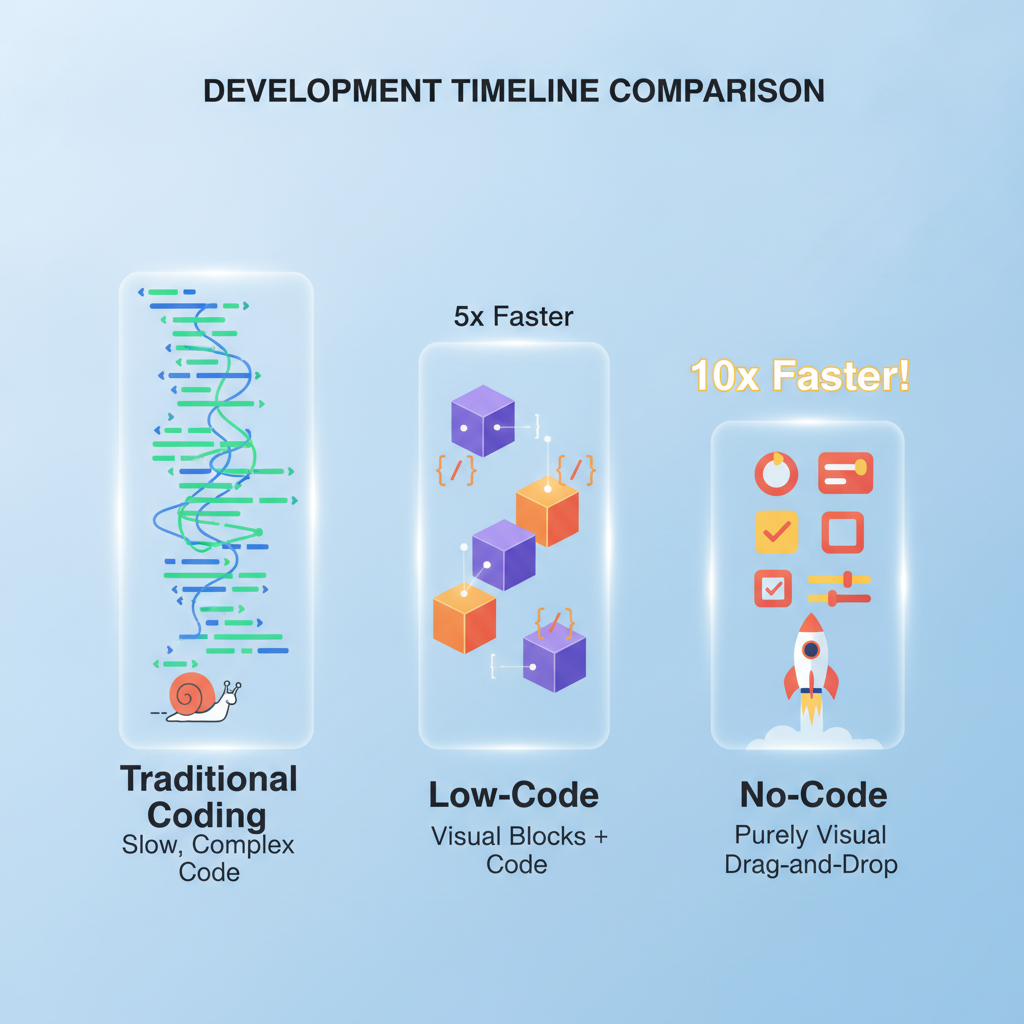
The traditional approach to software development, often referred to as "pro-code," involves manual coding in languages like Python, Java, or C++. This method grants developers unlimited flexibility and control, making it ideal for building highly customized and complex systems from the ground up. However, this power comes at a significant cost: time. Developing a typical custom AI implementation, for instance, can require 3-6 months of initial development time, with the majority of costs accruing post-deployment.
Enter no-code platforms, a paradigm shift designed for users with limited or no coding experience. These platforms emphasize simplicity, utilizing visual builders, drag-and-drop components, and pre-built templates to enable rapid application creation. The impact on development speed is staggering: low-code development, a close cousin of no-code that allows for minimal custom code, can accelerate the application development process by up to 90% compared to traditional methods. For businesses, this translates into delivering solutions 56% faster on average, significantly reducing time to market. Industry analyst Forrester estimates that low-code development platforms can make software development ten times faster than traditional methods, with some enterprise apps taking as little as 2-3 days to create.
No-code platforms empower non-technical individuals to create and launch applications—often in less time and with fewer costs—by replacing line-by-line programming with intuitive visual tools and pre-built components.
This speed is critical in dynamic fields like algorithmic trading, where market opportunities are fleeting. A faster path to strategy deployment means quicker iteration, allowing traders to adapt to market changes with incredible agility. Furthermore, no-code platforms significantly reduce software development costs by minimizing the need for specialized coding expertise, making sophisticated tools accessible to a broader audience. The ability to use existing staff to create and modify applications also reduces reliance on costly development teams, enhancing cost efficiency and enabling businesses of all sizes to leverage custom software.
Actionable Insight: For traders with a clear systematic edge but lacking coding proficiency, no-code platforms offer a direct route to automating strategies, bypassing the steep learning curve and lengthy development cycles of traditional programming.
Precision and Power: The Enduring Value of Traditional Coding
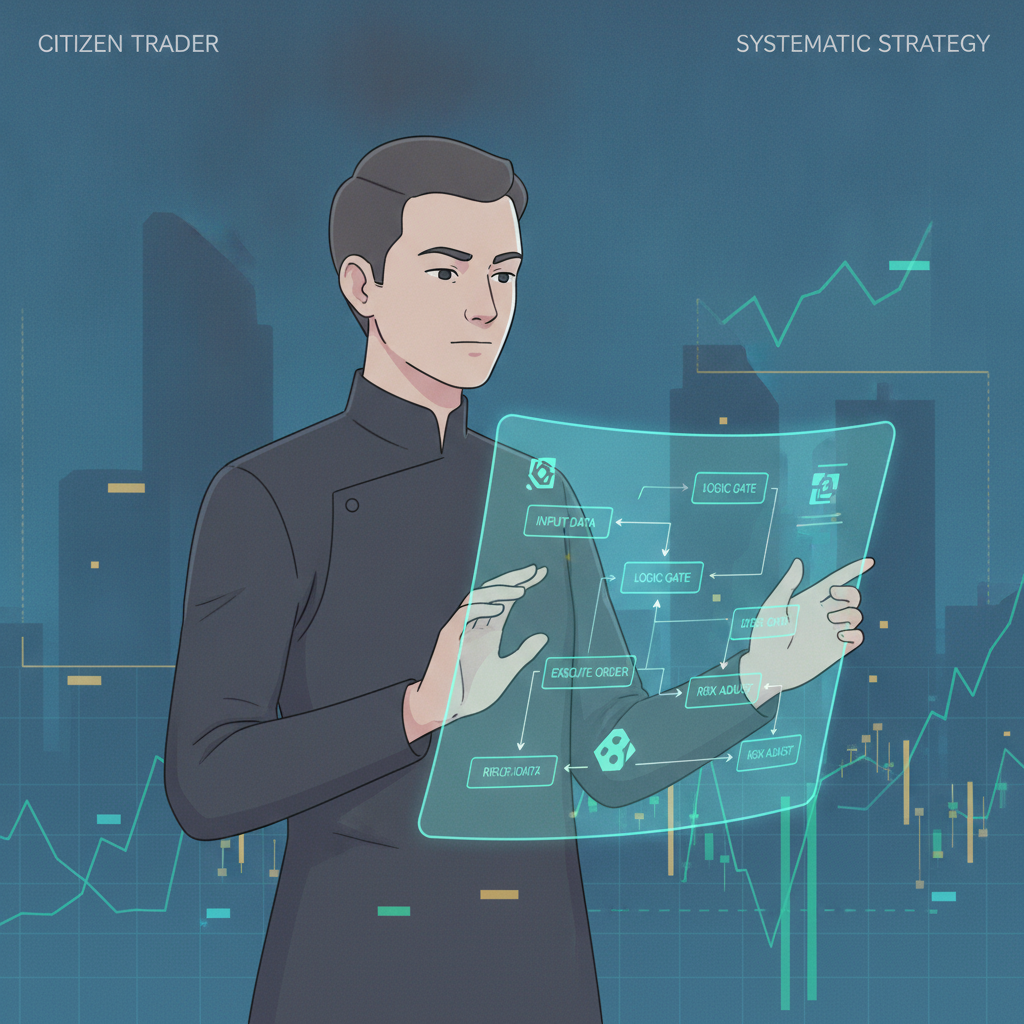
While no-code platforms offer unparalleled speed and accessibility, they come with certain trade-offs. The primary limitation often cited is less flexibility compared to traditional coding or even low-code solutions. This means that for highly specific, unique, or extremely complex sets of needs and expectations, a pure no-code platform may not be able to build an application that precisely meets every requirement. Traditional coding remains the champion for scenarios demanding absolute customization, granular control over every aspect of an application's architecture, and deep integration with highly specialized or legacy systems.
Professional developers, utilizing code-first approaches, can craft bespoke solutions optimized for peak performance, scalability, and security without inherent platform constraints. This is crucial for organizations where the software itself is a core product differentiator or when building mission-critical challenges that require every ounce of custom logic and integration. For instance, creating core APIs or highly optimized trading engines that process millions of transactions per second might still necessitate traditional programming to achieve the desired level of efficiency and control.
The advantages of traditional development include highly customizable options, scalability, adaptability, expanded functionality, and the ability to integrate with other systems more readily.
The maintenance and updating of applications can also present challenges in a purely no-code environment, as control over the underlying code is relinquished to the platform provider. Security, too, can be a concern since developers don't maintain direct control of the code and are potentially subject to platform vulnerabilities. While platform providers invest heavily in security, the ultimate responsibility for certain aspects of the application's integrity rests with the platform, rather than being fully managed by the end-user's development team. Traditional coding, while requiring a more hands-on approach to security and maintenance, ultimately grants the developer complete oversight and control.
Actionable Insight: For institutions or individuals requiring absolute, uncompromised control over every line of logic or needing to build entirely novel, deeply integrated systems, traditional coding remains the optimal choice, albeit at a higher cost in time and specialized expertise.
Bridging the Gap: Low-Code and the Rise of Citizen Developers
Between the extremes of pure no-code simplicity and traditional code complexity lies low-code development. Low-code platforms provide a visual environment with pre-built components, similar to no-code, but critically, they still allow professional developers to add custom code (pro-code) for complex logic, unique integrations, or specific customizations. This makes low-code a powerful middle ground, boosting developer productivity while maintaining a significant degree of flexibility.
This hybrid approach is gaining significant traction. Some estimates suggest that low-code and no-code platforms now handle up to 75% of new enterprise applications, demonstrating their widespread utility. This frees up pro-code developers to focus on the most complex, mission-critical challenges, often building the core APIs or systems that "citizen developers" then use within visual platforms. This collaboration fosters what McKinsey describes as 33% higher innovation scores in organizations that adopt low-code and no-code platforms to empower citizen developers.
In a 2024 survey, over 90% of developers reported productivity gains from using low-code tools, with nearly half saving as much as 50% of their development time on projects.
The benefits of low-code development extend beyond mere speed. It offers a crucial balance between rapid development and customization, making it suitable for a broader range of projects. Low-code applications can still be deployed faster than software developed through traditional methods, while providing more flexibility than pure no-code solutions. This agility is vital in today's rapidly evolving digital landscape, allowing businesses to adapt effectively to market shifts and opportunities. By abstracting away much of the complexity associated with programming, these platforms enable users to focus more on the logic and functionality of their applications rather than the intricacies of syntax and architecture, thereby democratizing software development and fostering a culture of innovation.
Actionable Insight: For traders or small firms who need more customization than pure no-code but want to avoid full-stack development, low-code solutions offer a robust compromise, leveraging pre-built components while allowing for bespoke adjustments.
The Strategic Imperative: Why Flexibility and Accessibility Matter in Algorithmic Trading
In the high-stakes world of algorithmic trading, the choice between development paradigms is not merely technical; it's strategic. The ability to rapidly test, iterate, and deploy new trading ideas can be the difference between sustained profitability and obsolescence. Traditional coding, with its lengthy development cycles, can put systematic traders at a disadvantage, especially those operating outside large institutional environments with dedicated quant teams.
The financial markets are characterized by constant change, requiring strategies that can quickly adapt to new data, economic shifts, and emerging patterns. A platform that enables rapid application development (RAD) allows traders to build, test, and refine strategies in days or weeks, rather than months. This directly translates to competitive advantage. While no-code platforms might have fewer customization options, they are best-suited for simpler projects and rapid prototyping, which is often sufficient for generating and testing hypotheses in trading.
Moreover, the accessibility of no-code tools means that traders whose primary expertise lies in market analysis, economics, or risk management — rather than computer science — can translate their insights directly into executable algorithms. This democratization lowers the barrier to entry for sophisticated algorithmic trading, allowing a broader pool of talent to contribute to market efficiency and innovation. The ability for non-developers to configure AI agent behavior through graphical interfaces means that organizations can deploy AI-driven trading strategies without extensive technical hiring, yielding the fastest time-to-value for straightforward workflows.
Actionable Insight: Systematic traders should evaluate their specific needs: if speed, ease of iteration, and the ability to focus on market logic without coding are priorities, no-code solutions offer a compelling strategic advantage. For bespoke, highly complex market microstructure strategies, traditional coding may still be required.
How Horizon Addresses This
Horizon Global Trade recognizes that many serious traders possess a deep understanding of market dynamics and systematic thinking but may lack the specialized coding skills required by traditional algorithmic development. This is precisely where Horizon's AI-powered no-code platform shines, transforming your edge or any ideas—proven or in progress—into automated, disciplined execution.
Unlike retail apps that often treat trading like gambling, or institutional platforms like Bloomberg terminals that necessitate a dedicated quant team, Horizon is built for the professional in the middle: intelligent, capitalized, and ready to operate at the next level. Our platform provides an intuitive, no-code environment that allows you to generate custom trading strategies using AI, completely eliminating the need for complex coding.
Horizon offers an institutional-grade backtesting engine, allowing you to validate your no-code strategies against historical market data with robust metrics like return, Sharpe ratio, out-of-sample backtesting, and Monte Carlo simulations. This ensures your strategies are genuinely robust before deployment. Furthermore, with multi-asset support, real-time analytics, and seamless broker integrations for automated execution, Horizon provides the speed, accessibility, and reliability of a no-code solution without compromising the depth and rigor serious traders demand. You can even explore a marketplace of community-built strategies, buying, copying, and customizing them to fit your unique vision, or sell access to your own proven strategies, building a transparent reputation based on real performance.
Conclusion
The dichotomy between no-code platforms and traditional coding is not about one replacing the other, but rather about choosing the right tool for the job. In the realm of algorithmic trading, the shift towards no-code and low-code solutions is empowering a new generation of systematic traders, democratizing access to powerful automation tools that were once the exclusive domain of institutional players. While traditional coding continues to offer unparalleled flexibility for highly specialized and complex applications, no-code platforms provide the speed, accessibility, and cost-efficiency necessary for rapid strategy iteration and disciplined execution. For traders seeking to transform their market insights into automated strategies without the burden of coding, exploring platforms like horizon.trade represents a strategic step forward, enabling them to harness the power of AI and algorithmic trading to operate at the next level of precision and agility.