Published Jul 04, 2026
No-Code Trading Platform With AI Suggestions: Unlocking Algorithmic Edge
Once the exclusive domain of quantitative analysts and institutional firms, algorithmic trading now processes an overwhelming majority of market transactions. In 2023, automated systems were estimated to account for 60-73% of all U.S. equity trading volume, a significant leap from just 20% in 2005. This shift underscores a fundamental truth: systematic, disciplined execution often outperforms discretionary trading. Yet, the barrier to entry—complex coding languages, advanced statistical modeling, and specialized infrastructure—remains formidable for many intelligent traders. This is where no-code trading platforms, supercharged with AI suggestions, are fundamentally reshaping the landscape, allowing a broader cohort of serious traders to harness the power of automation.
Key Takeaways
Algorithmic trading has become the dominant force in modern markets, with automated systems handling up to 73% of US equity volume, necessitating a systematic approach for serious traders.
No-code platforms are democratizing algorithmic trading by enabling traders to generate, backtest, and deploy sophisticated strategies using intuitive interfaces and plain language, eliminating the need for coding.
AI suggestions are transforming strategy creation, allowing platforms to interpret natural language prompts (e.g., "find stocks with volatility up 5%") and translate them into executable trading logic.
Robust, institutional-grade backtesting—including out-of-sample analysis, Monte Carlo simulations, and heatmaps—is critical for validating AI-generated strategies and ensuring their robustness against market dynamics.
A diverse ecosystem of tools allows traders to either fully customize strategies with AI assistance or leverage community-built marketplaces, but thorough vetting of strategy performance is always paramount.
The New Era of Algorithmic Trading: No Code, Powered by AI
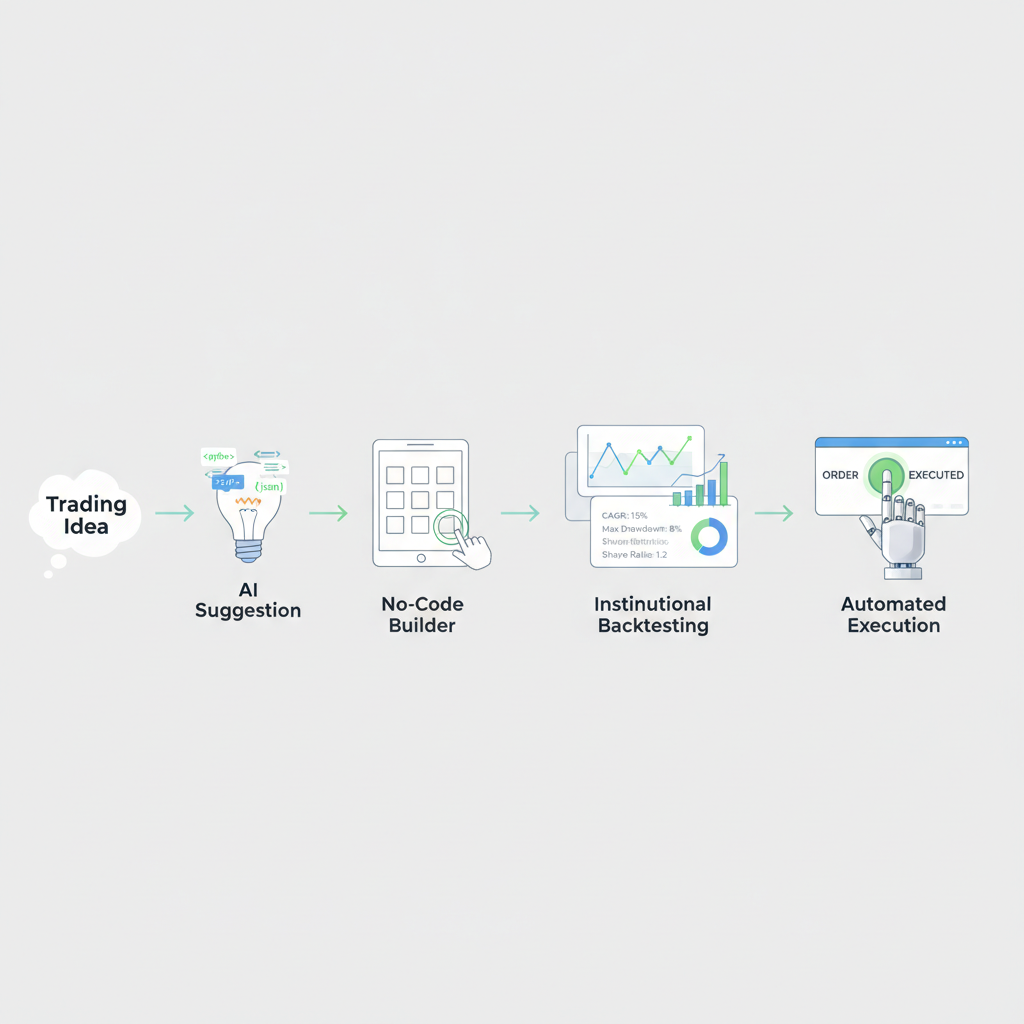
The traditional path to algorithmic trading demanded proficiency in programming languages like Python or C++, alongside a deep understanding of financial engineering. This created a significant chasm between traders with innovative ideas and their ability to automate them effectively. However, the emergence of no-code trading platforms is bridging this gap, making sophisticated automation accessible to a much wider audience.
These platforms provide visual interfaces, drag-and-drop builders, and pre-configured modules that allow traders to design complex strategies without writing a single line of code. The true revolution, however, lies in the integration of Artificial Intelligence (AI). AI suggestions transform these platforms from mere automation tools into powerful co-creators, helping traders refine existing ideas or discover entirely new ones based on market data and their specified criteria. Some advanced no-code platforms have already demonstrated their potential, with one notable platform facilitating over $20 billion in trading volume and fostering a thriving community of strategy creators Source. This illustrates a clear demand for democratized quantitative investing, empowering everyday traders to operate at a higher level.
"No-code platforms provide a fertile ground for AI to democratize complex trading, transforming abstract ideas into concrete, executable strategies for those who think systematically but lack coding expertise."
The actionable takeaway here is that serious traders no longer need to choose between manual execution and hiring a quant team. No-code platforms with AI suggestions provide a middle ground, offering the discipline and scalability of automation combined with the flexibility of human intuition. Identifying a platform that offers both ease of use and deep analytical capabilities is paramount for those looking to leverage this new era.
From Intuition to Automation: Crafting Strategies with AI Suggestions
One of the most compelling features of modern no-code trading platforms is their ability to translate a trader's natural language ideas into actionable trading logic. Historically, expressing a nuanced trading hypothesis, such as "buy when the Relative Strength Index (RSI) crosses above 30, but only if the 50-day moving average is above the 200-day moving average," required meticulous coding. AI suggestions now streamline this process dramatically.
Platforms like Nvestiq, for instance, have impressed users with their AI's ability to interpret plain English and convert it into sensible trading logic. This capability extends to complex scenarios where AI agents, powered by models like GPT-4o mini, can process real-time indicator data—such as an RSI reading of 58.87 for a specific stock—and, based on pre-defined "expert" instructions, suggest whether to "Buy, sell, or do nothing" Source. The flexibility of AI allows for sophisticated prompts, such as instructing the agent to "find all stocks with any specific float, or find stocks that have volatility that moved up 5% within the last 2 hours," transforming complex market scanning into an automated process Source.
This process of prompt-based strategy creation, exemplified by features like Public Agents' ability to "build automated workflows with plain-English prompts" without needing API keys or separate bots, significantly lowers the technical barrier Source. Traders can interact with AI to refine their strategies, asking it to update models or adjust parameters, creating a dynamic feedback loop that continuously improves the strategy. For example, a trader could use AI to define a basic buy signal, then prompt the AI to add risk management conditions, such as "limit order quantity to 2% of our portfolio" Source. The actionable insight here is to embrace iterative prompting. Start with a simple idea, then progressively add layers of complexity and conditions, allowing the AI to help build out robust trading logic, remembering to consistently check the outputs for logical soundness.
Beyond the Backtest: Ensuring Robustness for AI-Generated Strategies
While AI suggestions empower traders to generate sophisticated strategies with unprecedented ease, the true test of any algorithmic approach lies in its ability to perform reliably under varying market conditions. This makes rigorous backtesting not just a feature, but an absolute imperative. Relying solely on AI suggestions without thorough validation is akin to building a house without a stable foundation—it may look good, but it's prone to collapse.
Many no-code platforms offer basic backtesting, but for serious traders, "institutional-grade" capabilities are non-negotiable. This means going beyond simple return metrics to evaluate a strategy's robustness. Key metrics and methodologies include:
Out-of-Sample Backtesting: Crucial for identifying strategies that are genuinely predictive rather than simply overfitting to historical data. This involves testing the strategy on data it has never seen before.
Monte Carlo Simulation: Assesses the strategy's sensitivity to random variations in market outcomes, revealing its stability and potential range of returns under different probabilistic scenarios.
Heatmaps: Visualize performance across various parameter combinations, helping traders identify optimal settings and understand their strategy's sensitivity to inputs.
Sharpe Ratio and Max Drawdown: Essential for evaluating risk-adjusted returns and capital preservation, providing a clearer picture of a strategy's efficiency and resilience.
Even with advanced AI interpreting strategies, "no AI is perfect and your ideas may need fine-tuning to translate correctly into real trades," as one expert notes Source. Therefore, the actionable takeaway is to demand comprehensive backtesting features from any no-code platform you consider. The ability to simulate various market conditions, stress-test parameters, and analyze detailed performance statistics is what differentiates a speculative idea from a robust, deployable trading system.
The Strategy Ecosystem: Building, Customizing, and Curating with AI Tools
The landscape of no-code trading platforms offers a diverse ecosystem where traders can either meticulously craft strategies from the ground up, customize existing frameworks, or leverage community-driven marketplaces. Understanding these options helps traders align their platform choice with their preferred level of engagement and control.
Customization Through Visual Builders
For traders who prefer hands-on creation without coding, platforms offering drag-and-drop visual builders are ideal. Tools like Kryll allow for "drag-and-drop strategy design" and "no-code bot creation" with features like marketplaces, backtests, and paper trading Source. Similarly, Coinrule empowers users with a "no-code strategy builder" for "customized trading plans" using intuitive rules and templates Source. These platforms are particularly good for beginners, offering "easy setup" and allowing for "rule-based crypto trading" without extensive technical knowledge Source. The actionable insight here is to seek platforms that combine intuitive visual builders with robust AI assistance, allowing you to build complex logic step-by-step.
Leveraging Pre-built Bots and AI-managed Portfolios
Many platforms recognize that not every trader wants to build from scratch. They offer marketplaces of pre-configured AI bots and even AI-managed portfolios. StockHero, for example, features a "Strategy Marketplace" where users can "rent pre-configured AI bots without writing a single line of code" and benefit from "cloud-based bots that execute trades 24/7" Source, Source. Tickeron utilizes "AI Robots" and "Financial Learning Models" to provide "probability-based trade ideas" and manage specific asset portfolios Source. These options provide quick entry into automated trading, particularly useful for those new to automation or specific asset classes. The key takeaway is that while convenient, traders should still thoroughly understand the logic and historical performance of pre-built bots before deployment.
Community-Driven Strategy Marketplaces
Another powerful aspect of the no-code ecosystem is the rise of community marketplaces where traders can share, buy, or copy strategies. Platforms like ZuluTrade allow users to "browse through hundreds of leader strategies for forex, crypto, indices, and more—each with complete performance stats" and "copy their trades" after connecting a brokerage account Source. Cryptohopper also offers a "flexible, AI-powered trading system" and a marketplace for custom strategies Source. These marketplaces offer "granular analytics and transparent results," making it easier to learn and replicate successful approaches Source. However, it's crucial to acknowledge that "marketplace quality varies—you still need to vet what you copy" Source. The actionable insight is to utilize these marketplaces as a source of ideas and diversification, but always with a critical eye, ensuring the transparent performance metrics are aligned with your risk tolerance and goals.
How Horizon Addresses This
Horizon is engineered precisely for the serious trader who thinks systematically but lacks a coding background. Our platform directly addresses the evolving needs highlighted in this discussion by offering a comprehensive, institutional-grade environment that integrates no-code AI suggestions with unparalleled validation tools.
Unlike retail apps that simplify trading to the point of speculation, Horizon empowers you to generate custom trading strategies using AI, without writing a single line of code. Our intuitive interface allows you to transform your trading ideas, whether proven or in progress, into automated logic with the assistance of intelligent AI. Once a strategy is conceived, Horizon's institutional-grade backtesting engine provides the deep analytics necessary for rigorous validation. You can backtest strategies against historical market data with detailed performance metrics, including crucial out-of-sample backtesting, Monte Carlo simulations, and heatmaps, ensuring your strategy is genuinely robust and not merely overfit. For those looking to leverage collective intelligence or monetize their expertise, Horizon also features a marketplace where you can access or sell community-built strategies, all transparently backed by real performance data. Horizon provides the tools for intelligent, capitalized traders ready to operate at the next level.
Conclusion
The era of no-code trading platforms with AI suggestions marks a pivotal moment for systematic traders. It demolishes the technical barriers that once confined sophisticated algorithmic strategies to elite institutions, offering a powerful avenue for transforming intuitive market insights into automated, disciplined execution. From AI-assisted strategy generation and rigorous backtesting to diverse strategy marketplaces, the tools are now available to elevate your trading approach without needing to learn complex programming.
For traders seeking to harness this transformation and gain a tangible edge, the next step is clear. Explore platforms that blend cutting-edge AI with institutional-grade analytical rigor. We invite you to experience how Horizon empowers you to unlock your full trading potential. Visit horizon.trade today to learn more and get early access to AI suggestions for your trading strategies.