Published Jul 04, 2026
No-Code Trading Strategy Builder Features Explained: Bridging Ideas to Automated Execution
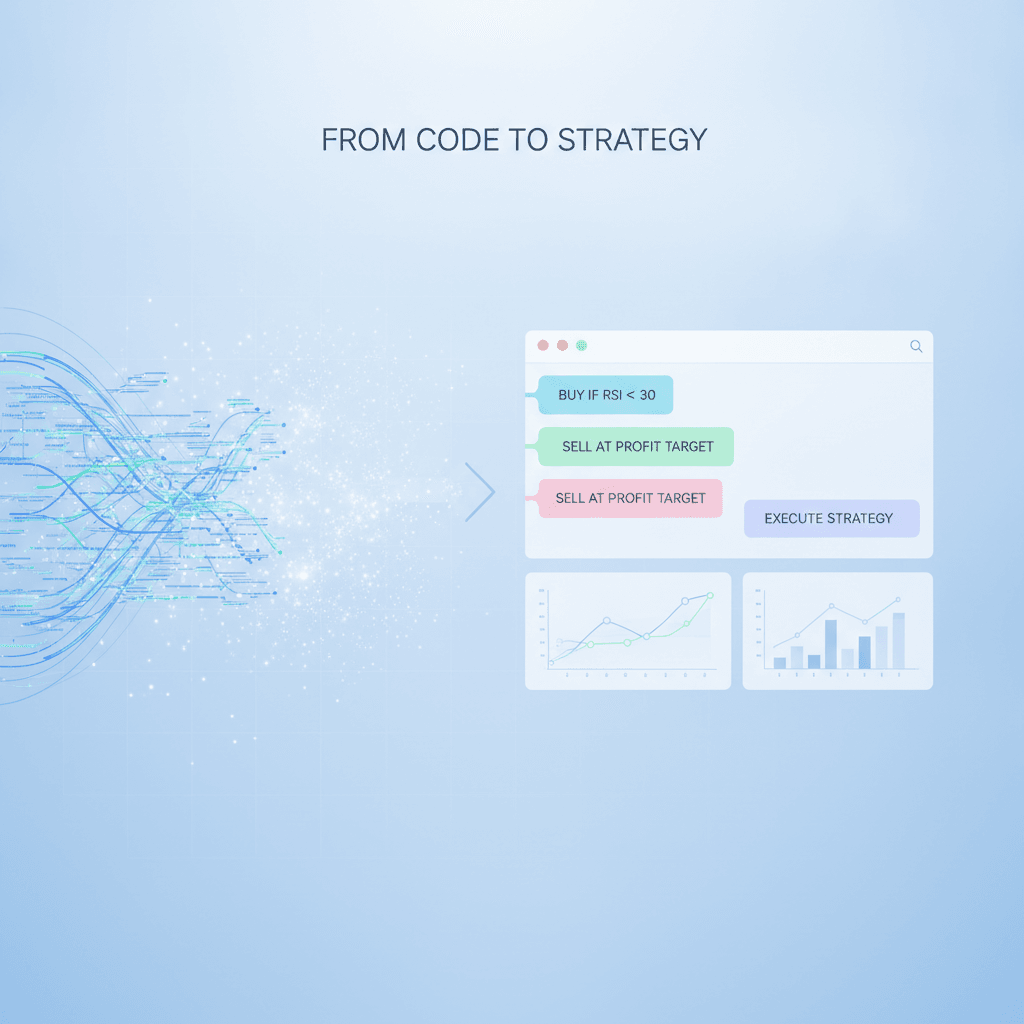
The landscape of global financial markets has been irrevocably reshaped by algorithmic trading. What was once the exclusive domain of institutional quants and high-frequency trading firms, now accounts for an estimated 60-73% of US equity trading volume, a significant leap from just 20% in 2005. This technological shift, driven by advancements in automation and artificial intelligence, has paved the way for a new era of accessibility, particularly through no-code trading strategy builders.
Key Takeaways
Algorithmic trading, now comprising an estimated 60-73% of US equity volume, is increasingly accessible through no-code platforms, democratizing sophisticated strategies.
No-code builders empower traders to define complex strategies using visual interfaces and "if-then" logic, incorporating technical indicators, price action, and multi-condition rules without programming.
Institutional-grade backtesting features, including out-of-sample validation, Monte Carlo simulations, and realistic slippage/commission modeling, are crucial for identifying genuinely robust strategies and avoiding overfitting.
Advanced platforms offer AI strategy generation from natural language prompts and portfolio-level risk management, moving beyond single-strategy optimization to holistic system governance.
Comprehensive risk controls like stop-losses, take-profits, and secure API key integrations are standard, ensuring capital protection while facilitating automated execution and real-time performance monitoring.
The Democratization of Algorithmic Trading Through No-Code
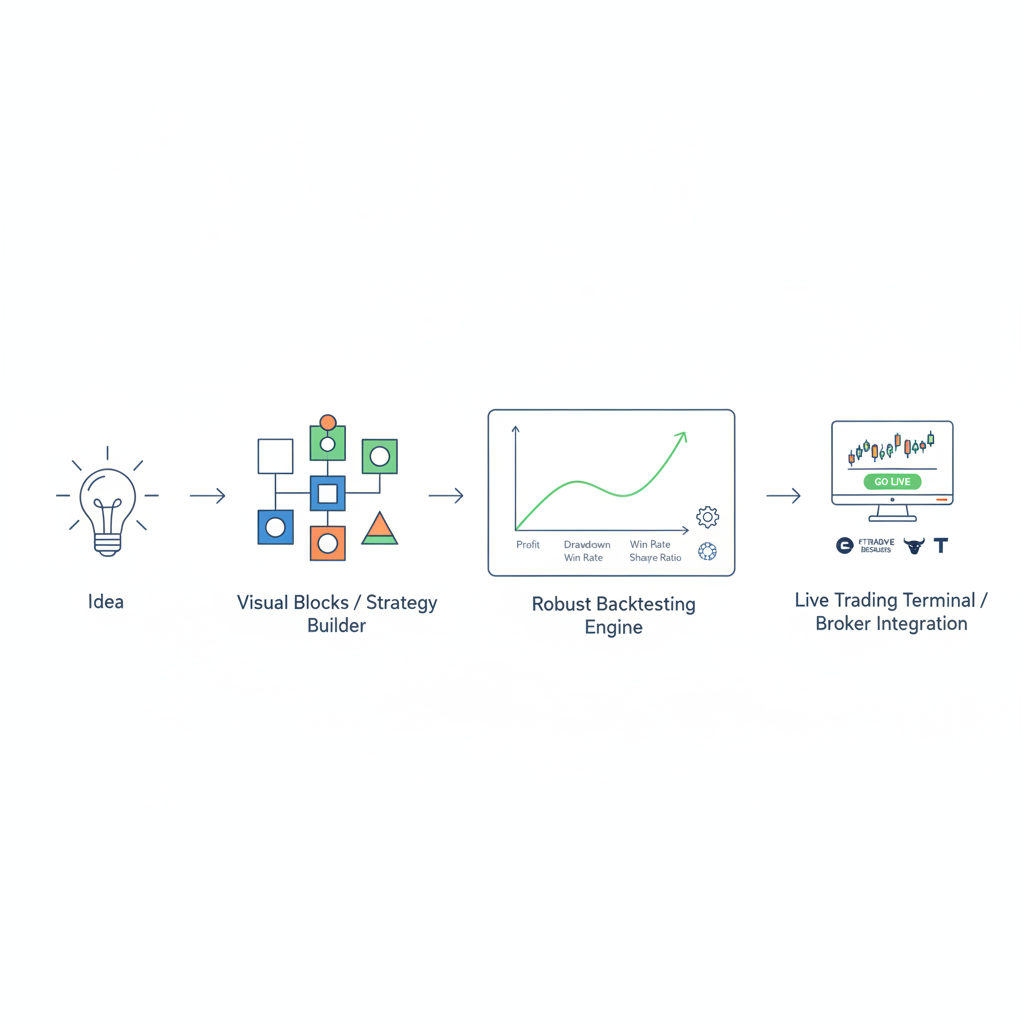
The traditional barrier to entry for algorithmic trading has always been coding proficiency. Traders with sharp market insights but lacking programming skills often found themselves unable to translate their systematic ideas into automated execution. However, the emergence of no-code AI platforms has dramatically lowered this hurdle, making sophisticated trading tools accessible to a broader audience. These platforms allow traders to design, automate, and fine-tune strategies using visual interfaces rather than complex code, effectively "democratizing what was once reserved for tech experts," as noted by Wundertrading.
This shift represents a significant evolution, enabling individuals to leverage powerful AI and automation without the steep learning curve associated with programming or financial modeling. The appeal lies in the ability to focus purely on trading logic and market analysis, rather than the syntax of a programming language. For instance, platforms like NinjaTrader’s Strategy Builder are explicitly "designed to be accessible to traders who want to explore automation without prior programming experience," utilizing a point-and-click workflow to define trading rules NinjaTrader Strategy Builder.
The proliferation of no-code platforms has opened algorithmic trading to a wider demographic, with visual tools replacing complex coding as the primary interface for strategy development.
The primary actionable takeaway here is that serious traders no longer need to learn Python or C++ to engage with systematic trading. They can now channel their strategic thinking directly into functional, automated algorithms, accelerating the ideation-to-deployment cycle and allowing for more rapid experimentation, much like scientists running "hundreds of experiments that fail for every one that succeeds" due to efficient tools Medium.
Core Features: Building Strategies Without Writing a Single Line of Code
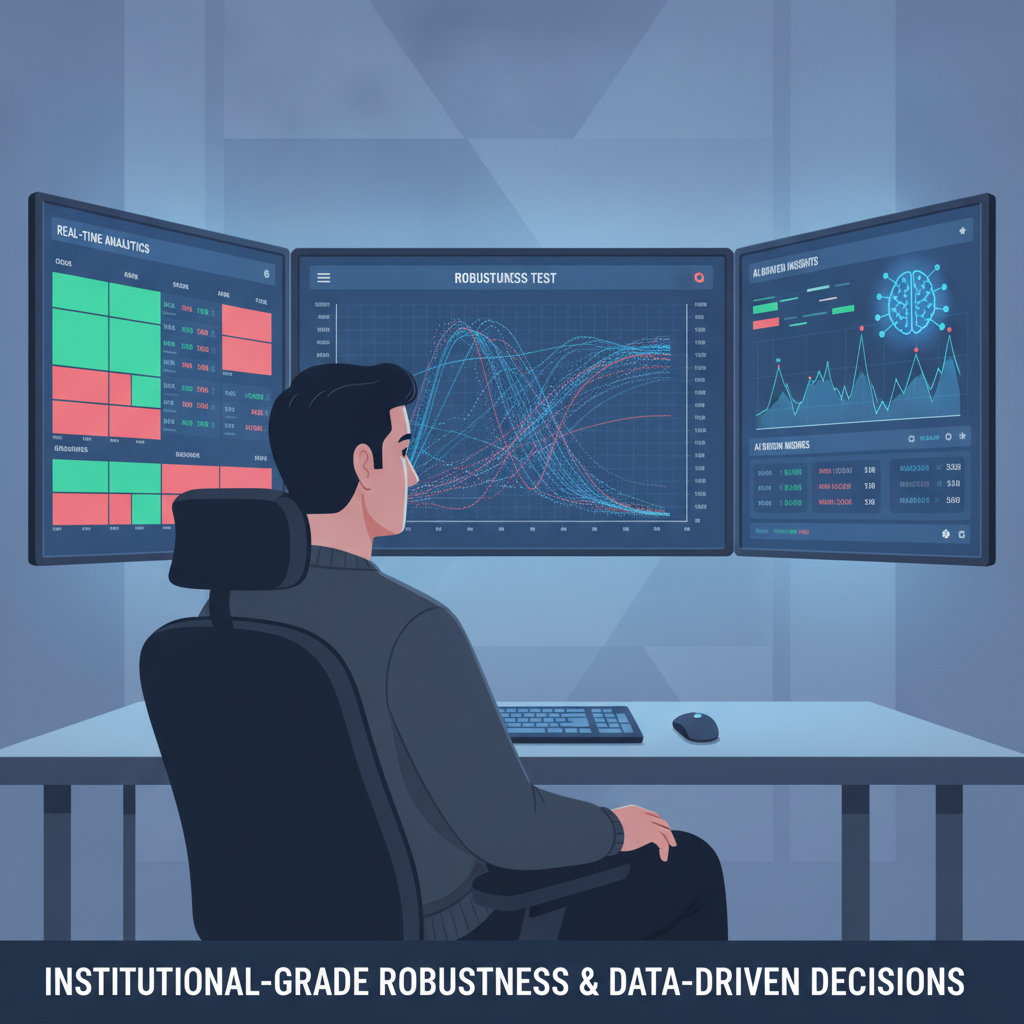
At the heart of every effective no-code trading strategy builder is a robust set of features designed to translate trading logic into executable algorithms. These features typically revolve around intuitive visual interfaces and rule-based systems.
Visual Strategy Builders and Rule-Based Logic
The most fundamental feature is the visual strategy builder, which often employs drag-and-drop elements or "if-then" rule builders. Instead of writing lines of code, traders interact with menus, visual blocks, or simple language prompts. For example, a rule might be constructed as: "If Bitcoin's RSI falls below 30, then purchase Bitcoin and set a 2% stop-loss below entry," as illustrated by Wundertrading. This approach makes complex logic accessible even to newcomers.
These builders allow for the definition of comprehensive entry and exit criteria using a variety of conditions:
Technical Indicators: Access to a wide library of indicators like moving averages, RSI, MACD, and Bollinger Bands, which can be combined in creative ways Medium.
Price Conditions: Specifying actions based on price levels, breakouts, support/resistance, or candlestick patterns.
Time Filters: Limiting trading activity to specific market sessions, days of the week, or times of day.
Multi-Condition Logic: Building sophisticated rules by combining multiple indicators and conditions with logical operators (AND, OR, NOT), often supporting nested conditions without coding NinjaTrader Strategy Builder.
Platforms like Tradetron offer pre-built modules for technical indicators, price action, and volume analysis, aiding in the translation of a trading concept like "Buy when a stock's 50-day moving average crosses above its 200-day moving average" into actionable logic Tradetron Blog.
Actionable Takeaway: Traders should prioritize platforms that offer a comprehensive library of indicators and robust multi-condition logic builders, allowing for flexible expression of diverse trading ideas without coding constraints.
Order and Risk Management Integration
Beyond defining entry and exit points, a crucial aspect of any robust trading strategy is effective order and risk management. No-code builders integrate these directly into the strategy design process:
Automated Order Entry: The ability to submit market or limit orders automatically based on defined conditions.
Trade Management Actions: Setting stop-loss and take-profit levels, trailing stops, and other position sizing limits directly within the strategy. These "professional-grade risk controls" are available without manual coding, helping to keep investments safer Wundertrading.
Alerts: Options for signal-only execution where the system triggers an alert, allowing the trader to manually place the trade, offering a spectrum of automation from hands-on to fully automated NinjaTrader YouTube.
Actionable Takeaway: Ensure the platform offers granular control over order types and integrates essential risk management features like stop-losses, take-profits, and position sizing directly into the strategy builder for disciplined execution.
Advanced Capabilities: Beyond Basic Strategy Construction
While basic visual builders are powerful, advanced no-code platforms extend functionality significantly, incorporating AI for strategy generation, institutional-grade backtesting, and sophisticated risk management at a portfolio level.
AI Strategy Generation from Prompts
A cutting-edge feature in many modern no-code builders is the ability to generate entire trading strategies from simple text prompts. Instead of meticulously building rules, traders can describe their desired strategy in natural language, and the AI module constructs the underlying logic. For example, a user might type "Create a Bitcoin breakout strategy with RSI filter and trailing stops," and the system generates the strategy instantly Wundertrading.
This speeds up strategy development dramatically, handling complex logic and allowing traders to explore a vast array of ideas with unprecedented efficiency. uTrade's AI Strategy Builder, for instance, "understands a trader’s inputs in simple language (whether Hindi or English) and empowers them to create sophisticated algo strategies that once only skilled coders could build" uTrade AI Strategy Builder.
Actionable Takeaway: To rapidly explore diverse trading concepts and accelerate development, seek platforms with advanced AI strategy generation capabilities that can translate natural language into robust algorithmic logic.
Institutional-Grade Backtesting and Robustness Testing
The true test of any trading strategy lies in its historical performance. No-code platforms integrate powerful backtesting engines that simulate strategies against historical market data. However, not all backtesting is created equal. Crucial features for robust backtesting include:
Detailed Performance Analytics: Beyond basic profit and loss, a good builder provides metrics like drawdown, win rate, profit factor, maximum consecutive losses, and average trade duration. These tell you "whether a strategy is genuinely robust or just got lucky during a favorable market period" Medium.
Realistic Assumptions: The backtest must account for real-world trading costs, including slippage, commissions, and execution constraints. It should use bid/ask data instead of mid-prices and simulate order fills conservatively. As one expert notes, "the backtest should be pessimistic, not optimistic. Better to be pleasantly surprised in live trading than disappointed" Medium.
Out-of-Sample Testing and Walk-Forward Analysis: To prevent overfitting—where a strategy performs perfectly on historical data but fails live—platforms should offer tools to test performance on unseen data. Walk-forward optimization, for example, helps identify robust parameter ranges that work across different market conditions Medium.
Monte Carlo Simulation: This statistical technique runs thousands of simulations with random variations to understand the range of possible outcomes and the probability of specific profit/loss scenarios, giving a more realistic expectation of future performance.
Heatmaps: Visualizing strategy performance across different parameter combinations and market conditions to identify sweet spots and potential vulnerabilities.
Multi-Asset and Multi-Timeframe Support: The ability to test strategies across various asset classes (stocks, crypto, forex, futures, options) and timeframes, which is crucial for identifying robust strategies that are not overfit to a single market or period Tradetron Blog.
Advanced platforms like Build Alpha go further with "institutional grade robustness testing and continuous strategy health monitoring," evaluating strategies against historical limits, regime behavior, and portfolio-level risk impact to identify fragile systems early. This moves beyond mere optimization to "portfolio governance" Build Alpha.
Actionable Takeaway: When evaluating no-code platforms, prioritize those with comprehensive, realistic backtesting features, including out-of-sample testing, Monte Carlo simulations, and detailed performance metrics to validate strategy robustness.
Dynamic Parameter Adjustment and Portfolio Generation
Some no-code builders allow for highly sophisticated strategies that adapt to changing market conditions. Parameters can "automatically adjust based on volatility, trend strength, or other market characteristics without requiring code modifications" Tradetron Blog. This dynamic adaptation is key to maintaining an edge in volatile markets.
For traders managing multiple strategies, advanced platforms offer portfolio generation tools. Build Alpha, for instance, "automatically generates optimal multi-strategy portfolios based on your specified risk profile, desired fitness function, and saved strategies," analyzing combinations and allocations across strategy types, asset classes, and timeframes Build Alpha.
Actionable Takeaway: Consider platforms that support dynamic parameter adjustment and multi-strategy portfolio optimization if your goal is to manage a complex, adaptive trading system.
Deployment and Monitoring: From Backtest to Live Market
Building a robust strategy is only half the battle; deploying it securely and monitoring its performance in real-time is equally critical.
Paper Trading and Live Deployment
Before deploying with real capital, traders typically use paper trading (simulated trading) to test strategies in live market conditions without financial risk. Once satisfied with paper trading results, strategies can be deployed for live trading. Many platforms offer "a smooth transition from testing to live trading with minimal discrepancies" Goat Funded Trader.
Real-time Monitoring and Adjustability
Once live, continuous monitoring is essential. Platforms provide comprehensive tools to track:
Real-time performance metrics
Open positions and pending orders
Risk exposure across all strategies
Detailed trade logs and execution reports Tradetron Blog
Crucially, strategies should be modifiable even after deployment. Platforms like Tradetron allow "real-time strategy modification and optimization," enabling users to adjust parameters, add new conditions, or modify risk controls without stopping execution. Changes can be tested in paper trading mode before applying to live strategies Tradetron Blog.
Actionable Takeaway: Prioritize platforms that offer seamless paper trading, robust real-time monitoring dashboards, and the flexibility to modify live strategies with immediate effect.
Security Protections
Security is paramount when integrating a trading platform with your broker. Most reputable no-code platforms "never hold your funds directly." Instead, they use API keys with encrypted, limited permissions that allow trading but not withdrawals. These permissions can often be further restricted to specific trading pairs, minimizing security risks and keeping capital safe Wundertrading.
Actionable Takeaway: Always verify that the platform employs robust security measures, including non-custodial API key integrations with configurable, limited permissions.
How Horizon Addresses This
Horizon (horizon.trade) is purpose-built for the serious trader who thinks systematically but lacks coding expertise, offering an institutional-grade AI trading platform that transforms ideas into automated, disciplined execution. Our platform directly addresses the features and pain points discussed by providing a comprehensive suite of no-code tools.
AI Strategy Generation: Horizon enables you to generate custom trading strategies using AI with no coding required. Simply input your trading idea, and our AI constructs sophisticated rule-based logic.
Institutional-Grade Backtesting: Go beyond simple P&L with Horizon's advanced backtesting engine. We provide detailed performance metrics like Sharpe ratio, max drawdown, and profit factor, alongside critical robustness tests such as out-of-sample backtesting, Monte Carlo simulation, and heatmaps. This ensures your strategy is genuinely robust and not merely overfit to historical data, addressing the need for pessimistic and realistic testing highlighted in our research.
Multi-Asset Support and Risk Management: Our platform supports stocks, forex, crypto, futures, and options, allowing for diverse strategy development. Integrated risk controls, including dynamic stop-losses and take-profits, are inherent in every strategy generated or built.
Automated Execution & Real-time Monitoring: Seamlessly connect your broker and deploy strategies for live trading with automated execution. Monitor performance with real-time analytics, ensuring you have constant oversight and the ability to dynamically adjust strategies as market conditions evolve.
Strategy Marketplace & Community: Explore a marketplace of community-built strategies to buy, copy, and customize, or sell access to your own strategies, fostering a transparent environment where real reputation and performance are paramount.
Horizon empowers traders to operate at the next level, offering the depth of a quant-driven solution without the programming prerequisite.
Conclusion
The evolution of no-code trading strategy builders marks a pivotal moment in algorithmic trading, bridging the gap between innovative trading ideas and automated execution for a wider audience. These platforms, powered by AI and sophisticated backtesting engines, are transforming how traders develop, validate, and deploy their strategies. By offering visual builders, AI-driven generation, robust backtesting with essential safeguards against overfitting, and comprehensive risk management, no-code solutions empower serious traders to operate with the discipline and rigor previously reserved for institutional players.
As financial markets continue to increase in complexity and speed, the ability to rapidly iterate, test, and deploy automated strategies without coding becomes not just an advantage, but a necessity. The future of systematic trading lies in democratized access to these powerful tools. Explore how Horizon can transform your trading edge into automated, disciplined execution and elevate your strategy development. Visit horizon.trade today to discover the power of AI-powered no-code algorithmic trading.