Published Jun 12, 2026
Trading AI: Systematic Strategies for the Modern Trader
The financial markets, once the exclusive domain of human intuition and lightning-fast floor traders, are increasingly shaped by algorithms and artificial intelligence. What started as simple programmatic execution has evolved into sophisticated AI-driven systems that generate, test, and deploy complex trading strategies. Today, algorithmic trading accounts for a significant portion of market activity, with some estimates suggesting it contributes to a large percentage of daily trading volume.
Key Takeaways
AI trading apps assist traders with market scanning, signal generation, and backtesting, but successful deployment often requires robust strategy development and execution automation, not just insights.
Retail traders can leverage AI to identify and capitalize on arbitrage opportunities too small for large institutions, mitigating the challenge of competing with high-frequency trading firms.
Effective AI integration involves using it as a research and development assistant to convert trading rules into executable code, rather than a black box that blindly trades, freeing mental bandwidth for strategy refinement.
Robust strategy validation demands comprehensive metrics beyond screenshots, including full trade logs, equity curves, maximum drawdown, and results that account for fees and slippage, over a large sample size.
AI excels at execution discipline and rapid iteration, significantly speeding up the process of encoding tested rules into production-ready automated strategies.
The Transformative Role of AI in Algorithmic Trading
Artificial Intelligence, encompassing machine learning models and large language models, has moved beyond conceptual discussions to become a foundational component of modern trading. AI stock trading platforms actively assist traders by scanning markets, generating signals, and backtesting strategies. The integration of AI tools marks a significant shift from traditional trading, promising increased efficiency and data-driven decision-making. For instance, platforms like Trade Ideas have, since 2003, offered AI-powered tools such as "Holly" and "Money Machine" which provide AI-generated trading signals and real-time strategies that adapt daily based on market conditions.
"AI stock trading refers to the use of artificial intelligence, including machine learning models and large language models like ChatGPT, Claude, and Gemini, to assist with or automate parts of the trading process." – StockBrokers.com
However, it's crucial to distinguish between an AI trading app and an AI trading bot. An AI trading app typically provides insights, alerts, and analytical tools, requiring the user to interpret and execute trades. In contrast, an AI trading bot or a fully automated platform can execute trades automatically through a connected broker API, embodying a complete shift from insight generation to automated action. This distinction is critical for serious traders looking to move beyond manual intervention.
The true value of AI in trading for non-institutional players often lies not in outperforming sophisticated high-frequency trading (HFT) firms on speed, but in identifying and exploiting market inefficiencies that are too small for larger firms to bother with. This allows for a unique arbitrage advantage for sophisticated retail traders, provided they have the tools to identify and act on these smaller opportunities systematically.
Practical Insight: To effectively leverage AI, traders should view it as an enhancement to their analytical capabilities and execution discipline, not a replacement for fundamental strategy development. Start by using AI to identify patterns and generate ideas that might be overlooked by human analysis, then meticulously validate these insights.
Generating and Validating Strategies with AI

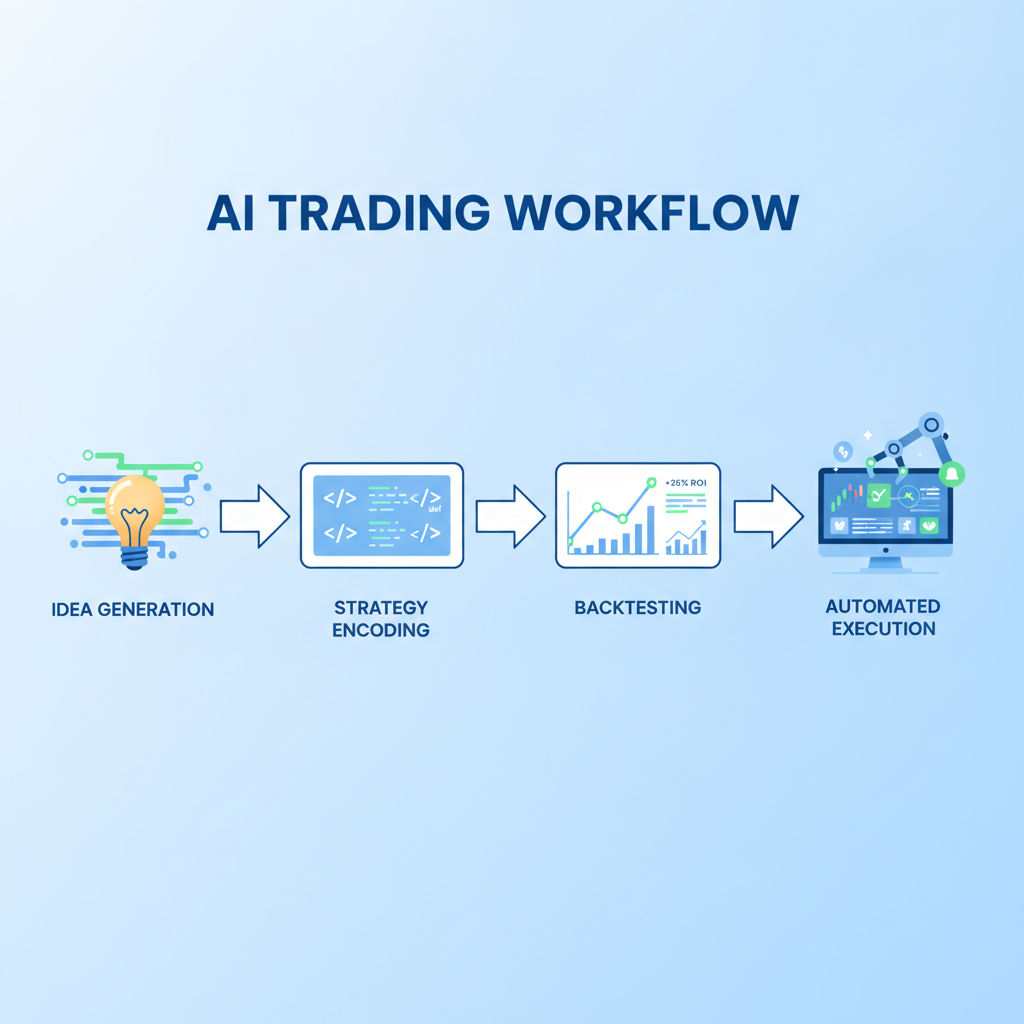
The promise of AI in trading often centers on its ability to generate novel strategies and backtest them against historical data. This capability democratizes systematic trading, allowing individuals without deep coding knowledge to develop complex algorithms. AI can help convert trading rules into execution code, making the process of algorithmic strategy development more accessible. As one Redditor noted, "AI is good for turning a rule into code. It is bad at inventing edge from thin air," highlighting that while AI can streamline the implementation of an idea, the core trading edge still often originates from human insight or market understanding.
AI-Powered Idea Generation and Filtering
AI tools excel at processing vast amounts of data, identifying trends, patterns, and anomalies that might indicate trading opportunities. This includes scanning news, analyzing sentiment across social media, and detecting "whale activity" or smart money trends. For example, some AI tools offer instant, in-depth analysis of candlestick charts, providing AI-generated buy/sell signals, technical analysis, and economic context. This reduces research time from hours to seconds, allowing traders to quickly identify high-probability strategies or specific event types like product changes or lawsuits that historically move stock prices.
However, the output from AI-driven signal generators or idea filters should be treated as starting points for further investigation, not direct trading instructions. Traders report using AI primarily for idea filtering and due diligence, sifting through market noise to surface promising candidates for deeper analysis. One user shared, "I use AI to help me sort through due diligence, that’s it," underscoring the role of AI as a powerful research assistant.
Actionable Takeaway: Utilize AI to generate a diverse range of trading ideas and quickly filter through market noise. Focus on how AI helps you discover *what to investigate*, rather than simply *what to trade*. For instance, instead of asking AI to "tell me what to buy," ask it to "identify stocks showing abnormal volume spikes coinciding with positive news sentiment over the last 24 hours."
Rigorous Backtesting and Optimization
Once a potential strategy is identified, robust backtesting is non-negotiable. This involves testing the strategy against historical market data to evaluate its hypothetical performance. A common pitfall for traders is relying on superficial backtesting results or short live runs. To genuinely validate a strategy, traders need comprehensive metrics including full trade logs (large sample size), profit factor, maximum drawdown, and an equity curve over time, all accounted for fees and slippage. Without this rigor, a seemingly profitable strategy in backtesting can quickly fail in live markets.
AI can significantly enhance the backtesting process by facilitating rapid iteration and optimization. Traders can use AI to modify strategy parameters, test different entry/exit conditions, and even combine indicators in novel ways. The goal is to build strategies that are not only profitable but also robust across various market conditions and resilient to unforeseen events. The ability to simulate thousands of scenarios with Monte Carlo simulations, for example, gives traders a much clearer picture of potential risks and rewards than a single backtest run.
Actionable Takeaway: When backtesting, always prioritize comprehensive metrics. Look for platforms that offer institutional-grade backtesting capabilities, including out-of-sample testing, Monte Carlo simulations, and detailed performance heatmaps, to ensure your strategy's robustness before considering live deployment. Avoid platforms that provide only high-level summary statistics without deep drill-down capabilities.
Automated Execution and Performance Monitoring
The ultimate goal for many systematic traders is automated execution, where strategies are deployed live and trades are placed automatically according to predefined rules. This eliminates emotional biases and ensures disciplined adherence to the strategy. AI plays a critical role here by handling the execution and position sizing, freeing up mental bandwidth for traders to focus on strategy development and refinement. "The value isn't higher returns, it's freeing up mental space to think about trades instead of babysitting 10 positions," noted a user on Reddit, highlighting the benefit of AI in execution discipline and automation.
From Strategy to Automated Live Trading
Connecting a broker and deploying a strategy for live trading with automated execution is a powerful capability. This allows traders to capitalize on opportunities identified by AI and validated through extensive backtesting, without needing to constantly monitor the market or manually enter orders. Platforms that offer seamless broker integration are essential for this step, enabling strategies to run 24/7 if needed, especially in markets like crypto or forex.
However, the transition from paper trading to live trading requires caution. Redditors frequently advise starting simple, paper trading with realistic slippage, logging everything, and only scaling after many real small-size live trades. This incremental approach helps to identify and mitigate real-world execution issues that might not appear in backtesting or paper trading environments.
Actionable Takeaway: When moving to automated execution, choose a platform that offers robust broker integrations and supports paper trading with realistic slippage. Start with small positions to observe real-world performance before scaling up. Continuously monitor your strategy's performance against its backtested metrics.
Real-Time Monitoring and Adaptation
Once live, AI can assist in real-time performance monitoring. This includes tracking key metrics, identifying deviations from expected performance, and even adapting strategy parameters based on evolving market conditions. Some sophisticated AI systems can provide real-time alerts on significant market events for thousands of companies, cutting research time and providing effortless trade ideas. For example, LevelFields claims to offer AI stock news monitoring for over 6,300 companies, delivering automated event alerts that mirror event-driven hedge fund strategies.
The ability of AI to manage and analyze large volumes of real-time data from diverse sources is a significant advantage. This can include anything from economic news and social media sentiment to specific technical indicators, all contributing to a more informed and adaptive trading approach. However, it's crucial that traders maintain human oversight. As one day trader put it, "Treat AI like a smart research assistant, not a money-printing machine," emphasizing that AI should augment, not replace, human judgment and a solid trading strategy.
Actionable Takeaway: Implement real-time monitoring tools to track your automated strategies. Look for platforms that provide detailed analytics, alerts for significant market shifts, and allow for swift manual intervention if a strategy deviates unexpectedly. Regularly review your strategy’s performance and be prepared to pause or adjust if market conditions fundamentally change.
How Horizon Addresses This
Horizon is engineered for the serious trader who thinks systematically but may lack coding expertise, bridging the gap between sophisticated ideas and automated execution. Our platform empowers you to generate custom trading strategies using AI, requiring no coding. This means your unique insights and ideas can be rapidly translated into executable algorithms.
We provide an institutional-grade backtesting engine that goes beyond basic simulations, offering detailed performance metrics like Sharpe ratio, out-of-sample backtesting, Monte Carlo simulations, and heatmaps to ascertain your strategy's true robustness. This addresses the critical need for rigorous validation, ensuring your strategies are truly robust against historical market data, not just superficially profitable.
Furthermore, Horizon allows you to connect your broker and deploy strategies for live trading with automated execution, providing the discipline and efficiency discussed throughout this article. You can also monitor strategy performance with real-time analytics, ensuring you maintain oversight and can adapt to market changes. For those looking to accelerate their journey, our marketplace of community-built strategies offers proven starting points that can be customized and deployed.
Conclusion
Artificial intelligence is not just a buzzword in trading; it is a fundamental shift towards systematic, data-driven decision-making and automated execution. For serious traders, AI offers unprecedented capabilities in generating, validating, and deploying strategies with a level of rigor and efficiency previously reserved for institutional players. The key lies in understanding AI as a powerful assistant for research, development, and disciplined execution, rather than a magic bullet for guaranteed profits. By leveraging AI to automate repetitive tasks, identify nuanced market opportunities, and rigorously backtest strategies, traders can free up mental capacity to focus on refining their edge and operating at a higher level of professionalism. Explore how sophisticated platforms like Horizon Trade can transform your trading ideas into automated, disciplined execution.