Published Jun 23, 2026
Trading Psychology: Your Mind, Your Edge
In an era where algorithmic platforms dominate market volume, executing trades with robotic precision, a counterintuitive truth persists: the human mind remains the ultimate battleground for trading success. While technology provides unprecedented analytical power and execution speed, expert traders consistently affirm that trading is not a battle with the market; it's a battle with yourself, with psychological factors often determining profitability more than any strategy.
Key Takeaways
- Trading psychology isn't abstract; it's the study of how emotions like fear, greed, and specific cognitive biases—such as confirmation bias or gambler's fallacy—directly influence trading decisions.
- Emotional decision-making accounts for a significant portion of trading errors, leading to common pitfalls like premature exits, overtrading, and revenge trading, even with a robust strategy.
- Behavioral finance, merging psychology and economics, reveals how human irrationality impacts financial choices, underscoring the necessity of emotional control and discipline for consistent profitability.
- Developing a resilient trader mindset involves recognizing "trader DNA," identifying and mitigating biases, and leveraging tools like trading journals and systematic approaches to maintain objectivity.
- Even with advanced algorithmic systems, the human element can override an otherwise perfect strategy through emotional intervention, making psychological mastery a critical edge for automated and manual traders alike.
The Invisible Hand: Defining Trading Psychology and Behavioral Finance
Trading is far more than charts, indicators, and market news; it is a profound exercise in human psychology. This discipline, known as trading psychology, delves into the mental and emotional states that dictate a trader's decisions and behaviors under the inherent uncertainty and risk of financial markets. It encompasses an individual's thoughts, behaviors, and inherent biases as they interact with dynamic market conditions, influencing everything from trade entry and exit to risk management and overall strategy adherence.
"Trading psychology refers to the mental and emotional aspects that influence how traders make decisions. It includes your thoughts, behaviors, and biases when you’re interacting with the market."
Dukascopy Bank SA
This field is not merely anecdotal; it is rigorously explored by behavioral finance, a branch of economics that integrates insights from psychology to explain observed anomalies in financial markets. Behavioral finance illuminates why individuals often deviate from rational economic behavior when making financial choices, highlighting the powerful, often subconscious, sway of human emotions and cognitive errors. For instance, the very act of risking capital can activate what some experts call the "ancient brain," triggering primal emotional responses that override logical thought processes, according to trading psychology coach Rande Howell (Rande Howell). This means that even with a meticulously crafted strategy, a trader’s emotional state can dictate their success or failure.
Understanding these underlying psychological mechanisms—what drives impulsive actions, early exits, or persistent losses—is the critical first step toward self-correction and disciplined execution. It's about recognizing that your biggest adversary in the market isn't the institution on the other side of the trade, but often your own mind.
The Trader's Mind: Navigating Fear, Greed, and Cognitive Biases

The financial markets are a crucible for human emotion, where the interplay of powerful feelings like fear and greed, alongside a spectrum of cognitive biases, can profoundly distort rational decision-making. These emotional and psychological drivers are often cited as primary contributors to suboptimal trading performance, far more so than a lack of technical analysis skills. Indeed, "many trading mistakes are psychological and not technical," as acknowledged by industry insights (Tradeciety.com).
Key emotions that frequently derail traders include:
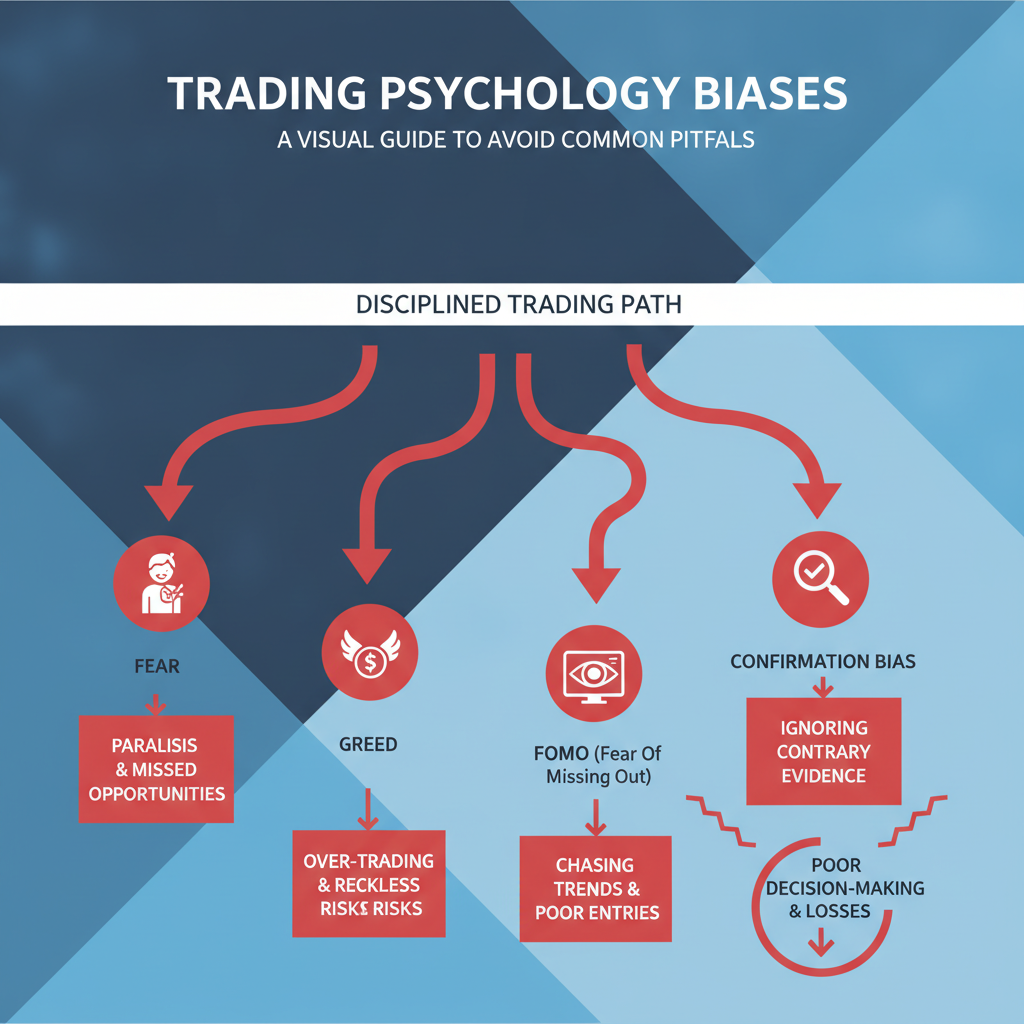
- Fear: Leading to premature exits from winning positions, paralysis, or avoiding profitable setups.
- Greed: Driving overleveraging, holding losing trades too long in hopes of a rebound, or deviating from profit targets.
- Impatience: Prompting overtrading or entering trades before confirming setups.
- Ego and Overconfidence: Causing traders to ignore stop losses, increase position size after a few wins, or dismiss contrary evidence (TradingTruth.in).
- Fear of Missing Out (FOMO): Pushing traders into chasing trending assets without proper analysis, often at elevated prices.
- Regret: Leading to "revenge trading" after a loss or avoiding subsequent valid setups (Saxo).
Beyond raw emotions, cognitive biases systematically distort our perception and judgment. Prominent examples include:
- Confirmation Bias: The tendency to seek out and interpret information that confirms one's existing beliefs, while ignoring contradictory evidence (Saxo). For a trader, this might mean focusing only on news that supports a long position, disregarding bearish indicators.
- Gambler's Fallacy: The mistaken belief that future probabilities are affected by past events, even in independent trials (Saxo). This can manifest as believing a struggling stock "must" rebound after a series of declines.
- Representative Bias: Expecting strong historical performance to continue indefinitely into the future, such as assuming a stock with strong past quarterly earnings will maintain that pace regardless of changing market conditions (Saxo).
- Status Quo Bias: A preference for keeping things as they are, even when new information or market shifts suggest a change in strategy is warranted (Saxo).
Recognizing and actively mitigating these emotional triggers and cognitive biases is paramount. It allows traders to shift from reactive, impulsive decision-making to a more objective, systematic approach, thereby safeguarding their capital and maintaining adherence to their trading plan.
The Unshakeable Edge: Why Psychological Discipline Outperforms Pure Strategy
While the allure of a "perfect" trading strategy drives many beginners, seasoned professionals universally agree that consistent profitability hinges less on market prediction and more on unshakeable psychological discipline. The market is indifferent to your feelings, but your feelings will undoubtedly distort how you interpret and interact with the market. As one major trading platform succinctly puts it, "no trading strategy works without discipline" (Dukascopy Bank SA).
Even the most technically sound analysis can be sabotaged by emotional interference. Consider a scenario where a trader identifies a high-probability setup with clear entry and exit points. However, the moment they risk real capital, fear of loss might prompt them to move their stop-loss, or greed might tempt them to abandon their profit target for a larger, unrealistic gain. Lightspeed's guide on trading psychology underscores this, stating, "Even the most sophisticated trading algorithm is useless if the human operator overrides it based on a gut feeling of fear or a sudden rush of greed" (Lightspeed). This highlights the critical reality that human intervention can compromise automated systems if not managed psychologically.
"Excellent trading psychology is what separates consistently profitable traders from those who burn out. It’s the ability to execute your plan, day in and day out, regardless of the market's attempts to throw you off balance."
Lightspeed
The importance of mental fortitude is not lost on institutional players. Proprietary trading firms and hedge funds increasingly acknowledge psychology as a core component of trader development, often bringing in "prominent performance psychologists to work with their traders to improve their psychological hurdles" (Bear Bull Traders). This professional endorsement underscores that psychological mastery is not a soft skill but a critical competitive advantage, allowing traders to execute plans consistently, manage risk effectively, and learn constructively from both wins and losses. Without it, even a statistically superior strategy will yield inconsistent and often disappointing results.
Developing mental resilience and strict adherence to a trading plan are, therefore, non-negotiable for anyone aspiring to long-term success in the markets. It’s the framework that enables a trader to navigate the inevitable volatility and setbacks without deviating from their systematic approach.
Building a Resilient Trader Mindset in a High-Stakes Environment
Cultivating strong trading psychology requires specific, actionable steps focused on self-awareness, systematic planning, and robust emotional control. It’s a continuous process of self-improvement that allows traders to align their mental state with their strategic objectives.
The journey begins with profound self-awareness. Every trader possesses a unique "trader DNA"—a combination of traits, beliefs, and psychological predispositions that shape their trading style (Britannica Money). Objectively evaluating oneself to identify and confront unproductive personality traits, such as impulsiveness or stubbornness, is essential. As Saxo Bank advises, the first step to strengthening trading psychology is to "Recognise your emotions and biases" (Saxo). This self-recognition is often achieved through rigorous self-reflection and candid assessment.
Once emotions and biases are identified, the focus shifts to disciplined execution and process improvement:
- Develop a Robust Trading Plan: A detailed plan outlining entry/exit rules, risk management, and position sizing removes subjective decision-making in the heat of the moment. Discipline, defined as creating and executing your plan consistently even when uncertain or impatient, is critical for "cleaner execution and fewer 'regret trades'" (Tradeciety.com).
- Utilize a Trading Journal: This is a powerful tool for tracking not just trade specifics, but also the emotional state, thoughts, and rationale behind each decision. Keeping a "trading journal can help you spot emotional patterns and make more informed, measured decisions over time" (Saxo). Reviewing this journal helps identify recurring psychological pitfalls and reinforce positive habits.
- Practice Emotional Control: Techniques such as mindfulness, deep breathing exercises, or simply stepping away from the screen after a significant event can help maintain objectivity. The goal is to stay calm and objective during fast market moves, mitigating the impact of fear, greed, or hesitation (Tradeciety.com).
- Focus on Risk Management: Adhering to strict risk parameters per trade helps control potential losses, reducing the emotional impact of individual losing trades and preventing devastating drawdowns.
- Learn from Experience (Objectively): Instead of dwelling on losses or being overly euphoric about wins, analyze each outcome dispassionately. This continuous learning cycle reinforces good behaviors and helps refine one's mental approach.
Active self-reflection, coupled with the implementation of structured routines and robust tools, is vital for overcoming the inherent psychological hurdles of trading. It transforms trading from a speculative venture into a professional, systematic endeavor.
How Horizon Addresses This
For serious traders who recognize the critical role of psychology but lack the tools to systematically manage it, Horizon offers an institutional-grade platform designed to minimize emotional interference and reinforce disciplined trading. Our AI-powered strategy generation fundamentally removes human biases from the initial design phase, allowing you to generate custom trading strategies using AI with objective, data-driven logic rather than gut feelings or impulsive ideas. This means your strategies are born from analytical rigor, not emotional influence.
Once a strategy is generated, Horizon's institutional-grade backtesting engine provides a crucial psychological safeguard. By allowing you to backtest strategies against historical market data with detailed performance metrics, out-of-sample backtesting, and Monte Carlo simulations, it builds profound confidence in a strategy’s robustness. This rigorous validation directly counters anxiety and fear, ensuring you understand if your strategy is truly resilient or merely a product of curve-fitting, thereby reducing the mental burden of uncertainty.
Furthermore, the ability to deploy strategies for live trading with automated execution directly addresses the most significant psychological pain points: fear and greed during trade execution. Trades are entered and exited precisely according to your predefined rules, eliminating the impulsive decisions to cut winners short or let losers run. This automated discipline ensures that your meticulously crafted strategy is executed without the interference of human emotion, making consistency a default, not a struggle.
Horizon also fosters a disciplined environment through its marketplace of community-built strategies, where transparent performance metrics are key. This encourages the adoption of robust, proven strategies and allows you to monitor strategies performance with real-time analytics, providing objective data that counters cognitive biases like confirmation bias or overconfidence. By integrating AI-driven strategy creation with automated, disciplined execution, Horizon empowers traders to operate at the next level, where their mental edge is preserved and enhanced by technology.
Conclusion
In the complex and often unforgiving world of financial trading, the ultimate differentiator is not merely access to advanced tools or proprietary strategies, but the mastery of one's own psychology. While technological advancements have democratized sophisticated analysis and automated execution, the human element remains a powerful, often unpredictable, variable. Understanding and actively managing emotions like fear, greed, and the pervasive influence of cognitive biases is not just an advantage—it is the foundational requirement for sustainable profitability.
As markets continue to evolve at an unprecedented pace, the ability to maintain discipline, adhere to a plan, and learn objectively will increasingly separate long-term winners from those caught in the emotional rollercoaster. For traders ready to harness the power of their mind and combine it with cutting-edge technology, the path to consistent, disciplined performance is clearer than ever. Explore how Horizon empowers serious traders to transform their psychological edge into automated, disciplined execution, enabling you to focus on strategy refinement while the platform handles the emotional discipline of trading.
Sources
- Trading Psychology - Forex Trader's Mindset | Dukascopy Bank SA
- Trading Psychology Hub
- Trading Psychology for Beginners : 7 deadly trading psychology mistakes - TradingTruth.in
- What is trading psychology and why does it matter? | Saxo
- Trading Psychology: How to Develop a Trader Mindset | Britannica Money
- Trading Psychology: A Complete Guide | Lightspeed
- [PDF] Mastering Trading Psychology - Bear Bull Traders
- Master Trading Psychology in UNDER 83 Minutes with Rande Howell