Published Jun 23, 2026
How to Automate Stock Trading with AI: A Complete Guide

Algorithmic trading now accounts for a staggering 60-73% of all US equity trading volume, a dramatic increase from just 20% in 2005. This surge isn't just about speed; it's increasingly driven by artificial intelligence, which is transforming how traders identify opportunities, manage risk, and execute strategies. The integration of AI moves automated trading beyond rigid rules, enabling systems to learn, adapt, and predict with unprecedented precision.
Key Takeaways
AI algorithms leverage advanced techniques like sentiment analysis, predictive modeling, and real-time data mining to identify nuanced market patterns that human traders often miss.
Automating stock trading with AI involves defining clear strategies, performing rigorous backtesting against historical data, and establishing secure, low-latency broker integrations.
AI significantly enhances risk management capabilities by running millions of market simulations and providing real-time alerts, offering a proactive approach to portfolio protection and optimization.
Implementing an AI trading system does not necessarily require deep coding knowledge, with modern platforms offering intuitive tools for strategy generation and deployment.
The Evolution of Automated Trading: From Algos to AI Intelligence
The landscape of stock trading has been profoundly shaped by automation, moving from simple rule-based algorithms to sophisticated AI-driven systems. Traditional algorithmic trading, which has dominated markets for decades, executes trades based on pre-set conditions like price, time, or volume. However, the advent of artificial intelligence, particularly machine learning, has pushed the boundaries of what automated systems can achieve.
AI enhances traditional algorithms by learning and adapting to market patterns, improving trade efficiency through different machine learning methods.
AI's role extends beyond mere execution speed, which is critical in high-frequency trading (HFT) where AI-powered systems can make split-second decisions Source: Investing.com. It imbues trading systems with the capacity to analyze vast, complex datasets, identify subtle correlations, and make predictions based on learned patterns rather than explicit programming. This shift fundamentally alters how traders approach strategy development, risk assessment, and market analysis, providing an adaptive edge in volatile markets. This intelligence is crucial for transforming raw data into actionable insights, moving from reactive responses to proactive strategic decisions.
Actionable Takeaway: Embrace AI's adaptive capabilities to move beyond static, rule-based trading into a dynamic system that continuously learns and refines its approach to market conditions.
Core AI Capabilities for Smarter Stock Trading Automation

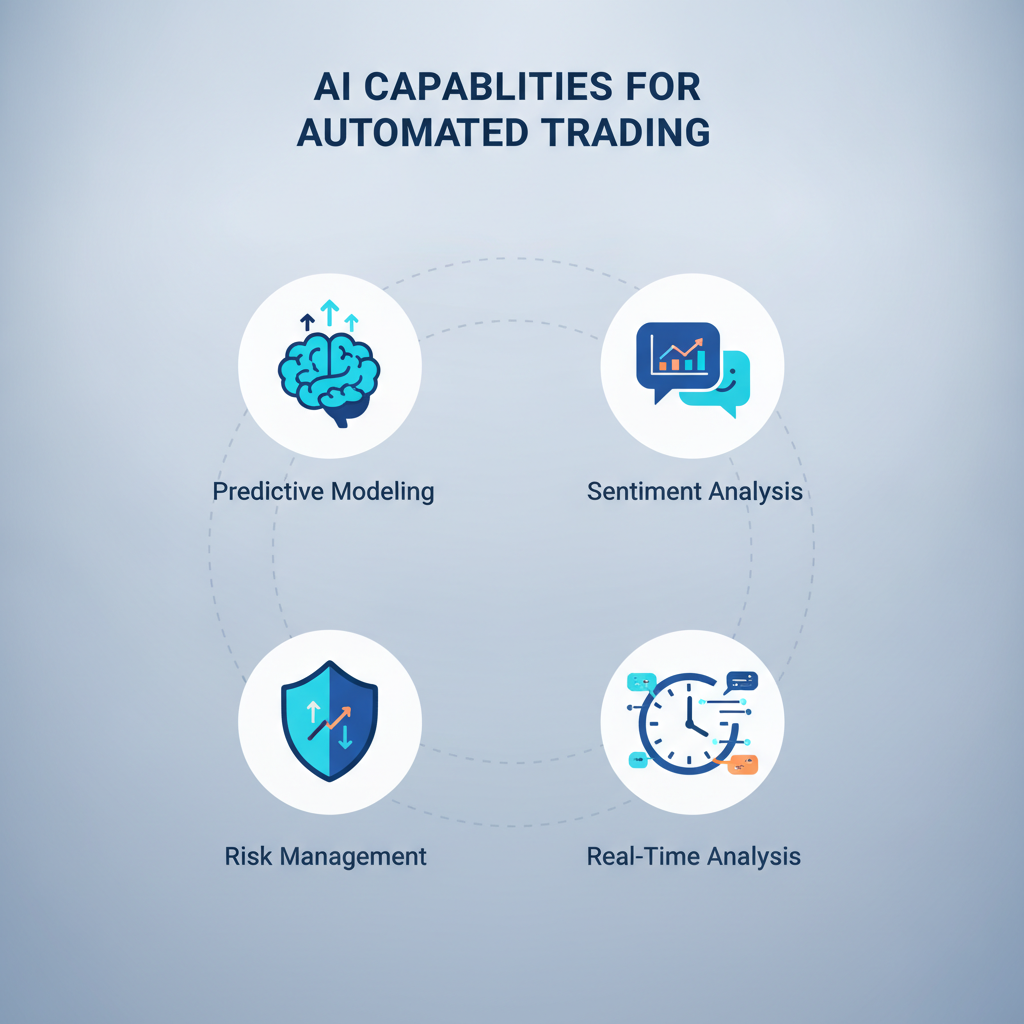
AI's utility in automated stock trading stems from its ability to process and interpret data on a scale and at a speed impossible for human traders. Several core AI capabilities form the backbone of these intelligent systems, each contributing to a more informed and efficient trading process.
Predictive Modeling and Data Mining
At its heart, AI in trading seeks to predict future market movements. Predictive modeling involves collecting past data and analyzing it to anticipate future trends. AI algorithms can process millions of historical transactions, identifying patterns and behaviors that may indicate future stock market movements Source: Built In. This goes hand-in-hand with data mining, which involves compiling and analyzing massive volumes of data to identify trends and patterns. By extracting insights from historical data, AI empowers traders to make smarter, data-driven decisions Source: Built In.
Sentiment Analysis for Market Foresight
Beyond numerical data, AI excels at interpreting qualitative information. Sentiment analysis is the process of gathering text and linguistic data from various online sources, using natural language processing (NLP) to identify emotional tones and patterns. An AI trading system can gather information from news outlets, social media, and community forums to determine market sentiment, gauge potential investor behavior, and predict market swings Source: Built In. This provides a crucial, often overlooked, layer of insight into market dynamics.
Real-Time Analysis for Timely Execution
In fast-paced markets, the speed of analysis directly impacts trading advantage. Real-time analysis refers to algorithms processing data as soon as it's produced to determine immediate market patterns and trends. AI trading tools have the capacity to analyze large amounts of data instantly and generate actionable insights, enabling investors to execute faster trades and gain a competitive edge Source: Built In.
Actionable Takeaway: Integrate AI capabilities like sentiment analysis and real-time processing to develop a multi-faceted view of the market, combining quantitative and qualitative data for more robust strategy signals.
Building Your AI-Powered Trading System: A Step-by-Step Approach
Automating stock trading with AI might sound complex, but a structured approach can demystify the process. While many advanced solutions simplify deployment, understanding the underlying steps is crucial for effective implementation and risk management.
1. Define Your Strategy and Rules
The first step in building an AI trading system is to clearly define your trading strategy. What is your edge? What market conditions trigger a buy or sell? While AI can learn and adapt, it performs best when given a clear framework. Focus on simple and precise rules, avoiding the temptation to stack too many indicators or conditions at the start to prevent over-optimization Source: monday.com. This "plan mode" involves articulating your trading hypothesis and the core logic behind it Source: SMB Capital.
2. Rigorous Backtesting and Optimization
Before any capital is deployed, your AI strategy must be thoroughly tested against historical market data. This backtesting phase is critical for validating the strategy's profitability and robustness. An institutional-grade backtesting engine should provide detailed performance metrics such as return, Sharpe ratio, and drawdown. Advanced testing includes out-of-sample backtesting, Monte Carlo simulations, and heatmaps to ascertain if the strategy's performance is truly robust or merely curve-fitted to past data Source: Horizon Trade. This step ensures that your strategy can withstand various market conditions and isn't just a fleeting success.
3. Secure Broker Integration and Execution
Once a strategy is validated, it needs a reliable and secure connection to a brokerage account for live trading. This account serves as the system's foundation, prioritizing security for both capital and confidence Source: monday.com. Permissions for your AI bot should be minimal and deliberate, only allowing actions you explicitly authorize to keep automation helpful rather than risky Source: monday.com. This setup facilitates automated execution, allowing the AI to act on market signals without human intervention, ensuring consistent application of the strategy.
Actionable Takeaway: Prioritize rigorous backtesting with diverse market scenarios to stress-test your AI strategy's viability before connecting to a live broker. Start with simple rules and iteratively refine them based on performance metrics.
Mitigating Risk and Optimizing Portfolios with AI
One of the most significant advantages of integrating AI into stock trading automation is its superior capability in risk management and portfolio optimization. Human traders are prone to emotional biases, often leading to inconsistent decisions, especially during market volatility. AI systems, conversely, operate based purely on data and predefined parameters, maintaining logical and consistent trading behavior Source: Built In.
Advanced Risk Modeling and Simulation
AI tools can automate the process of collecting data and building predictive models based on historical data to weigh the likelihood of various outcomes Source: Built In. More critically, AI helps manage risk by running millions of simulations of different market scenarios to assess potential outcomes for portfolios Source: Investing.com. These simulations provide sophisticated risk analysis, allowing traders to understand how their portfolio might perform under various market conditions, far beyond what manual analysis can achieve. AI can also provide real-time alerts when certain risk thresholds are breached, enabling immediate strategy adjustments Source: Investing.com.
Dynamic Portfolio Optimization and Rebalancing
AI excels at continuously analyzing portfolio performance and adjusting asset allocations to balance risk and reward. By utilizing models like Modern Portfolio Theory (MPT), AI suggests portfolio mixes that offer the best possible returns for a given level of risk Source: Investing.com. This isn't a one-time calculation but an ongoing process, as AI can monitor markets 24/7, rebalancing portfolios as conditions change to maintain optimal risk-adjusted returns Source: monday.com. This automated rebalancing ensures portfolios remain aligned with strategic objectives without constant manual oversight.
Actionable Takeaway: Leverage AI's simulation capabilities to proactively stress-test your portfolio against diverse market scenarios, and utilize its optimization features to dynamically adjust asset allocations for superior risk-adjusted returns.
How Horizon Addresses This
For serious traders who recognize the power of systematic trading but lack the coding expertise, Horizon offers an institutional-grade AI platform that bridges this gap. While building a custom AI bot from scratch can be a complex endeavor, requiring significant programming skills and infrastructure Source: plainenglish.io, Horizon simplifies the entire process. Our platform transforms your trading ideas—whether proven or in progress—into automated, disciplined execution without any coding required.
Horizon's AI strategy generation allows you to articulate your market edge in plain language, instantly creating sophisticated algorithms. Our institutional-grade backtesting engine provides detailed performance metrics, out-of-sample testing, and Monte Carlo simulations to rigorously validate your strategy's robustness. Once confident, you can seamlessly connect your broker and deploy strategies for live, automated execution. For those seeking inspiration or a head start, our marketplace offers community-built strategies that can be customized and monitored with real-time analytics. This empowers you to operate at the next level, focusing on strategy development rather than technical implementation. Explore how Horizon can transform your trading at horizon.trade.
Conclusion
The journey to automate stock trading with AI is a strategic imperative for modern traders. By leveraging AI's unique capabilities—from sentiment analysis and predictive modeling to advanced risk management and portfolio optimization—traders can achieve a level of precision, speed, and consistency that manual trading simply cannot match. The key lies in a systematic approach: defining clear strategies, rigorously validating them through comprehensive backtesting, and deploying them securely with trusted platforms. As AI technology continues to evolve, its integration will only deepen, offering new frontiers for capturing alpha and managing market exposure. Embrace these advancements to elevate your trading game and navigate the markets with intelligence and discipline. Discover more insights on algorithmic trading and AI on our blog.