
AI can help turn a market idea into trading rules. It cannot remove uncertainty, guarantee a return, or make a strategy safe by itself. Before connecting any strategy to a broker, traders should understand the rules, test the assumptions, and decide the risk limits they are willing to accept.
## Quick answer
A responsible AI trading workflow is: define the idea, translate it into clear rules, test it against historical data, include costs and realistic assumptions, evaluate drawdown and robustness, paper trade, and only then consider automation with user-approved guardrails. Historical or simulated results do not guarantee future performance.
## 1. Turn the idea into rules you can inspect
“Buy quality stocks when they are oversold” is an idea, not yet a strategy. A testable strategy defines the asset, timeframe, entry condition, exit condition, position size, and what happens when conditions change. Plain-English AI tools can make this step faster, but the trader remains responsible for checking that the generated logic matches the intended rule.
Questions to answer:
- What exactly causes an entry and an exit?
- Which assets and timeframes are in scope?
- How much capital can one position use?
- When does the strategy stop trading?
- What assumptions are being made about price, liquidity, and execution?
## 2. Test more than return
A high historical return alone is not evidence that a strategy is reliable. Review the path as well as the endpoint: maximum drawdown, win rate, profit factor, Sharpe ratio, trade count, equity curve, and the periods when the strategy struggled. Compare those results with a relevant benchmark and ask whether a small number of trades or one market regime drove the outcome.
## 3. Use realistic assumptions
Backtests can be misleading when they ignore trading costs. Include commissions, fees, slippage, and spread assumptions where available. Be cautious with very short test windows, highly illiquid instruments, or rules that depend on information that would not have been known at the time of a trade.
## 4. Stress-test the strategy
A strategy should be tested across more than one market condition. Review performance during calm and volatile periods, different trend regimes, and reasonable variations of the parameters. Monte Carlo analysis and regime stress testing can help reveal how sensitive the result is to trade ordering and market conditions. They do not prove that the strategy will work in the future; they help identify fragility before capital is at risk.
## 5. Paper trade before automation
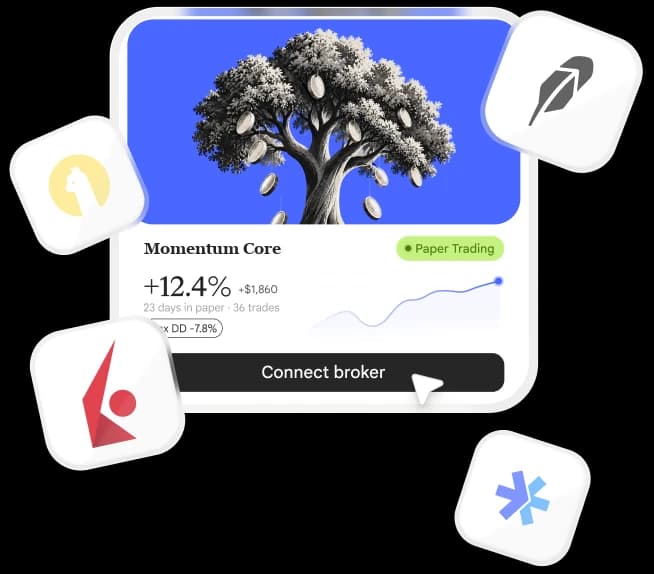
Paper trading is a practical bridge between historical testing and live execution. It lets you verify that signals, order logic, broker connectivity, and risk limits behave as expected without putting capital at risk. Treat unexpected behavior as a reason to return to the rules and testing stage.
## 6. Keep the trader in control
Automation should have explicit guardrails: position limits, maximum losses, approved assets, execution windows, and a clear way to pause or turn off the strategy. Horizon is designed so a user's broker holds the funds; Horizon does not have withdrawal access. Review every strategy and its risk rules before it goes live.
## A risk-first checklist
Before automating a strategy, confirm that you can explain the rules, identify the assumptions, review the full test period, account for costs, understand the worst historical drawdown, paper trade successfully, and set your own guardrails.
Horizon provides software and data tools, not investment advice. Trading involves substantial risk, and past or simulated performance does not guarantee future results.
Share this post: