Published Jun 20, 2026
Horizon vs. LuxAlgo: A Deep Dive into Algorithmic Trading Platforms

The landscape of algorithmic trading is undergoing a rapid evolution, with an increasing number of market participants leveraging automated strategies. In fact, algorithmic trading now accounts for a staggering 60-73% of US equity volume, a dramatic increase from just 20% in 2005, underscoring its pivotal role in modern markets Source. Amidst this shift, traders are often presented with a spectrum of tools, from sophisticated indicator suites to comprehensive execution platforms. Understanding the fundamental differences between these tools is paramount for transforming a trading edge into disciplined, automated performance.
Key Takeaways
- LuxAlgo primarily functions as an advanced indicator suite within the TradingView ecosystem, focusing on signal generation and technical analysis for over 500,000 users Source.
- A significant limitation of many indicator-based platforms, including LuxAlgo, is the phenomenon of "repainting," where historical signals alter, invalidating backtest results and leading to false entries in live trading Source.
- In contrast, Horizon provides an end-to-end algorithmic trading platform with institutional-grade backtesting, ensuring strategies are validated against historical data with robust metrics like out-of-sample testing, Monte Carlo simulations, and heatmaps.
- Horizon offers AI-powered strategy generation, allowing traders to build complex algorithmic strategies without coding, a significant advantage over manually combining indicators.
- Unlike indicator suites, Horizon seamlessly integrates with brokers for automated, disciplined execution of strategies in live markets, bridging the gap from insight to action.
Understanding the Core Distinction: Horizon vs. LuxAlgo
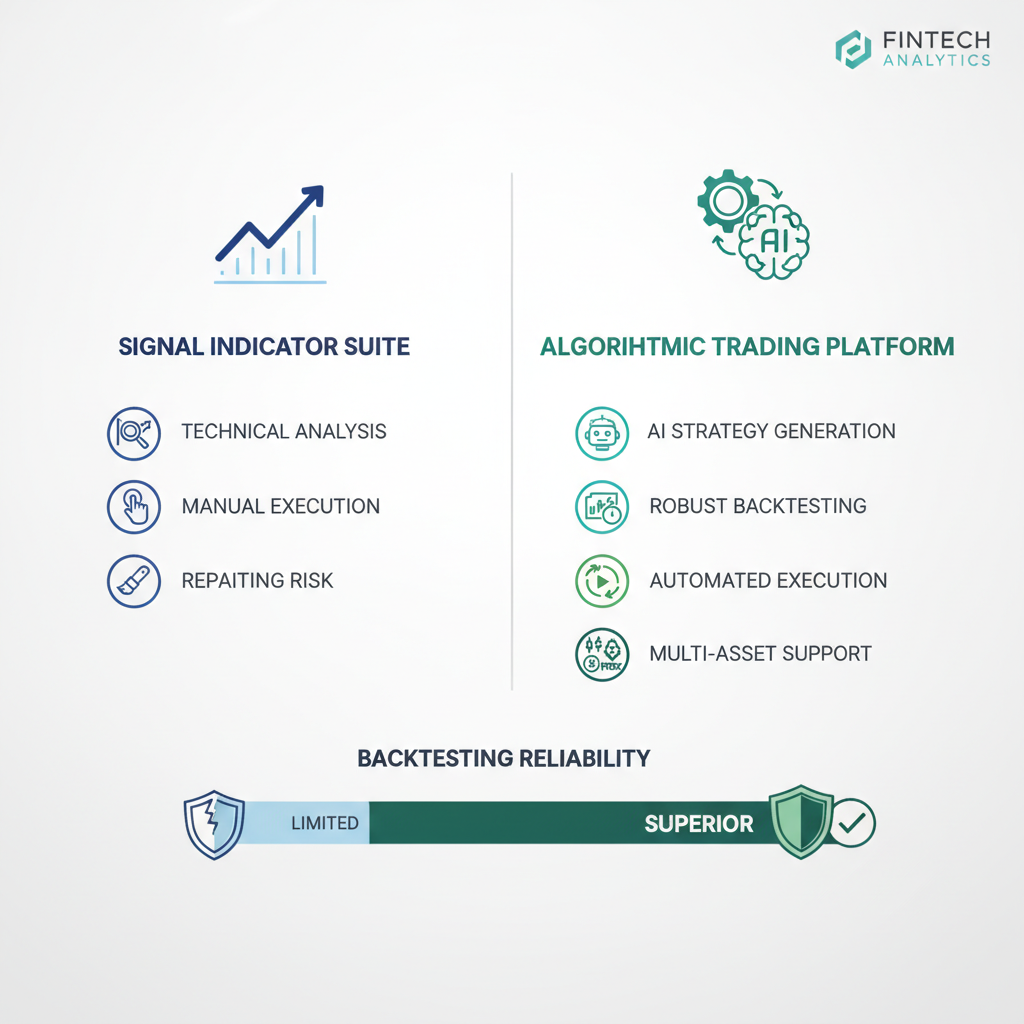
At its heart, the primary difference between Horizon and LuxAlgo lies in their fundamental approach to trading. LuxAlgo operates as a highly popular indicator suite integrated within the TradingView ecosystem, which boasts over 60 million monthly active users Source. This integration has allowed LuxAlgo to attract a massive user base of more than 500,000 traders seeking enhanced technical analysis tools and premium signal overlays. Its strength lies in providing a vast library of indicators—377 tools as of 2026—designed to assist traders in identifying potential market opportunities Source.
However, this focus positions LuxAlgo as a tool that augments manual or semi-automated trading decisions. It's built for those who prefer to analyze charts, interpret signals, and then execute trades, either manually or through other interfaces. The value proposition of LuxAlgo is primarily in "time savings, workflow coherence, and community support" for traders who spend significant time on charts Source. It caters to a methodical approach to identifying trading plans but does not inherently provide automated execution capabilities.
Conversely, Horizon is engineered as a comprehensive, AI-powered algorithmic trading platform. Its architecture supports the entire lifecycle of an algorithmic strategy: from conception and generation using AI (without coding) to rigorous backtesting, deployment with automated execution via broker integrations, and real-time performance monitoring. The distinction in the Horizon vs. LuxAlgo comparison is stark: one provides advanced signals for analysis, the other provides a complete framework for automated trading.
"LuxAlgo provides a robust environment for those who prefer to analyze, test, and build strategies methodically, rather than chasing fleeting intraday opportunities." — Lunefi Blog
The practical insight here is that while LuxAlgo is excellent for enhancing technical analysis within TradingView, it requires traders to bridge the gap between signal generation and actual, disciplined execution. Horizon, on the other hand, is built precisely to close this gap, transforming conceptual edges into automated trading systems.
The Critical Difference in Backtesting Reliability: Addressing Repainting in Horizon vs. LuxAlgo
One of the most critical aspects of developing any systematic trading strategy is the ability to conduct reliable backtesting. Backtesting allows traders to assess the historical performance of a strategy, giving them confidence in its potential future efficacy. However, a pervasive issue that undermines the integrity of backtesting, particularly prevalent in many indicator-based platforms, is "repainting."
Repainting occurs when an indicator's historical signals change on past candles as new market data becomes available. This creates an illusion of high accuracy in historical charts, showing buy or sell signals that would not have been present in real-time. For instance, reports indicate that LuxAlgo "repaints signals in real-time, altering past candles for accuracy up to 72% but causing false entries on live charts" Source. This means that while a backtest using repainting indicators might appear profitable, live trading with those same signals can lead to significantly worse outcomes, or "18% max drawdown due to repaints" in hypothetical backtests on a 1-year dataset Source.
The impact of repainting is profound: it renders historical backtests misleading, making it impossible to truly validate a strategy's edge. A Reddit trader explicitly stated, "No indicator prints money; LuxAlgo repaints, free alts like LazyBear Impulse MACD + price action yield better results (60/40 win rate vs 50/50 with LuxAlgo)" Source. This feedback highlights a core challenge for traders relying on such indicators for systematic decision-making.
This is where platforms like Horizon distinguish themselves. Horizon provides an institutional-grade backtesting engine specifically designed to ensure robustness and eliminate such ambiguities. Its capabilities include:
- Out-of-Sample Backtesting: Testing a strategy on data it has never seen before, critical for preventing overfitting.
- Monte Carlo Simulation: Assessing strategy performance under various market scenarios and parameters to gauge resilience.
- Heatmaps: Visualizing strategy performance across different parameter combinations to identify optimal settings.
- Detailed Performance Metrics: Beyond simple returns, including Sharpe ratio, max drawdown, and other sophisticated risk-adjusted metrics.
The absence of repainting is a foundational principle for any platform claiming to offer robust backtesting. The difference in the Horizon vs. LuxAlgo backtesting approach is not merely a feature disparity; it's a fundamental divergence in reliability and validity. Traders serious about systematic performance must prioritize platforms that offer verifiable, non-repainting backtesting, ensuring that historical performance truly reflects what could have been achieved in real-time.
The actionable takeaway is to "Test indicators on out-of-sample data. Forward-test live for at least 100 trades to spot repainting before risking capital" Source. Horizon's comprehensive backtesting suite is built to address this need pre-emptively, providing confidence before live deployment.
From Signals to Automated Execution: The Operational Gap Between Horizon and LuxAlgo
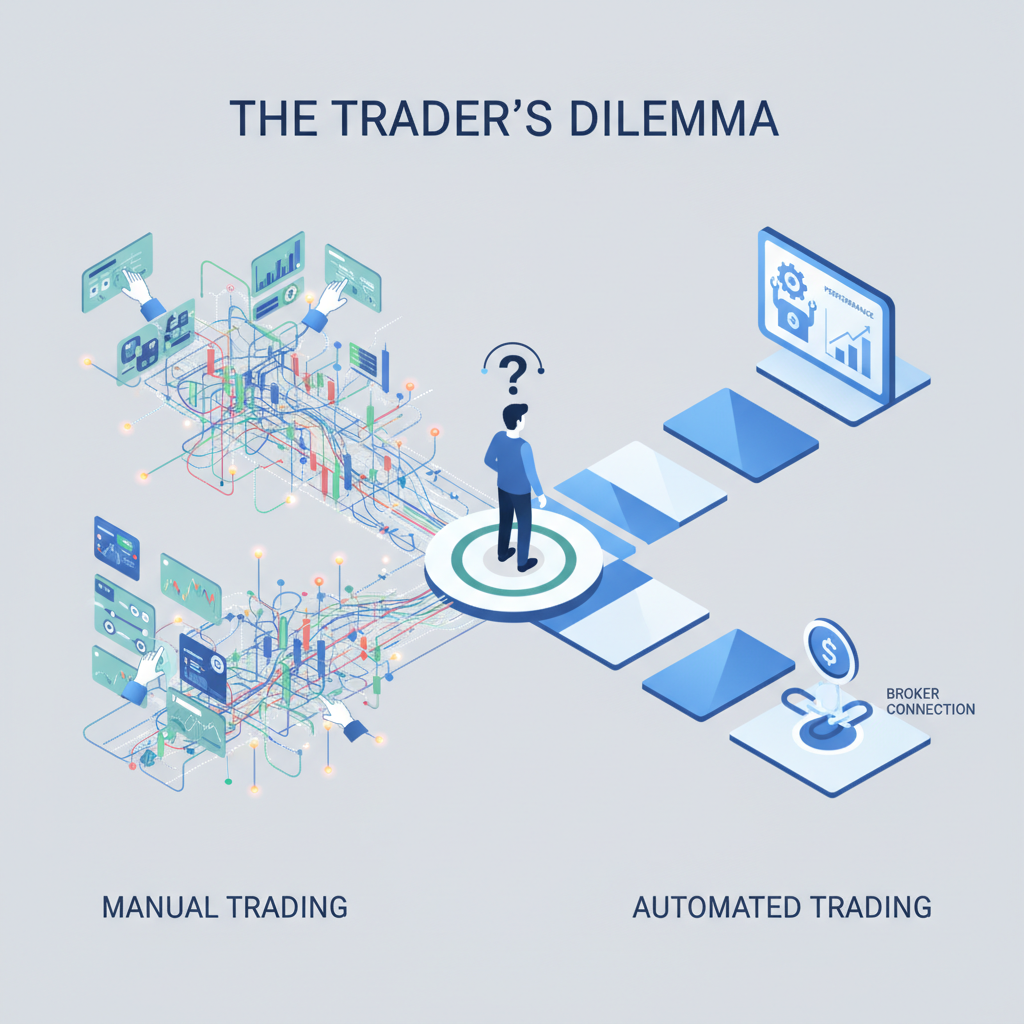
The journey from identifying a potential trading opportunity to executing a trade can be fraught with human error, emotional bias, and latency. LuxAlgo, while powerful for generating signals through its indicator library, does not provide an integrated platform for automated trade execution. Traders using LuxAlgo typically rely on its signals to inform their manual trading decisions or connect to third-party services to automate trades based on TradingView alerts. While LuxAlgo "can generate signals, its strength isn't necessarily in providing the split-second alerts that a pure day trader might need" Source, emphasizing its role as an analytical tool rather than an execution engine.
In contrast, Horizon bridges this operational gap seamlessly. After a strategy is generated and rigorously backtested, traders can connect their broker accounts directly to Horizon. This enables the automated deployment and execution of strategies, eliminating the need for constant manual intervention. This automation extends beyond simple buy/sell orders; it encompasses sophisticated order types, risk management parameters, and position sizing rules predefined within the strategy.
The advantages of automated execution are significant:
- Discipline: Strategies are executed without emotional interference.
- Speed: Trades are placed instantaneously, capitalizing on fleeting market opportunities.
- Consistency: Ensures every trade adheres strictly to the predefined strategy rules.
- Scalability: Allows traders to manage multiple strategies across various assets simultaneously.
For a professional trader, the ability to transition from strategy development to automated, disciplined execution is a game-changer. It shifts the focus from constant market monitoring to strategy optimization and portfolio management. The choice in the Horizon vs. LuxAlgo debate becomes clear for those prioritizing hands-off, systematic trading. LuxAlgo assists in finding the "what," but Horizon takes care of the "how" and "when" for fully automated operations, enabling traders to truly "operate at the next level."
A practical takeaway is that relying solely on an indicator suite for signals necessitates a robust, external execution mechanism. Horizon integrates this capability, providing a complete solution where a strategy, once validated, can be deployed with confidence for automated trading across multi-asset classes including stocks, forex, crypto, futures, and options.
Beyond Indicators: Comprehensive Strategy Development with Horizon
LuxAlgo excels in offering a vast and diverse collection of technical indicators, with 377 tools available in 2026 Source. This allows traders to combine various overlays and signals to form a discretionary or semi-systematic approach to market analysis. Its strength lies in providing visual cues and quantitative data points directly on TradingView charts, aiding in pattern recognition and trend identification.
However, developing a truly robust algorithmic strategy often requires more than combining a few indicators. It involves complex logic, dynamic parameter adjustments, sophisticated risk management, and the ability to adapt to changing market conditions. This is where Horizon's AI-powered strategy generation comes into play. Horizon enables traders to:
- Generate Custom Trading Strategies with AI: Traders can articulate their ideas or hypotheses, and the AI assists in translating these into executable algorithms without requiring any coding knowledge. This democratizes sophisticated strategy development, moving beyond pre-defined indicator sets.
- Explore Robustness: Through features like Monte Carlo simulations and out-of-sample backtesting, traders can assess if their strategy is genuinely robust or merely curve-fit to historical data, a critical step often overlooked or difficult to perform with basic indicator backtesting.
- Multi-Asset Agnostic Development: Horizon's platform is designed for multi-asset support, meaning strategies can be developed and applied across stocks, forex, crypto, futures, and options, leveraging a unified logic framework rather than separate indicator applications for each asset class.
The distinction in Horizon vs. LuxAlgo in terms of strategy development is that LuxAlgo offers a toolkit for visual and signal-based analysis, while Horizon offers a factory for creating, validating, and deploying systematic trading logic. This allows "serious traders who think systematically but cannot code" to transform "any ideas — proven or in progress — into automated, disciplined execution" Horizon Trade.
The actionable insight for traders is to consider whether their current tools truly enable the systematic development and rigorous validation of their trading edge. Relying solely on indicators, even advanced ones, may leave crucial gaps in understanding strategy robustness and real-world performance potential. Horizon offers a path to bridge these gaps, fostering a more scientific and disciplined approach to trading.
How Horizon Addresses This
The comparative analysis between indicator-driven platforms like LuxAlgo and comprehensive algorithmic trading platforms like Horizon highlights a clear choice for serious traders. While LuxAlgo excels in providing advanced technical indicators and signals within TradingView, its limitations regarding repainting signals and the absence of integrated automated execution pose significant challenges for those seeking truly systematic and disciplined trading. Horizon directly addresses these pain points by offering an institutional-grade, end-to-end solution.
Horizon’s AI-powered strategy generation allows traders to develop sophisticated algorithms without writing a single line of code, transforming conceptual trading edges into actionable systems. Crucially, its robust backtesting engine provides the necessary tools—including out-of-sample testing, Monte Carlo simulations, and heatmaps—to validate strategies against real historical data, ensuring reliability and eliminating the pitfalls of repainting indicators. Once validated, Horizon enables seamless, automated execution of these strategies via direct broker integrations, supported by real-time performance monitoring. For traders ready to move beyond reactive signal interpretation to proactive, automated, and rigorously tested strategies, Horizon offers the infrastructure to operate at the next level.
Conclusion
The evolution of financial markets demands tools that not only provide insights but also enable disciplined, automated execution. While indicator suites like LuxAlgo serve a valuable purpose in enhancing technical analysis for many traders, they fundamentally differ from comprehensive algorithmic trading platforms. The distinction between providing signals and enabling automated, robust strategy deployment is critical for systematic traders. Horizon is engineered to empower these traders, offering an institutional-grade platform for AI-driven strategy generation, rigorous backtesting, and automated execution across multi-asset classes.
For traders who prioritize a validated edge, disciplined execution, and the ability to scale their operations, exploring solutions that provide a full lifecycle of algorithmic trading is paramount. We invite you to explore how Horizon can transform your trading ideas into automated, systematically managed strategies. Visit Horizon Trade to learn more about our AI-powered platform and begin building your robust trading future. You can also delve deeper into various algorithmic trading topics on our blog.
Sources
- Buyupside.com - Algorithmic Trading Statistics
- TradeAlgo - TradeAlgo vs LuxAlgo: Algorithmic Trading Platforms Compared (2026)
- MEXC News - LuxAlgo vs. Free TradingView Indicators — Is the $40/Month Subscription Actually Worth It?
- Reddit - Lux Algo 1 month review : r/TradingView
- Lunefi Blog - LuxAlgo Review: Is This Trading Indicator Worth Your Investment
- Lunefi Blog - Best LuxAlgo Alternatives 2026: Top TradingView Indicators