
Accelevation raised $540 million in its IPO.
But most of that money did not go to the company.
The offering sold 30 million shares at $18 each. Accelevation itself sold only 10 million of them, raising $180 million.
Existing shareholders sold the other 20 million shares.
That means 66.7% of the IPO was secondary stock, with roughly $360 million of the offering going to existing shareholders rather than into the company.
That looked unusually high.
So we compared it with the largest U.S. technology IPOs since 2020.
Second only to Playtika
We took the 20 largest U.S. technology IPOs by base proceeds since 2020 and calculated how much of each offering consisted of shares sold by existing shareholders.
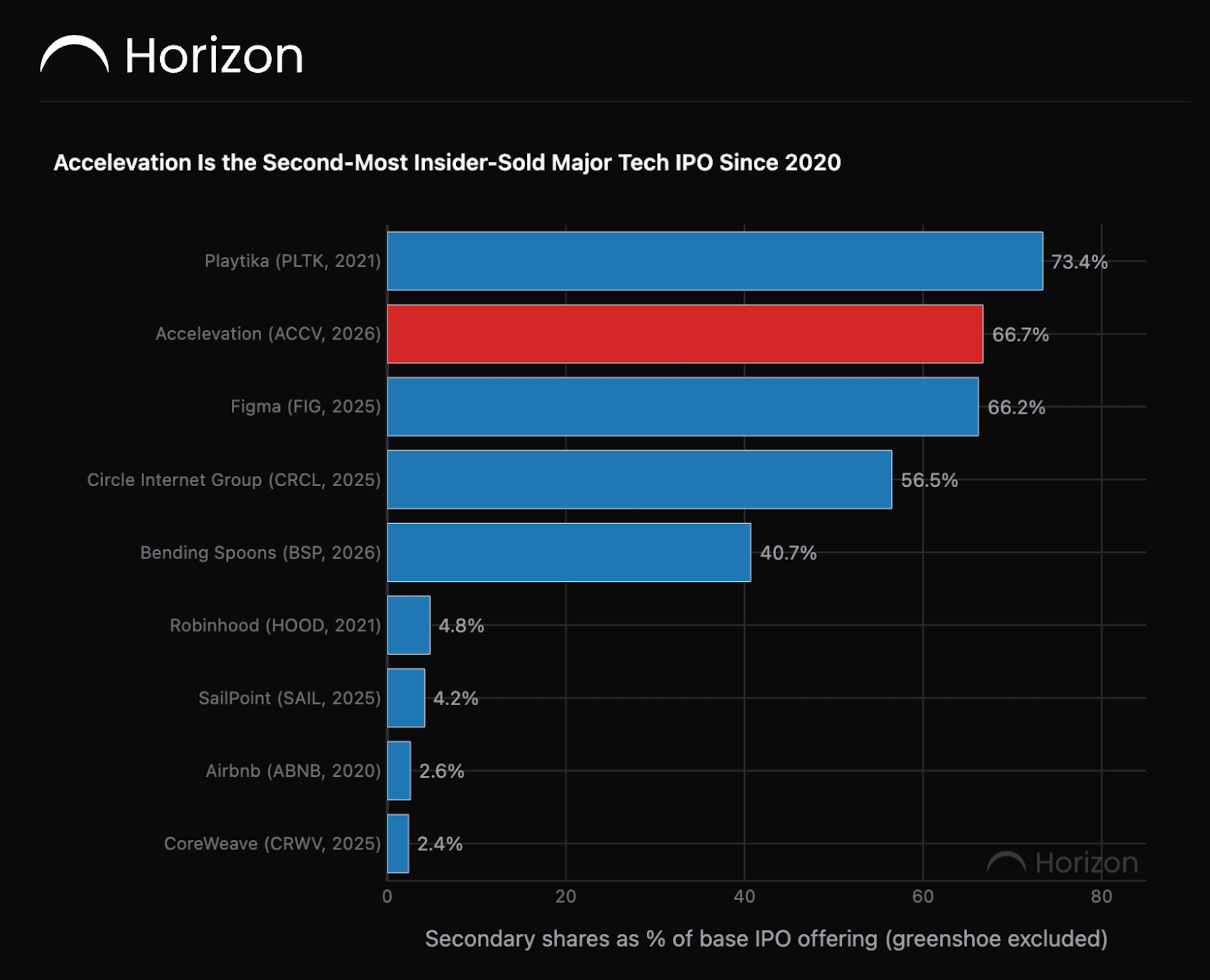
Accelevation ranked second-highest.
Playtika was the only deal above it, with 73.4% of its IPO consisting of secondary shares.
Accelevation came next at 66.7%, narrowly ahead of Figma at 66.2%.
Circle was next at 56.5%, followed by Bending Spoons at 40.7%. After that, the numbers fall sharply.
Most large tech IPOs look completely different
The more interesting comparison is with the rest of the sample.
12 of the 20 largest technology IPOs sold no secondary shares at all.
Companies including Snowflake, DoorDash, Bumble, Unity, Affirm and Cerebras used their offerings entirely to issue new shares and raise capital for the business.
Across the full comparison group, the median secondary share was 0%.
The mean was just 12.5%.
Accelevation sits at 66.7%.
That puts it in a very small group of technology IPOs where a large part of the transaction is providing liquidity to existing owners rather than simply raising new capital for the company.
The $540 million headline looks different
This distinction matters when looking at the size of the deal.
Accelevation's IPO was worth $540 million in total.
But only $180 million came from shares issued by Accelevation itself.
The remaining $360 million represented shares sold by existing shareholders.
So while the headline number is a $540 million IPO, only one-third of the base offering represented new capital raised by the company.
Two-thirds represented existing ownership changing hands.
One more unusual detail
The structure becomes more interesting because Accelevation did not price at the top of its marketed range.
The company priced at $18 per share, below the marketed range of $20 to $24.
A large secondary component is not necessarily negative by itself. Existing investors, founders and employees regularly use IPOs to create liquidity.
But the scale here is unusual.
Among the 20 largest U.S. technology IPOs since 2020, only Playtika had a larger proportion of its offering sold by existing shareholders.
Methodology
We compared Accelevation with the 20 largest U.S. technology IPOs by base proceeds since 2020.
For each company, we used the final prospectus and calculated secondary shares as a percentage of the base IPO offering. Greenshoe and over-allotment shares were excluded.
SPACs and direct listings were also excluded because they are structurally different from a traditional IPO.
The takeaway
Accelevation's IPO raised $540 million.
But the more unusual number is 66.7%.
Only one of the 20 largest U.S. technology IPOs since 2020 had a higher proportion of shares sold by existing shareholders.
For most major technology IPOs in the sample, secondary shares were either a small part of the transaction or did not exist at all.
For Accelevation, they were the majority.
$180 million raised by the company. $360 million sold by existing shareholders.
That makes Accelevation one of the most secondary-heavy major U.S. technology IPOs of the last several years.
Share this post: