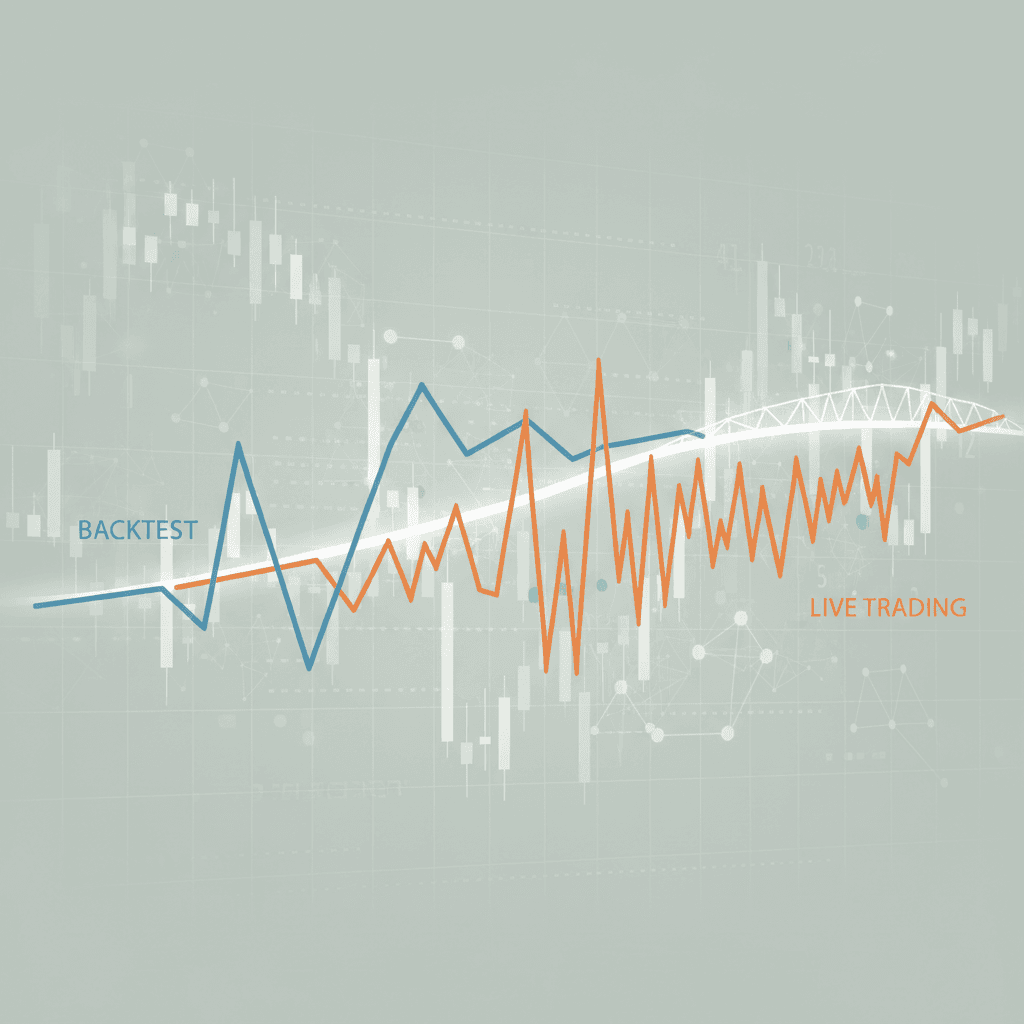

A backtest that shows a smooth equity curve and a high Sharpe ratio tells you one thing: those parameters fit that stretch of history. It does not tell you whether the same parameters will work on the months that come next, which are the only months you can trade. Walk-forward optimization is the test that answers the second question.
This guide explains what walk-forward optimization is, how to set it up, how to read its one key number, and the mistakes that make it meaningless.
Why a single backtest overstates a strategy
When you tune a strategy on ten years of data, you choose the parameters that did best over those ten years. The optimizer has seen every bull run, crash and sideways stretch in the sample, and it picks the settings that handled all of them. Future data was not in the sample, so nothing about that choice is tested against the future.
The more combinations you try, the worse this gets. Test enough parameter pairs and one of them will look excellent on any dataset, including random noise. That is curve fitting, and it is the main reason strategies that look strong in a backtest disappoint when deployed.
A plain in-sample and out-of-sample split helps. You optimize on the first part of the data and check on the last part. But it gives you one check, on one period, and that period may happen to be easy or hard for the strategy. Walk-forward optimization repeats the check many times across the whole history.
How walk-forward optimization works
Divide the history into a series of windows that step forward through time. In each window:
- Optimize on the in-sample part. Choose the parameters that performed best on, say, the first three years of the window.
- Test on the out-of-sample part. Run those exact parameters on the next period, say one year, that the optimizer never saw.
- Roll forward. Shift the whole window ahead by the out-of-sample length and repeat.
Stitch the out-of-sample periods together and you have a walk-forward equity curve. It shows what would have happened if you had re-tuned the strategy on a schedule and traded each tuning on unseen data, which is how a systematic trader actually operates.
Two settings define the test. The in-sample length has to be long enough for the parameters to mean something, usually one to three years for a daily strategy, but not so long that it averages across market regimes the strategy should adapt to. The out-of-sample length is how long you would trade before re-tuning, usually three to twelve months. A three-to-one or four-to-one ratio between them is a common starting point.
Walk-forward efficiency, the number to read
Walk-forward efficiency compares what the strategy earned out of sample with what it earned in sample, for the same length of time. Divide the annualized out-of-sample return by the annualized in-sample return.
- Above 50%. The out-of-sample periods kept more than half of the in-sample performance. The edge is probably real.
- Between 30% and 50%. Some edge, but the parameters are partly fitted to the past. Simplify the strategy or widen the parameter ranges.
- Below 30%. Most of the backtest result was curve fitting. Treat the strategy as unproven.
Look at the individual periods too, not just the average. A strategy that passed eight periods and failed two is different from one that was carried by a single exceptional year. You want the out-of-sample results to be consistently positive, not occasionally spectacular.
Mistakes that make the test meaningless
- Too few periods. Two or three walk-forward periods tell you almost nothing. Aim for at least eight, which usually means a long history or short out-of-sample windows.
- Leaking the future into the optimization. Any decision made with knowledge of later data, including the choice of which strategy to walk forward, undoes the test. Fix the rules before you start and change only the parameters.
- Leaving out costs. Commission, spread and slippage belong in every window. A strategy that trades often can pass walk-forward before costs and fail after them.
- Re-optimizing too often. Short in-sample windows fit noise. Re-tuning a daily strategy every month usually makes it worse, not better.
- Treating a pass as proof. Walk-forward tests parameter stability. It does not test whether the idea works on other instruments or whether live execution matches the backtest. Paper trading does that.
Walk-forward and Monte Carlo answer different questions
Walk-forward optimization asks whether the strategy survives being re-tuned and traded on unseen data. Monte Carlo analysis takes the trades the strategy produced and reshuffles or resamples them to show the range of equity curves that sequence of trades could have produced. The first tests whether the edge is real. The second tests how bad the drawdown could get even if it is. A strategy should pass both before it trades real money.
How Horizon fits
On Horizon you describe a strategy in plain English and backtest it over the date range you choose. That makes the walk-forward loop a matter of running the same strategy over successive windows: tune the parameters on one range, then run the tuned version on the range that follows, and compare. Each run reports the Sharpe ratio, maximum drawdown, win rate and profit factor, so the in-sample and out-of-sample numbers sit side by side.
When the out-of-sample results hold up, you can paper trade the strategy on live data and then deploy it to a connected broker without rewriting anything. For the rest of the validation checklist, see how to validate a trading strategy before automating it.
Frequently asked questions
What ratio of in-sample to out-of-sample should I use?
Three-to-one or four-to-one is the usual starting point. For a daily strategy that means two to three years of tuning data and six to twelve months of testing. Shorter windows can suit intraday strategies, as long as each out-of-sample period still contains enough trades to judge.
How many walk-forward periods do I need?
At least eight. Ten years of history with twelve-month out-of-sample windows gives you ten, which is enough for a first verdict.
Does walk-forward optimization prevent all overfitting?
No. It catches overfitted parameters. It cannot catch an overfitted choice of rules, instrument or timeframe, because those were fixed before the test began. Testing on other instruments and paper trading cover that.
How is this different from a rolling backtest?
A rolling backtest keeps the same parameters and moves the window. Walk-forward re-optimizes the parameters in each window before testing them. The second mirrors what a trader who re-tunes on a schedule actually does.
Test the strategy the way you will trade it
Describe the rules once, backtest them across successive windows, and keep only the strategies whose out-of-sample results hold up. Horizon runs each step from a plain-English description, with no code.
Share this post: