The AI infrastructure boom is usually discussed as a semiconductor, data-centre and earnings story.
It is also becoming a capital-markets story.
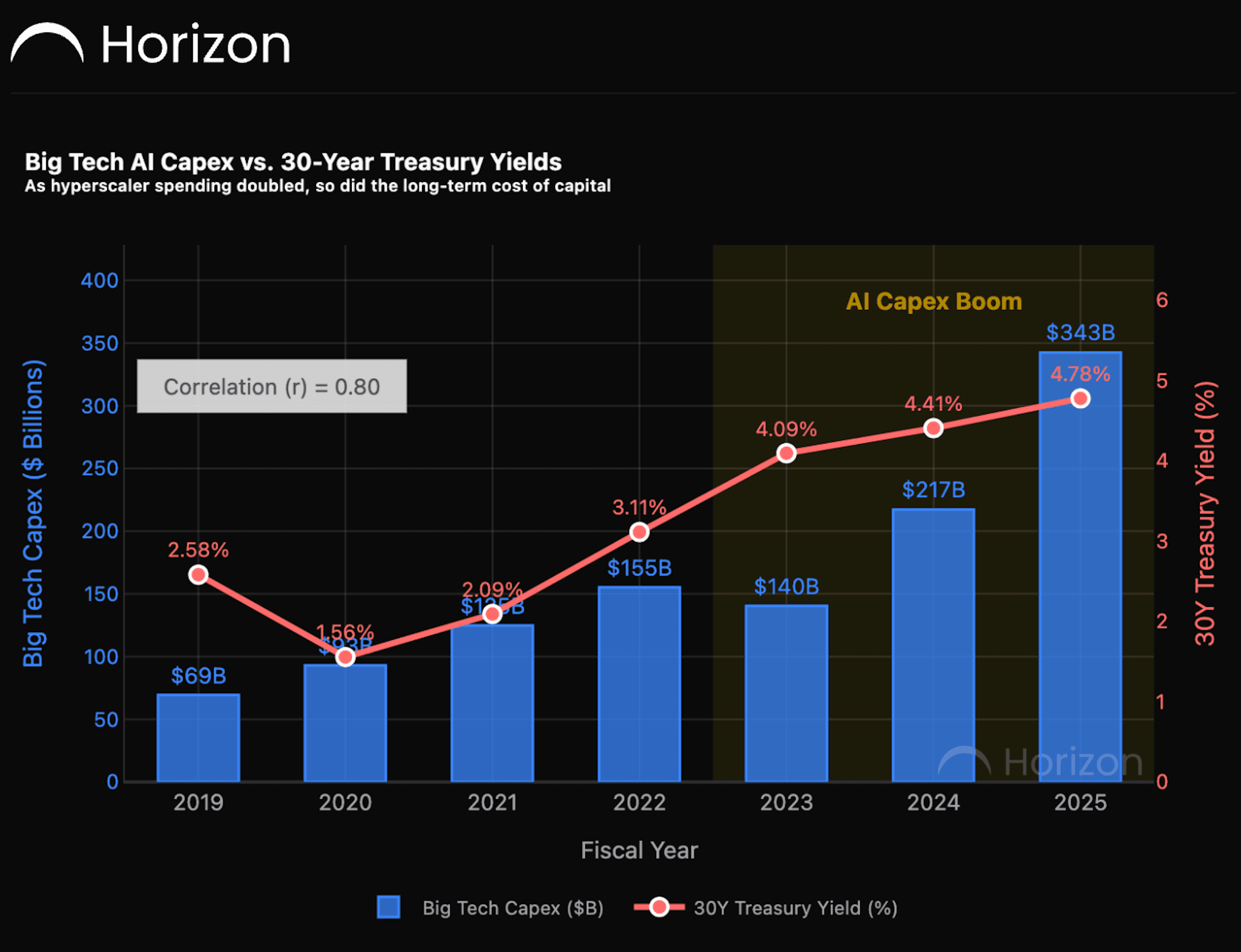
Aggregate capital expenditure across Microsoft, Alphabet, Meta and Amazon rose from $69 billion in 2019 to $343 billion in 2025.
Over the same period, the average 30-year U.S. Treasury yield climbed from 2.58% to 4.78%.
Across the seven annual observations, the two series show a correlation of 0.80.
Big Tech capex has exploded
The scale of the change is difficult to overstate.
In 2019, the four hyperscalers spent around $69 billion on capital expenditure.
By 2023, that figure had reached $140 billion.
In 2024, it rose to $217 billion.
By 2025, it reached $343 billion.
The average annual capex during 2019 to 2022 was $111 billion.
During 2023 to 2025, it more than doubled to $233 billion.
AI infrastructure is consuming enormous amounts of capital.
The cost of capital has risen at the same time
The long end of the Treasury curve has moved sharply higher.
The average 30-year yield increased from 2.34% during 2019 to 2022 to 4.43% during 2023 to 2025.
That matters because the same companies spending aggressively on AI are operating in a much more expensive financing environment.
Higher long-term yields increase the discount rate applied to future technology earnings.
They also make risk-free bonds more competitive with growth equities.
AI is competing for long-duration capital
Reuters reports that bond sales by five major hyperscalers are expected to reach roughly $250 billion in 2026 and almost double again by 2027.
That creates a new dynamic.
AI infrastructure spending is increasingly competing with government borrowing and other large capital needs for the same pool of long-duration money.
The investment boom does not happen in a vacuum.
Correlation is not causation
The 0.80 correlation does not prove that AI capex caused Treasury yields to rise.
That would be far too strong.
Fed policy, inflation, fiscal deficits, Treasury issuance and global growth all remain major independent drivers of long-term rates.
The point is narrower.
The AI boom is occurring at the same time capital itself has become materially more expensive.
Why that matters for valuations
The companies spending the most to capture future AI growth are also the companies most sensitive to long-duration valuation frameworks.
If capex keeps accelerating while long-term yields remain elevated, investors may become more selective about the returns generated by that spending.
The question shifts from "how much are they investing?" to "what return are they earning on that investment?"
The takeaway
The AI boom has a hidden cost: capital.
Big Tech capex has risen almost fivefold since 2019 while long-term Treasury yields have also moved sharply higher.
That does not mean AI spending caused higher rates.
It does mean the next stage of the AI trade will increasingly depend on whether enormous capital commitments can justify themselves in a more expensive funding environment.
Share this post: