Monday's AI shock erased $294.9 billion across eight AI-linked stocks at the open compared with Friday's close.
By the closing bell, that loss had narrowed to $199.2 billion.
On the surface, that looks like a fairly strong recovery. The basket clawed back $95.7 billion during the session, equal to 32.5% of the opening damage.
But the headline number hides what actually happened underneath.
The AI selloff did not reverse. It split.
The recovery was not broad
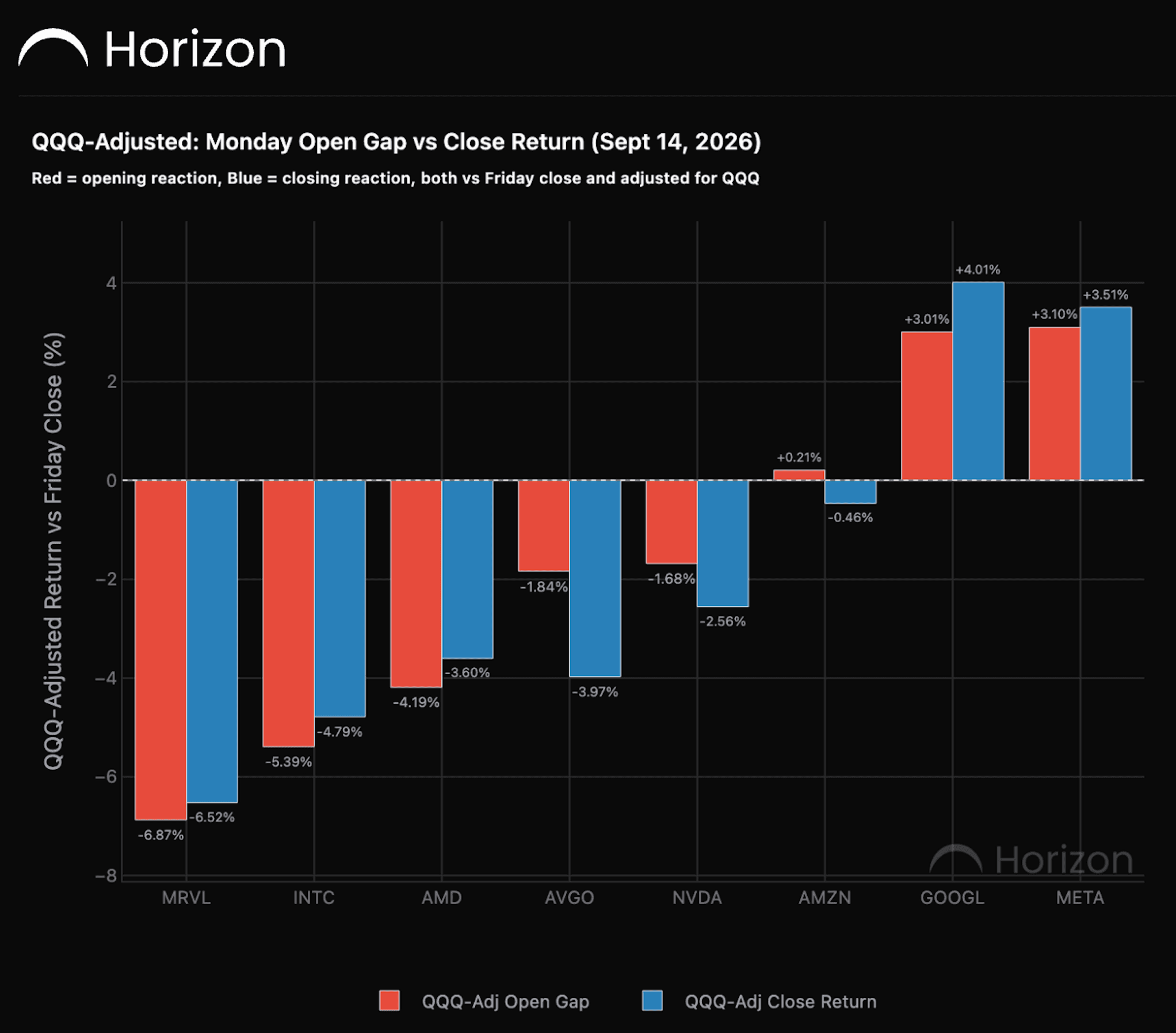
AMD, Intel and Marvell recovered part of their opening losses.
AMD clawed back $11.9 billion in market value during the session, Intel recovered $7.4 billion and Marvell recovered $2.4 billion.
That helped the aggregate basket improve, but all three still closed materially behind QQQ.
They bounced. They did not fully recover.
Google and Meta were trading a different story
Google and Meta behaved very differently from the chip names.
Both were already positive at the open, and both strengthened further into the close.
Google moved from a $56.9 billion gain at the open to a $131.8 billion gain by the closing bell.
Meta increased from $24.4 billion to $44.8 billion.
That matters because the session was not simply investors selling anything associated with artificial intelligence.
Capital was moving between different parts of the AI trade.
Nvidia and Broadcom kept deteriorating
The two semiconductor leaders did not participate in the intraday recovery.
Nvidia's loss widened from $174.6 billion at the open to $177.5 billion at the close.
Broadcom deteriorated from a $59.6 billion loss to an $82.2 billion loss. Its QQQ-adjusted decline deepened from -1.84% at the open to -3.97% by the close.
That is a very different message from the aggregate basket recovering a third of its opening loss.
Some names were being bought. Others were still being repriced lower.
What the split may be telling us
The important distinction appears to be where investors see the downside if frontier AI development slows.
The hyperscalers have enormous businesses outside any single AI spending cycle. They may also benefit if the economics of AI infrastructure become more rational over time.
The semiconductor leaders are much more directly exposed to the scale and pace of infrastructure spending.
That does not make one group safe and the other vulnerable in every scenario. It does explain why an AI-related shock can produce very different reactions across companies that are often grouped under the same theme.
The headline missed the real move
By the close, almost a third of the basket's initial loss had been recovered.
That sounds like a reversal.
It was not.
The session showed a market becoming more selective inside the AI trade. Google and Meta strengthened, several beaten-down semiconductor names partially recovered, while Nvidia and Broadcom continued to weaken.
The interesting signal was not that investors bought AI back.
It was that they started separating the winners from the companies carrying the most direct exposure to the concern that triggered the selloff.
Share this post: