
Over the weekend, several of the biggest names in artificial intelligence backed slowing the pace of frontier AI development.
Dario Amodei, Sam Altman and Elon Musk supported the idea, while Demis Hassabis also expressed support.
Monday was the first U.S. market open after those comments.
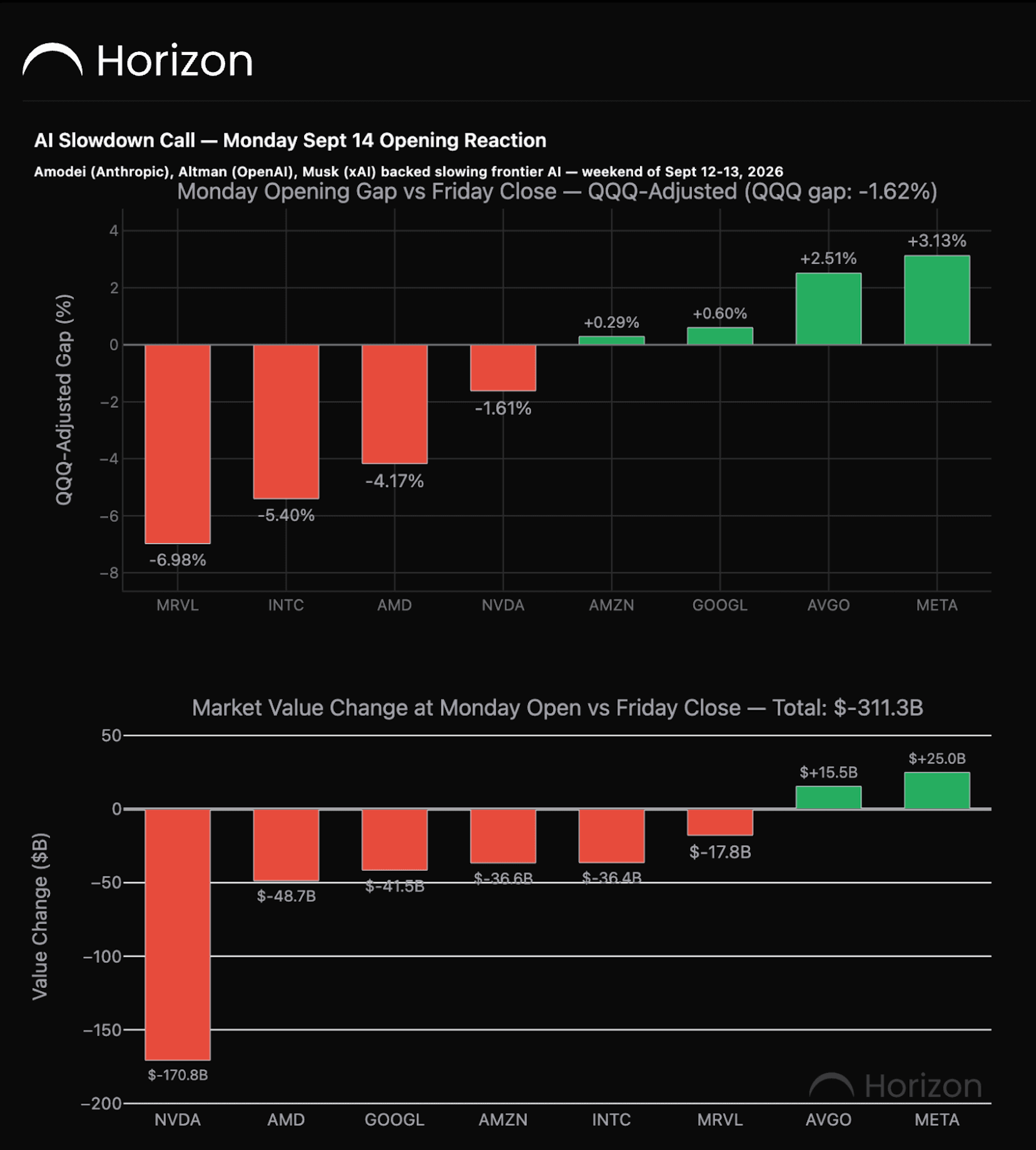
Across eight major AI-linked stocks, $311.3 billion of market value disappeared at the open compared with Friday's close.
But the more interesting result was where the losses showed up.
The market was already risk-off
QQQ opened 1.62% lower, so this was not an isolated AI selloff.
The broader technology market was under pressure too.
That means looking at the raw moves alone does not tell us which stocks were actually hit hardest by the AI-specific narrative.
To separate the two effects, we compared each stock's opening move with QQQ.
Semiconductors took the biggest relative hit
The sharpest QQQ-adjusted losses came from several semiconductor names.
Marvell underperformed QQQ by 6.98% at the open.
Intel lagged by 5.40%, AMD by 4.17% and Nvidia by 1.61%.
Amazon, Google, Broadcom and Meta all performed better than QQQ at the open.
That split matters.
If investors were simply rejecting the entire AI trade, we would expect the damage to be much more uniform.
It was not.
Why the chip names may have been more exposed
The semiconductor group is more directly linked to the physical buildout of frontier AI.
If the industry slows model development, stretches deployment timelines or becomes more cautious around capital spending, the companies supplying compute infrastructure can feel that concern more directly.
The hyperscalers have broader businesses and more diversified earnings streams.
That does not mean the weekend comments caused every move we saw. Markets were broadly weak, and a single session cannot establish causality.
But the relative performance shows where investors appeared most sensitive.
The useful takeaway
The headline number was large: $311.3 billion disappeared from the eight-stock basket at the open.
The better signal was underneath it.
The market did not sell every AI stock equally. The sharpest benchmark-adjusted damage was concentrated in semiconductor names such as Marvell, Intel, AMD and Nvidia.
That suggests the immediate concern was less about artificial intelligence disappearing and more about who is most exposed if the pace of frontier development slows.
Share this post: