
Meta's new Muse AI agent climbed to number two on the U.S. App Store.
That is a strong signal of consumer attention. It is much less clear whether it is a useful signal for the stock.
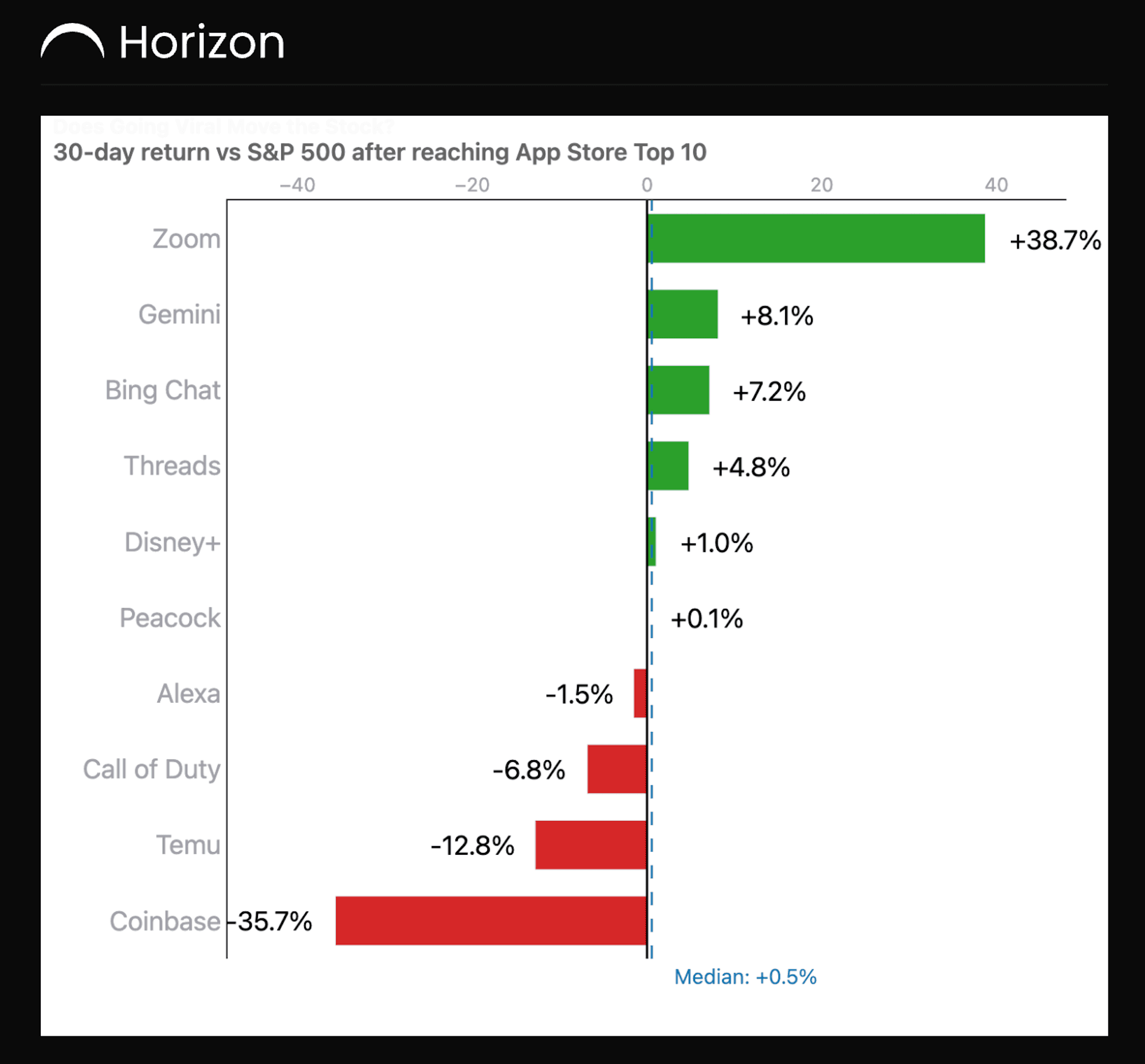
To test that, we looked at historical app launches from publicly traded companies that also reached the U.S. App Store Top 10, then measured how the parent company's shares performed over the next 30 trading days relative to the S&P 500.
The result was much weaker than the headlines around a viral launch might suggest.
Ten major app launches
The sample included 10 launches that achieved significant App Store traction.
Six of the 10 parent stocks outperformed the S&P 500 over the following 30 trading days.
At first glance, that sounds encouraging.
The median excess return, however, was only +0.54%.
That is a very small edge for a group where every product had already demonstrated enough consumer interest to reach the Top 10.
The outcomes were all over the place
The strongest example was Zoom, which outperformed the S&P 500 by 38.7% over the following 30 trading days.
Google Gemini gained 8.1% relative to the index, Bing Chat gained 7.2% and Threads gained 4.8%.
At the other end of the sample, Temu underperformed by 12.8% and Coinbase by 35.7%.
The full range stretched from +38.7% to -35.7%.
That dispersion is the key result.
These were all highly visible consumer products. The stock-market outcomes were completely different.
Virality is not the same as investment impact
A high App Store ranking tells us that people are downloading or engaging with a product.
It does not tell us how much revenue the product will generate, whether users will remain active, what the margins will look like or whether the success is already reflected in the share price.
It also does not tell us how important the product is relative to the size of the parent company.
A viral launch can be strategically meaningful without being financially material enough to move the stock.
The biggest winners had a bigger story
The strongest positive cases in the sample tended to coincide with a broader investment narrative.
Zoom was not simply an app moving up the charts. It was becoming a central part of how millions of people communicated during a major change in working behaviour.
Gemini and Bing Chat were tied to a much larger repricing of competitive positioning in artificial intelligence.
In those cases, the app ranking was part of the story rather than the entire story.
What Muse reaching number two actually tells us
Muse reaching number two on the U.S. App Store is evidence of strong early consumer attention.
That matters.
But history does not support jumping from a high ranking to the conclusion that META should outperform over the next month.
Across the 10 historical examples, a majority did outperform, but the median edge was only about half a percentage point and the spread between winners and losers was enormous.
The more important questions come next: does adoption persist, can Meta monetise it, and does Muse strengthen the broader investment case for the company?
Going viral gets attention. It does not, by itself, tell you what the stock does next.
Share this post: