
Tariff headlines can hit automakers quickly.
The first reaction is often simple.
Higher tariffs mean higher costs, supply-chain disruption and uncertainty, so auto stocks sell off.
History suggests that first move has often been the wrong one to chase.
Six major U.S. auto-tariff escalations
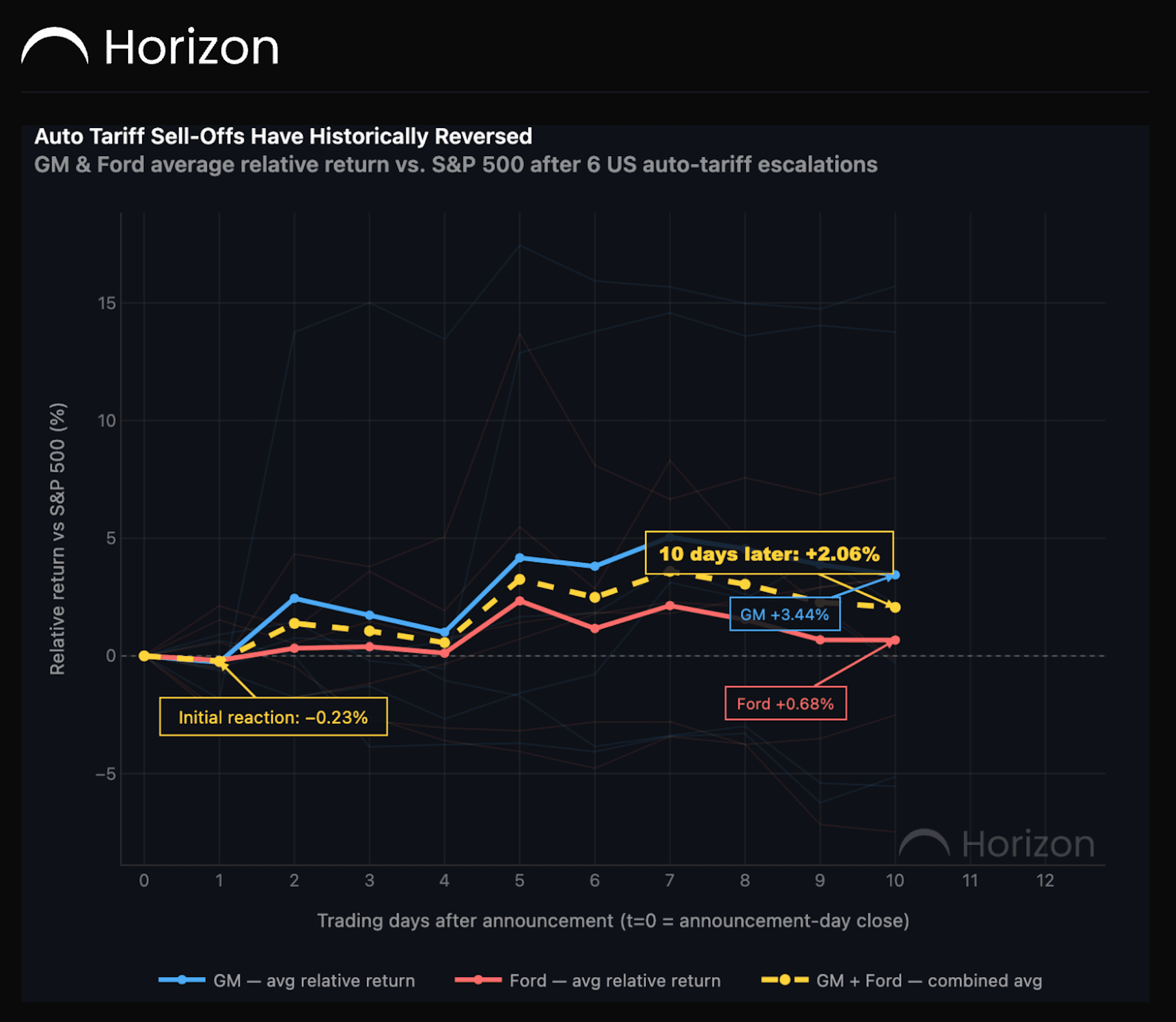
We looked at six major U.S. auto-tariff escalations since 2018 and measured General Motors and Ford relative to the S&P 500.
On Day 1, the two automakers underperformed by an average of 0.23%.
By Day 2, that loss had already reversed.
Average relative performance moved to +1.38%.
The recovery continued through the following week.
By Day 7, GM and Ford were ahead of the S&P 500 by 3.59% on average.
By Day 10, relative performance was still positive at +2.06%.
GM showed the stronger rebound
Across the full Day +10 window, GM outperformed the S&P 500 by 3.44% on average.
Ford's relative return was much smaller at +0.68%.
That difference is a reminder that "autos" are not one homogeneous trade.
Company-specific exposure still matters.
Not all tariffs are equal
There is an important caveat.
The six historical events were not identical.
Some tariffs were perceived as protective for U.S. producers.
Others were direct cost shocks to supply chains.
Those two structures can produce very different outcomes.
Two large positive events also pull the average higher.
So the result should be treated as a historical tendency, not a mechanical trading rule.
Why the first reaction can reverse
Headline shocks are often priced before investors fully separate winners from losers.
Domestic producers can sometimes benefit if tariffs raise the cost of imported competition.
That means a broad first-day selloff may overstate the eventual damage to U.S. automakers.
The details of the policy matter more than the word "tariff."
The takeaway
Auto-tariff selloffs in GM and Ford have historically tended to reverse rather than deepen.
Across six major episodes since 2018, the initial relative weakness was gone by Day 2 and average outperformance reached 3.59% by Day 7.
The setup is not uniform enough to treat as a rule.
But history suggests the first negative reaction has often been less informative than what happened after investors processed the details.
Share this post: