
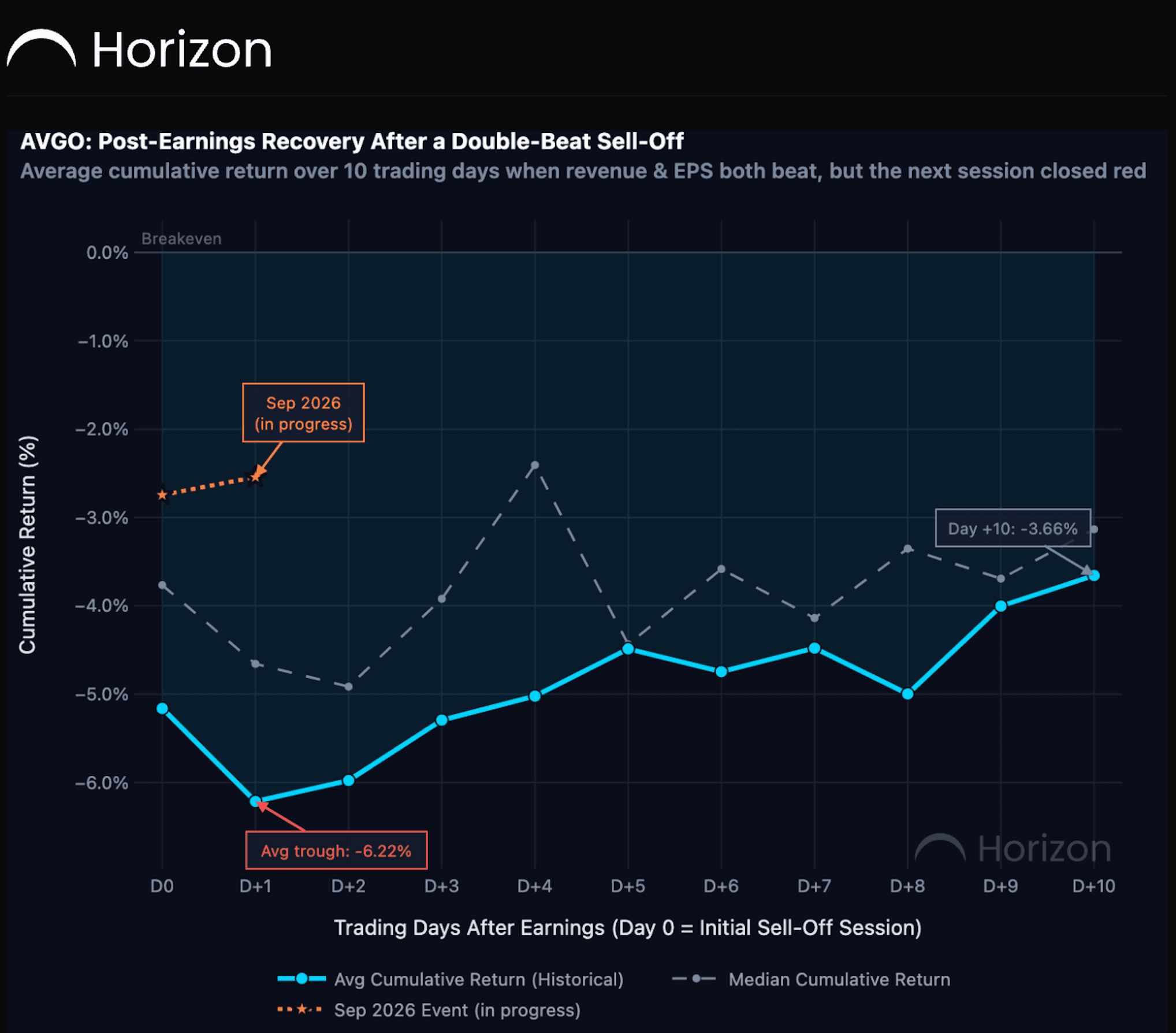
Broadcom beat both revenue and adjusted EPS in September 2026.
The stock still fell 2.74% in the first session after earnings.
That sounds contradictory, but it has happened before.
Since late 2012, 13 of Broadcom's 44 double beats were followed by a negative next-session close.
The interesting question is what usually happens after that rejection.
Double beats do not always mean strong price action
Earnings reactions are relative to expectations, not simply whether the company beat the published numbers.
A company can beat both revenue and EPS and still disappoint investors on guidance, margins, forward commentary or the size of the beat itself.
When the market sells a double beat, that reaction contains information.
The historical data suggests it should not be dismissed too quickly.
The stock usually stayed below the pre-earnings level
Across the 12 completed historical events where Broadcom beat both lines but fell the next session, the average path from the pre-earnings close bottomed at -6.22% on Day +1.
By Day +10, the average return was still -3.66%.
The median Day +10 return was -3.13%.
That means the typical event did not snap back immediately.
The initial rejection tended to persist.
Buying the first dip was only modestly better
If you measure returns from the post-earnings selloff instead of the pre-earnings close, the numbers improve.
The average rebound was +1.87%, with a median gain of +1.00%.
The win rate was 58.3%.
That looks mildly constructive until one outlier is removed.
September 2024 produced a 25.3% rebound.
Exclude that event and the average falls to -0.30%.
So the apparent mean-reversion edge is weak.
What the rejection may be telling us
When a stock sells off after apparently good earnings, investors are usually reacting to something beyond the headline beat.
That can be guidance, valuation, positioning or a mismatch between the reported result and what the market had already priced in.
The price reaction therefore matters.
Historically, Broadcom's negative reaction after a double beat has been more informative than the fact that both headline numbers beat expectations.
The current event
The September 2026 event is currently down 2.54% through Day +1.
That puts it directly into the historical bucket.
The useful comparison is not simply whether Broadcom beat revenue and EPS.
It is whether this post-earnings rejection follows the same path as previous examples.
The takeaway
When Broadcom beats both revenue and adjusted EPS but the stock falls anyway, the weakness has historically tended to persist.
Across the completed historical sample, AVGO was still below its pre-earnings level two weeks later on average.
Buying the first dip showed only a weak mean-reversion effect.
The headline beat matters.
The market's rejection of that beat may matter more.
Share this post: