The AI investment cycle has reached a new stage.
The market is no longer asking only how much Big Tech is spending.
It is starting to ask what that spending is producing.
Global AI capital expenditure is on pace to approach $800 billion to $1 trillion in 2026, while hyperscaler capex continues to climb sharply.
The pressure is increasingly visible in free cash flow.
Capex is rising faster than the old model was built for
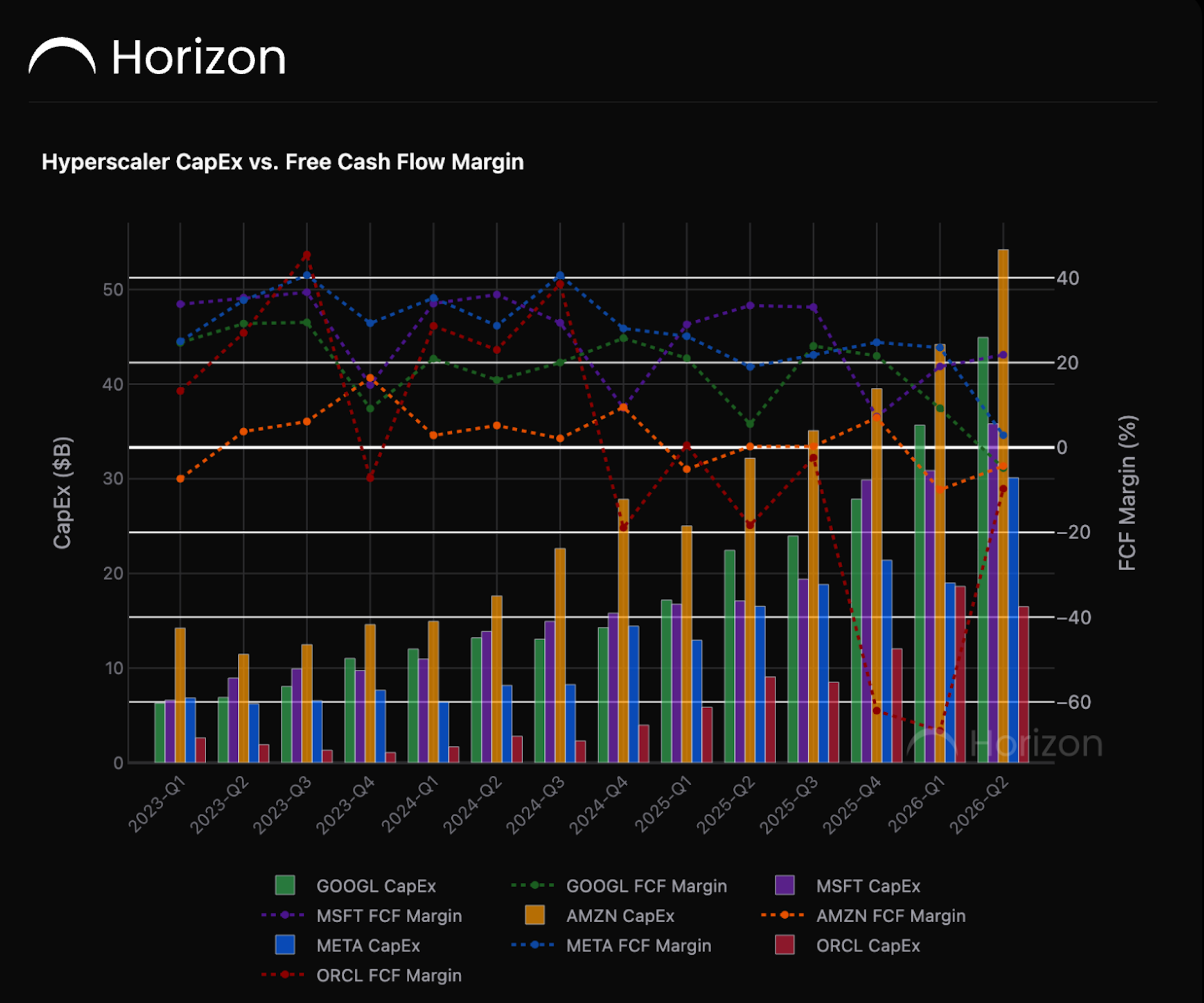
Across Alphabet, Microsoft, Amazon, Meta and Oracle, quarterly capital spending has accelerated dramatically since 2023.
Several of the largest hyperscalers are now spending tens of billions of dollars per quarter on data centres, compute and supporting infrastructure.
That expansion is changing the financial profile of the companies.
AI growth may be strong.
It is not free.
Cash flow quality is starting to separate the group
The original research showed a clear divergence.
Microsoft retained a more resilient positive free-cash-flow margin while other hyperscalers experienced much sharper pressure as capital spending accelerated.
That distinction matters.
If two companies can grow AI revenue at similar rates but one requires materially more capital to do it, the market should eventually value the cash-generative model more highly.
The next phase of the AI trade may therefore become less about spending leadership and more about capital efficiency.
Semiconductor growth has already started to normalise
The supply chain adds another layer.
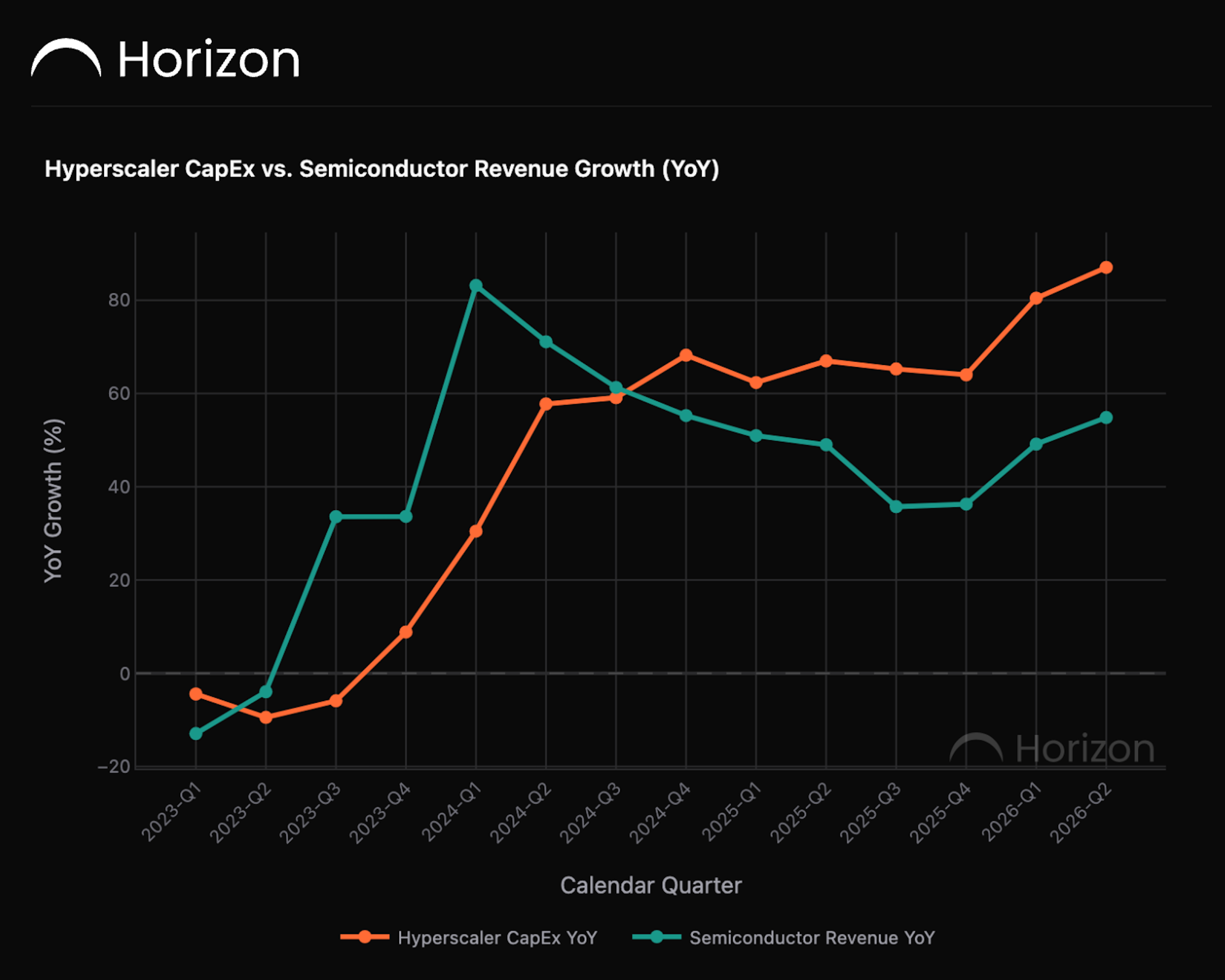
Semiconductor revenue growth surged early in the AI cycle.
Hyperscaler capex continued accelerating even after that growth began to moderate.
That does not automatically imply overinvestment.
It does raise the risk that infrastructure deployment can eventually outrun incremental demand.
If capex growth slows while chip revenue remains elevated, inventory and utilisation become more important questions.
More spending is not automatically rewarded
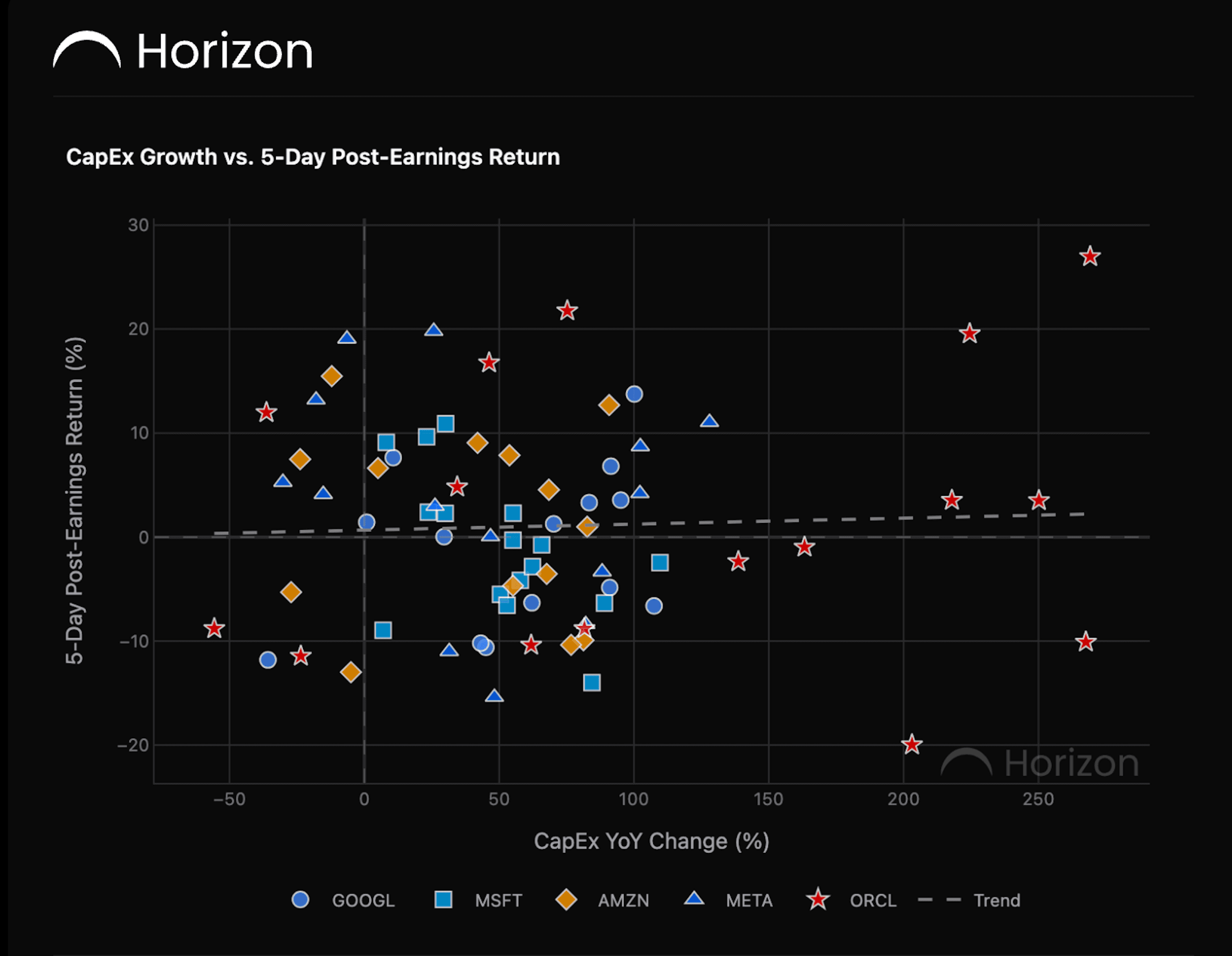
The earnings-reaction analysis in the original study showed little evidence that higher capex growth alone produced stronger stock returns.
That is logical.
Investors do not reward spending simply because it is large.
They reward spending when it produces visible revenue, margins and returns on invested capital.
The tolerance for "spend now, monetise later" becomes lower as the amounts involved get bigger.
The takeaway
Big Tech's AI race is becoming a cash flow test.
The companies can continue spending aggressively.
The market is increasingly likely to judge them on what they earn from that spending.
The next winners in AI may not simply be the biggest investors.
They may be the companies that convert the investment into the strongest free cash flow and returns on capital.
Share this post: