
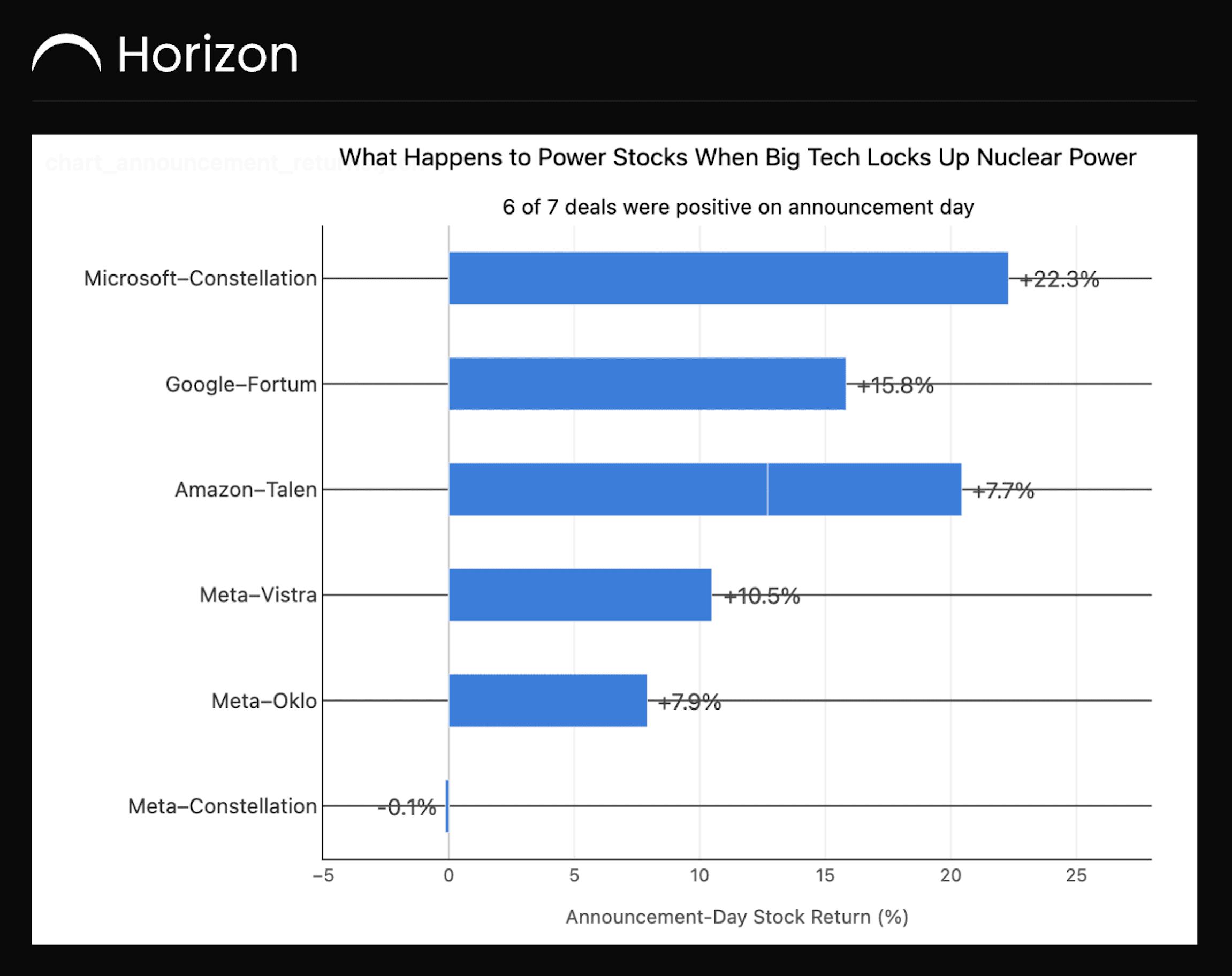
Google's new 22-year nuclear power agreement with Fortum sent Fortum shares up 15.8% on announcement day.
That is a large move for a power supplier.
It is also part of a broader pattern.
As hyperscalers secure long-term electricity supply for data centres and AI infrastructure, public nuclear and nuclear-adjacent companies are being repriced almost immediately.
Seven major deals
We looked at seven qualifying public-market deals involving hyperscalers and nuclear or nuclear-adjacent power suppliers.
Six of the seven suppliers rose on announcement day.
The strongest reaction came after Microsoft's agreement with Constellation Energy, which produced a 22.3% move.
The only negative case in the sample was Meta's deal with Constellation, where the stock was roughly flat at -0.1%.
That makes the immediate reaction unusually consistent.
Why these deals matter to investors
A long-term agreement with a major technology company can change how the market views an energy asset.
The customer is large, creditworthy and committing to demand over many years.
For nuclear suppliers in particular, that can improve the perceived value of scarce generation capacity.
AI has also changed the narrative around electricity demand.
Power is no longer just an input cost in the background. It has become one of the constraints on data-centre expansion.
That makes supply agreements strategically important.
The announcement pop does not always last
The longer-term results were much less consistent.
Talen produced strong gains over the following 60 days after two of its deals.
Oklo moved in the opposite direction and fell sharply after its initial announcement-day pop.
That distinction matters.
The market appears quick to price the strategic value of a Big Tech customer, but that does not automatically mean the supplier's equity remains attractive at the new valuation.
What the market seems to be pricing
The cleanest signal is the first-day repricing.
When a hyperscaler locks in scarce nuclear capacity, investors often treat that as validation of the supplier's assets, future demand and strategic position.
After that, normal questions return.
What is the deal worth? How much capital must be spent? What are the margins? How quickly can capacity come online? What valuation is already being paid?
Those factors determine whether the initial move holds.
The takeaway
Big Tech nuclear deals have produced a remarkably consistent immediate reaction.
Six of seven suppliers in our sample rose on announcement day, with some moves exceeding 20%.
The harder part is what comes after.
The announcement itself has been a strong repricing catalyst. The follow-through has been far less reliable.
Share this post: