
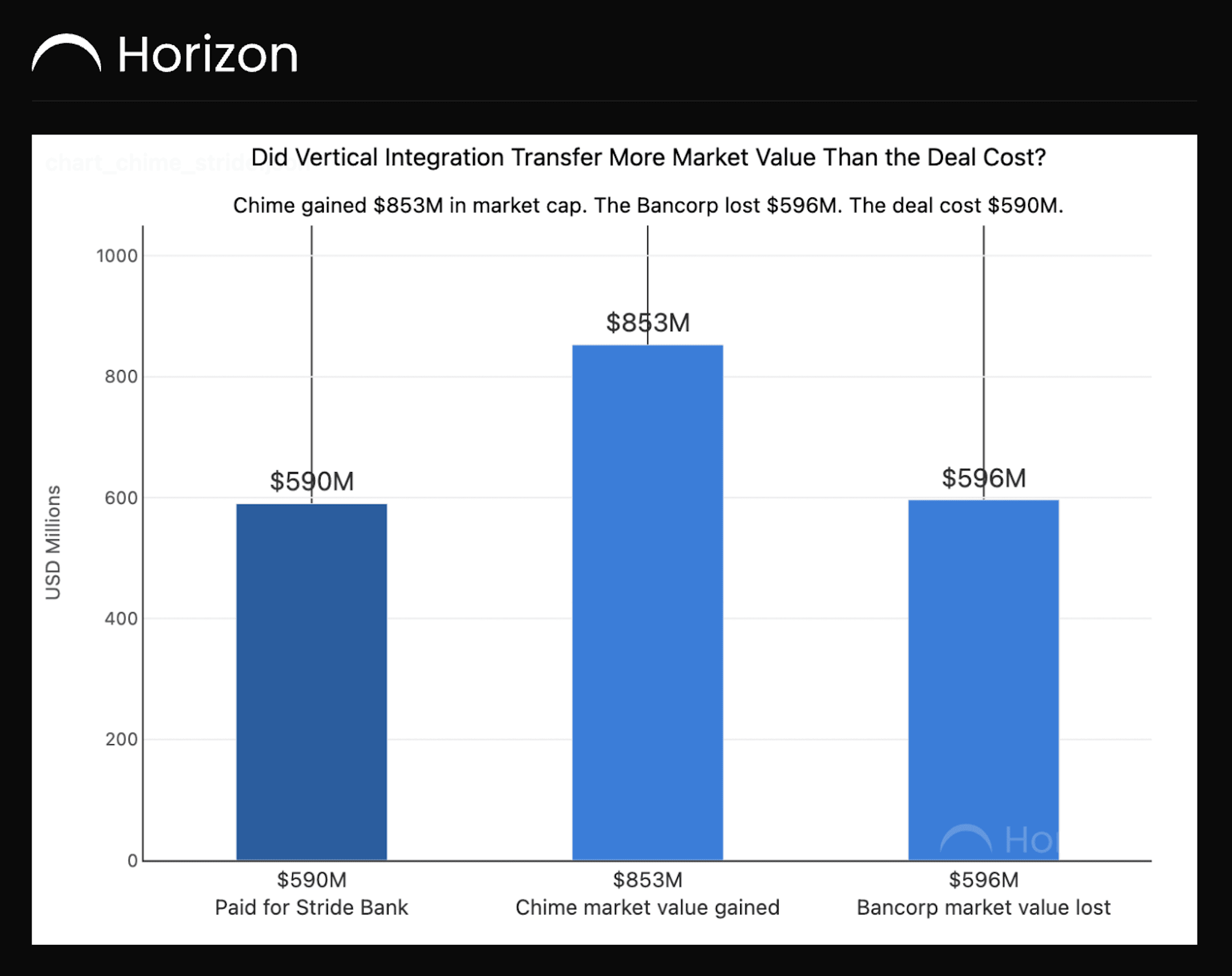
Chime agreed to buy Stride Bank for $590 million.
On the next trading day, Chime gained roughly $853 million in market value.
The Bancorp, one of Chime's existing banking partners, lost about $596 million.
Across the two stocks, roughly $1.45 billion of market value moved around a deal worth less than half that amount.
The buyer gained more than the purchase price
Chime's one-day market-cap increase was about 1.45 times the $590 million acquisition price.
That is notable.
Acquirers often face scepticism because investors worry they are overpaying, taking on integration risk or destroying capital.
Here, the market moved strongly in the opposite direction.
Investors appeared to like the strategic logic of Chime owning more of its banking infrastructure.
The partner took the other side of the trade
The Bancorp lost roughly $596 million in market value.
That is about 1.01 times the value of Chime's entire acquisition.
The logic is straightforward.
If Chime brings more banking functions in-house, some of the economics that previously flowed to external partners can move with it.
The market therefore repriced both sides of the relationship at once.
Chime gained from greater vertical integration.
The Bancorp lost value as investors reassessed the importance of a major client relationship.
Why vertical integration can create a larger reaction than the deal size
The purchase price only tells us what Chime is paying for Stride.
It does not capture the value investors assign to everything the acquisition might change afterwards.
Owning more of the banking stack can affect economics, product control, regulatory infrastructure and dependence on third parties.
That is why the equity-market reaction can be larger than the transaction itself.
The market is repricing the future operating model, not simply valuing the asset being acquired.
There is one important caveat
Chime also raised guidance alongside the acquisition announcement.
That means it would be too aggressive to attribute the entire $853 million gain to the Stride deal.
Part of the move may reflect better expectations for the underlying business.
The Bancorp reaction, however, adds useful context because its loss directly fits the vertical-integration story.
The takeaway
A $590 million acquisition was associated with roughly $1.45 billion of market-value movement across Chime and The Bancorp.
The deal mattered because it potentially changed who captures the economics inside Chime's banking stack.
The purchase price was only one part of what investors were valuing.
Share this post: