
Amazon's new Qualcomm agreement gives Amazon warrants tied to future purchases.
That creates an unusual relationship.
The customer is not only buying the supplier's products. It can also become an owner.
Markets often like these deals immediately because they appear to validate future demand.
The harder question is whether the initial stock-price pop lasts.
What we found
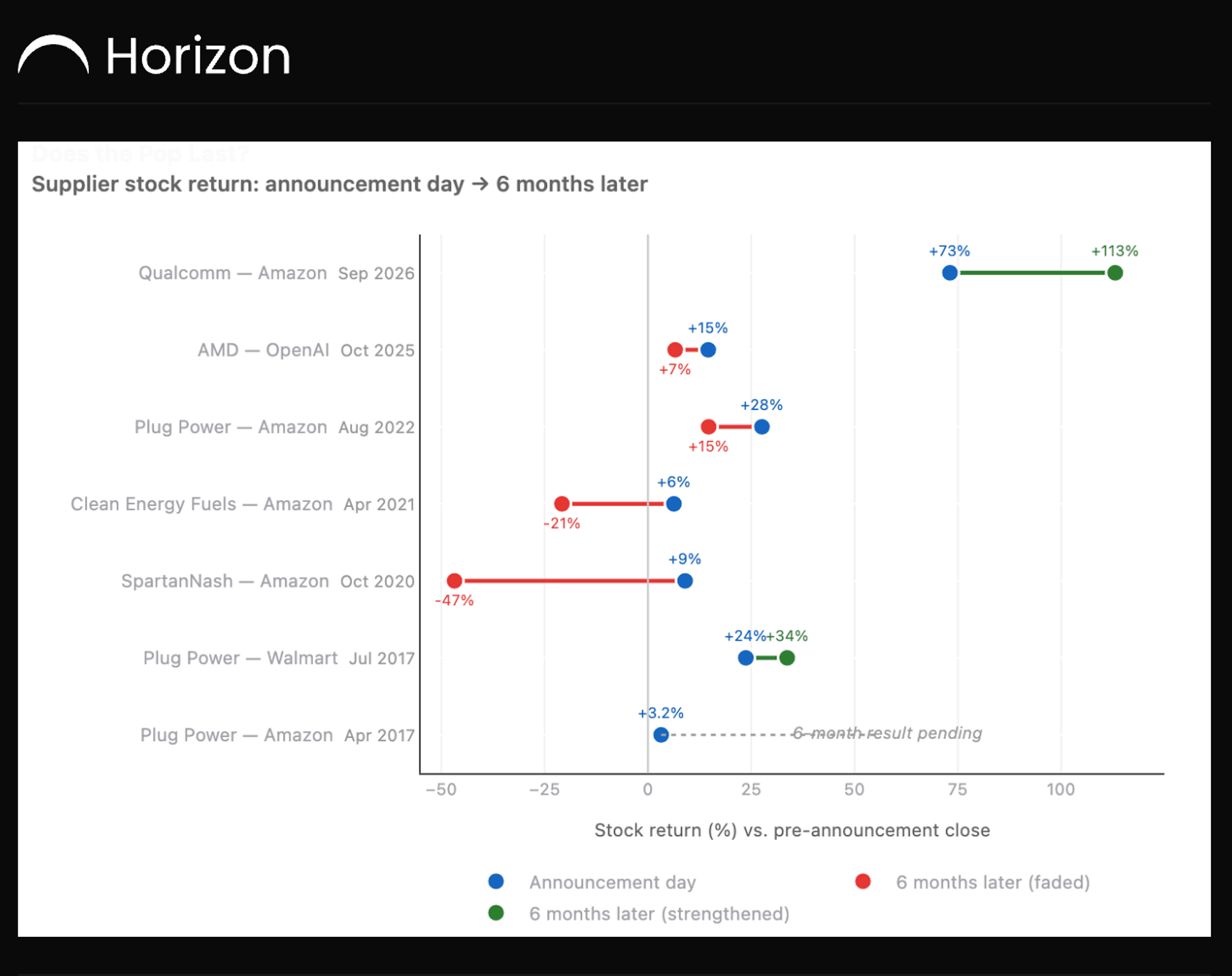
We looked at six completed historical deals where a major customer received equity or equity-linked incentives from a supplier.
Four of the six stocks gave back their announcement-day gain within six months.
Only two strengthened further.
Qualcomm rose about 3.2% on the announcement of its Amazon agreement, but its six-month outcome is still pending.
The historical pattern suggests the first-day reaction is much easier to find than durable follow-through.
Why investors like the structure initially
A major customer agreeing to warrants or equity-linked incentives sends several positive signals at once.
It can imply a deeper commercial relationship, future purchasing commitments and stronger alignment between customer and supplier.
That can be particularly powerful for a smaller supplier.
If a major customer is willing to tie its own economics to the supplier's success, investors may interpret that as validation.
Why the gains often fade
The structure of the deal is only one part of the investment case.
After the initial excitement, investors still need to see actual revenue growth, stronger margins, larger order volumes or a meaningful change in the supplier's competitive position.
If those fundamentals do not follow, the first-day validation premium can disappear.
That appears to be what happened in most of the historical examples.
The deals that held up had something more
The stronger long-term cases were not simply the companies with warrants attached to the agreement.
They were the cases where the customer relationship materially changed the supplier's growth story.
That distinction matters.
Equity alignment can make a headline more compelling, but it does not create economic value on its own.
The commercial relationship still has to deliver.
What this means for Qualcomm
Qualcomm's 3.2% announcement-day gain fits the historical pattern.
The market liked the validation.
Whether the move lasts will depend less on the warrant structure itself and more on what the Amazon relationship ultimately contributes to Qualcomm's business.
The takeaway
Major customer equity deals often create an immediate pop.
In our completed sample, however, four of six stocks gave that gain back within six months.
The initial signal is validation.
The durable signal is whether the relationship actually changes the supplier's growth trajectory.
Share this post: