
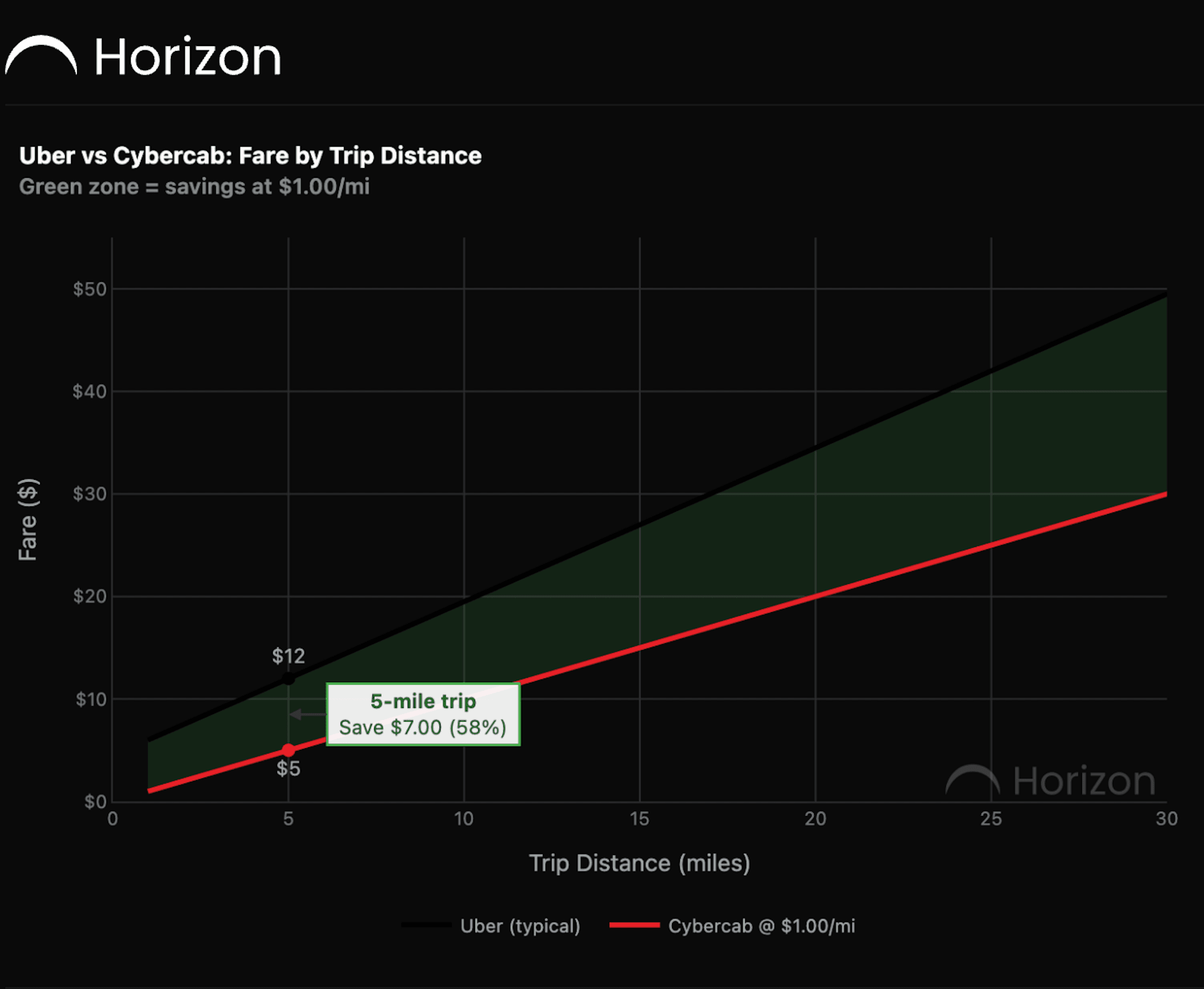
A five-mile Uber trip can cost roughly $12.
At a $1 per mile fare, the same trip in a Cybercab would cost about $5.
That is a 58% saving for the rider.
The obvious question is whether a fare that low can still work economically for the operator.
Our model suggests it can, but only if utilisation is high enough.
The consumer advantage is obvious
At $1 per mile, Cybercab has a substantial pricing advantage over a conventional ride-hailing trip.
That matters because ride-hailing is a relatively commoditised service.
For most passengers, getting from one place to another safely and conveniently matters more than who owns the vehicle.
If one service can offer the same basic trip at roughly half the price, customer behaviour can change quickly.
Utilisation is the key variable
The economics become much more interesting when we model the vehicle as an operating asset.
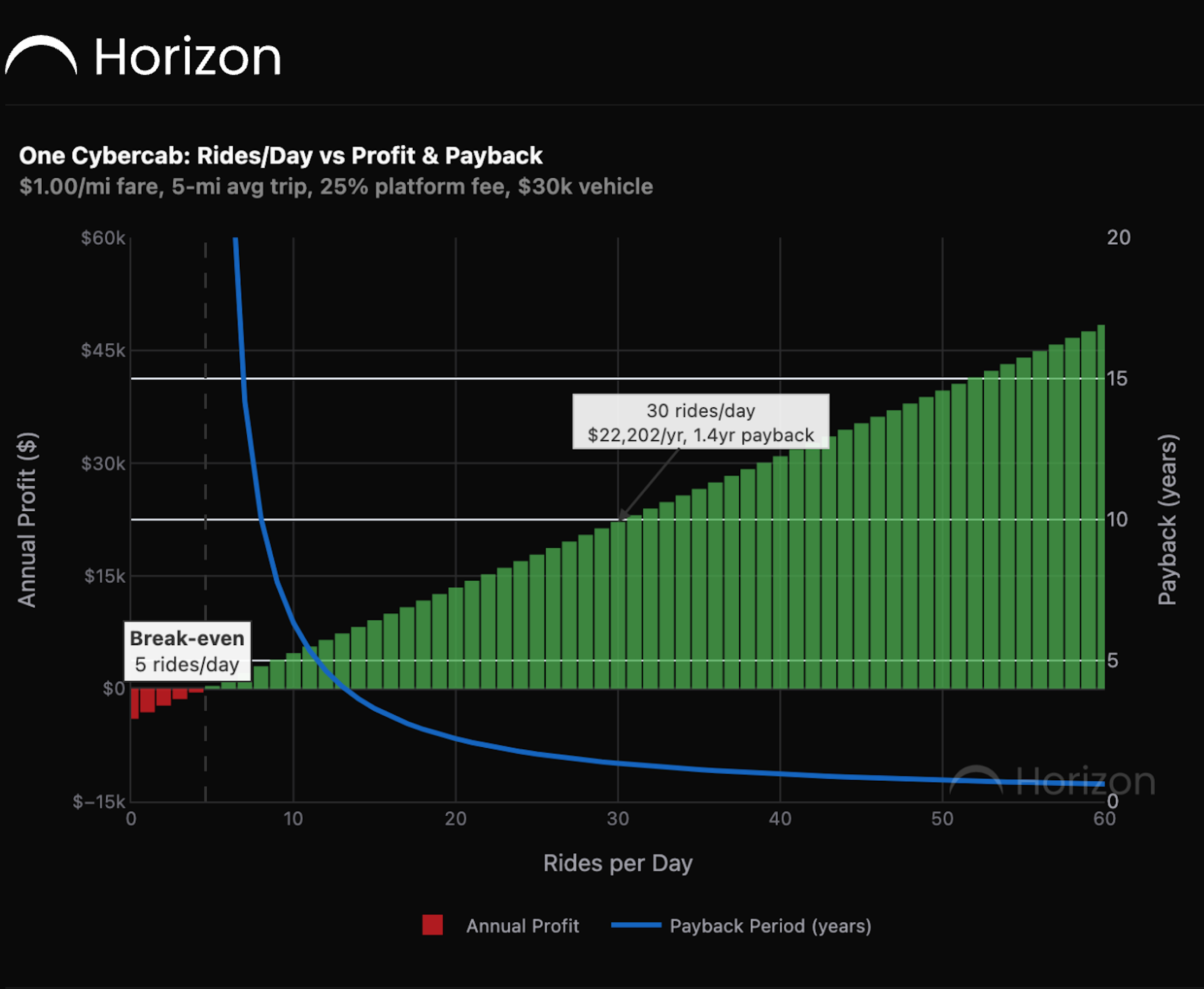
At around five rides per day, one Cybercab reaches roughly break-even in the model.
At 20 rides per day, annual profit rises to about $13,500.
That implies a payback period of roughly 2.2 years.
At 30 rides per day, annual profit increases to around $22,200 and the payback period falls to approximately 1.4 years.
The important point is that the economics improve rapidly once the vehicle is kept busy.
Why removing the driver changes the model
Uber's current structure has a large labour component.
A meaningful portion of each fare must compensate the driver.
A robotaxi removes that cost but replaces it with vehicle ownership, charging, maintenance, cleaning, insurance and technology costs.
If autonomy works reliably and vehicles can operate for large portions of the day, the fixed asset can be spread across many more trips.
That creates room for both a lower passenger fare and an acceptable operator return.
The threat to Uber is structural
This does not mean Uber disappears if robotaxis work.
Uber has a large customer base, demand network, routing infrastructure and a platform that could potentially distribute autonomous rides from multiple providers.
But the economics of its current model would change.
If autonomous fleets can offer materially cheaper rides while still earning attractive returns, the value of the human-driver marketplace becomes less central.
Uber would need to capture value somewhere else in the stack.
What has to go right
The model depends on assumptions.
Tesla must deliver genuine autonomous operation at scale.
Utilisation must be high enough.
Vehicle costs, maintenance, insurance and downtime must remain within workable ranges.
Regulation also matters.
If any of those assumptions fail, the economics deteriorate quickly.
The takeaway
The most important result is not simply that Cybercab could be cheaper than Uber.
It is that the model can remain profitable while charging much less.
At high utilisation, the economics become increasingly attractive.
If that can be delivered in the real world, robotaxis would not just be another competitor in ride-hailing. They would change the cost structure of the entire market.
Share this post: