
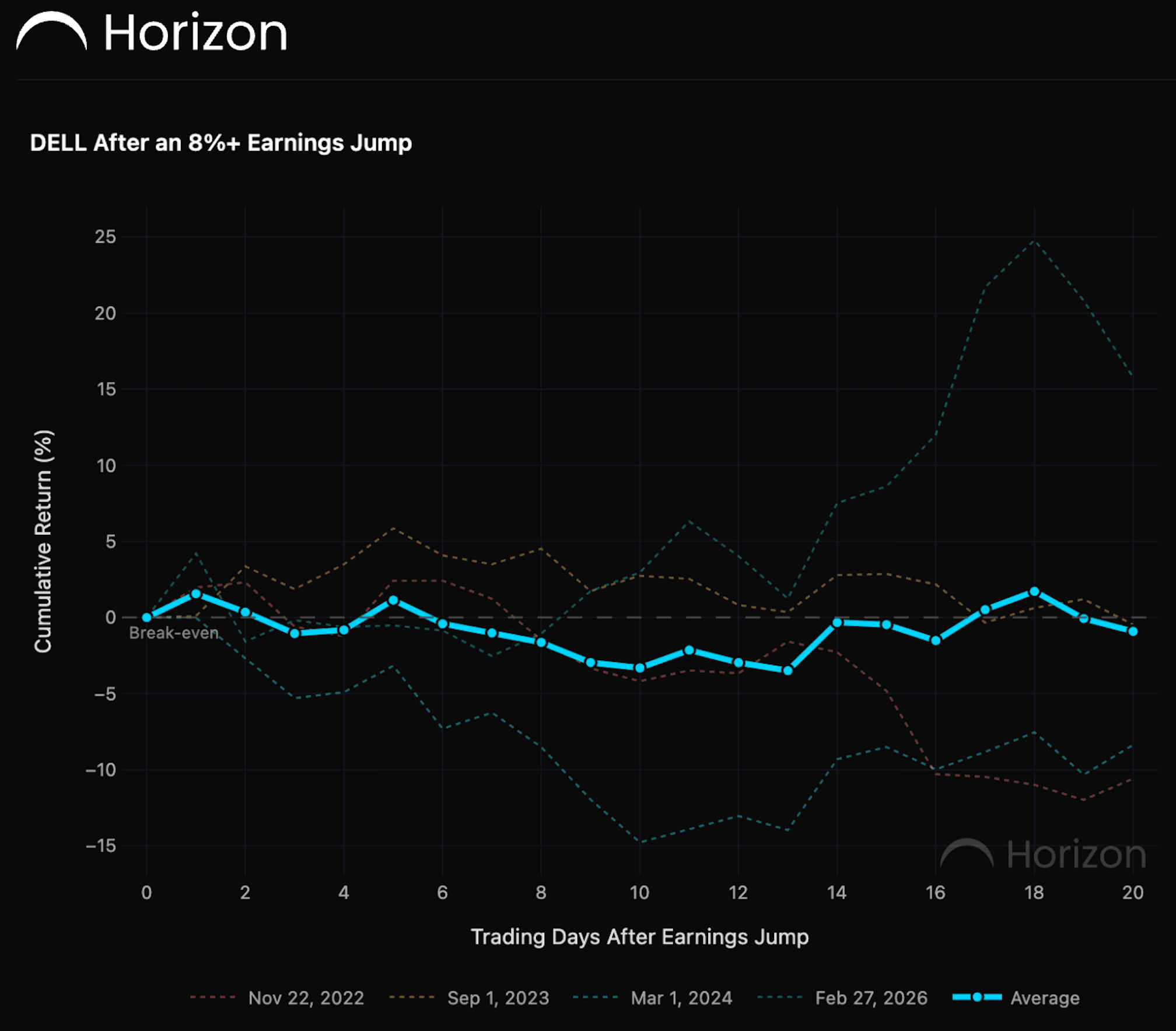
Dell has produced several large earnings gaps since returning to public markets in 2018.
The immediate reaction can look powerful.
The follow-through has been much less impressive.
We looked at every Dell earnings reaction of at least 8% since the December 2018 relisting.
There were four.
The first day usually added a little more
On average, Dell gained another 1.57% on the trading day after the large earnings reaction.
That suggests the initial momentum sometimes carried into the next session.
After that, the pattern weakened.
By Day +10, the average return from the reaction-day close was -3.31%.
By Day +20, it was -0.91%.
So the typical large earnings jump did not develop into a strong multi-week trend.
The four historical events
| Earnings Date | Reaction Day | Reaction |
|---|---|---|
| Nov 21, 2022 | Nov 22, 2022 | +8.72% |
| Aug 31, 2023 | Sep 1, 2023 | +11.69% |
| Feb 29, 2024 | Mar 1, 2024 | +12.00% |
| Feb 26, 2026 | Feb 27, 2026 | +9.57% |
The sample is small, but the direction is consistent enough to be interesting.
The big gap tended to capture much of the move immediately.
Why large earnings gaps often fade
A large earnings reaction reflects a sudden repricing.
If the stock jumps 8% to 12% in one session, a lot of the new information has already been absorbed.
That does not mean the move was wrong.
It means the easy part may already have happened.
After the initial repricing, the stock needs fresh buying pressure to continue higher.
Dell's historical examples did not show much of that.
The takeaway
Big Dell earnings gaps have not historically led to sustained follow-through.
Across the four 8%-plus reactions since the 2018 relisting, the average return was slightly negative one month later.
The first session after the gap sometimes added a little more.
After that, momentum usually faded.
The sample is small, so this is context rather than a rule.
But history does not suggest that chasing a large Dell earnings jump has offered a strong multi-week edge.
Share this post: