
The trade sounds obvious.
Oil spikes, then falls sharply.
Fuel costs should improve.
Airline margins should benefit.
Airline stocks should rally.
Historically, that chain of logic has not produced a reliable equity edge.
Twenty-five oil spike-then-drop events
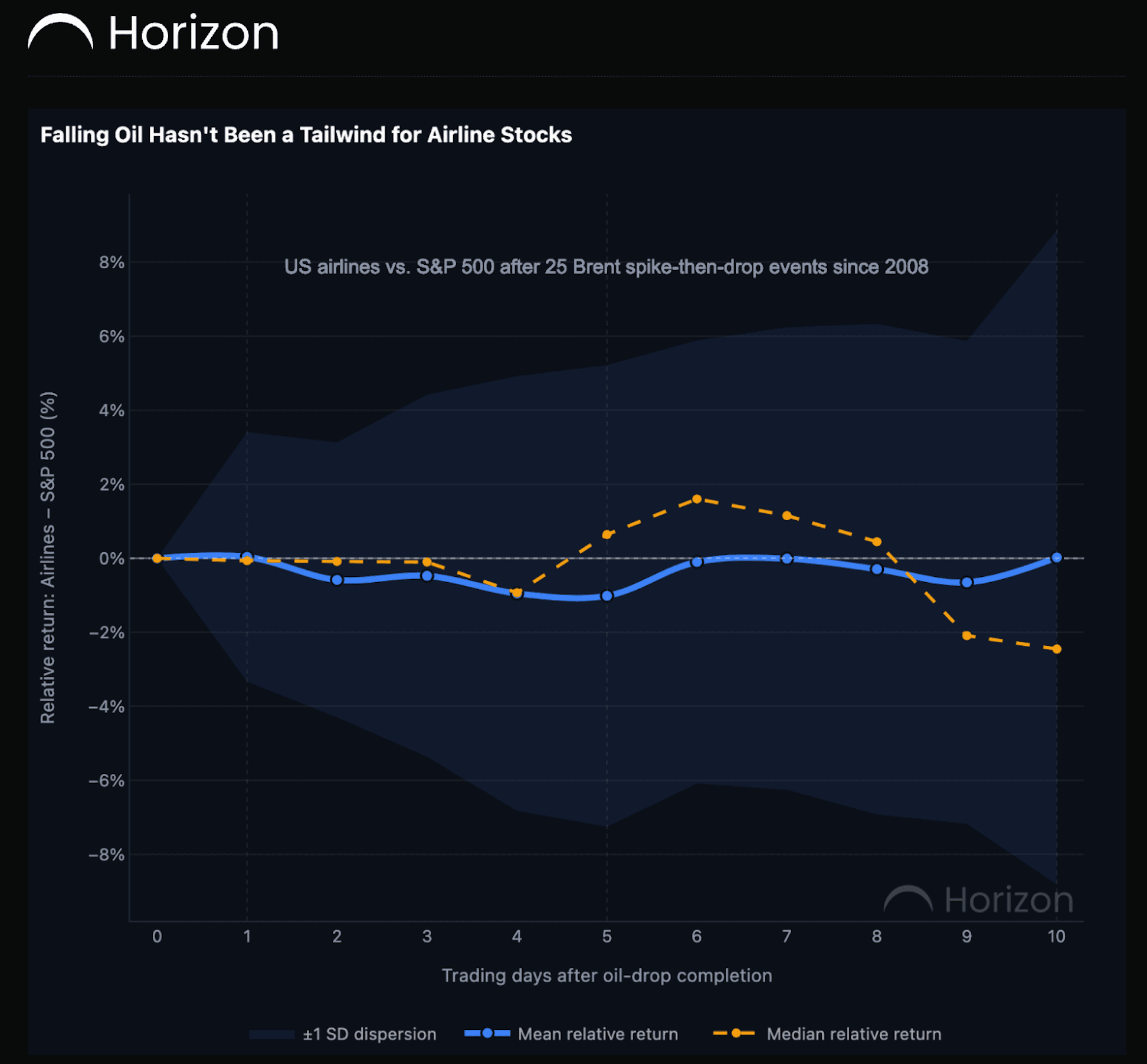
We looked at 25 Brent crude episodes since 2008 where oil first surged and then fell sharply.
We then measured U.S. airline performance relative to the S&P 500.
The average excess returns were almost flat:
- Day +1: +0.04%
- Day +5: -1.02%
- Day +10: +0.02%
By Day +10, airlines had outperformed the market in only 44% of the events.
That is not a useful buy signal.
Why cheaper fuel is not enough
Fuel is a major airline cost.
That part of the thesis is correct.
The problem is why oil is falling.
A sharp decline in crude can reflect weaker economic growth, lower travel demand, recession fears or broader risk-off conditions.
Those same forces can hurt airline revenues and valuations.
The savings on fuel therefore do not arrive in isolation.
The macro backdrop usually dominates
Airlines are highly cyclical businesses.
Ticket demand, pricing power, business travel, consumer confidence and broader economic growth all matter.
A lower fuel bill helps.
But if oil is falling because the market is pricing weaker demand, that benefit can be overwhelmed by the rest of the macro picture.
That helps explain why the historical outcomes were so dispersed.
The intuitive trade exists on paper
There is nothing wrong with the accounting logic.
Cheaper jet fuel improves costs.
The mistake is assuming that lower oil automatically translates into better stock performance.
The market prices the full earnings environment, not one input.
The takeaway
Falling oil after a major energy spike has not been a reliable buy signal for airline stocks.
Across 25 historical events, relative performance versus the S&P 500 was essentially flat after 10 trading days.
Cheaper fuel helps margins.
The broader macro environment has historically mattered more.
Share this post: