
The Federal Reserve raised rates on September 16, and the Bank of Japan is expected to follow on September 18.
What makes that setup unusual is not simply that both central banks are tightening. It is how close together the two decisions are.
Since 1990, the Fed and BOJ have raised rates within 30 days of each other only once.
The only previous case
The previous occurrence came in 2006.
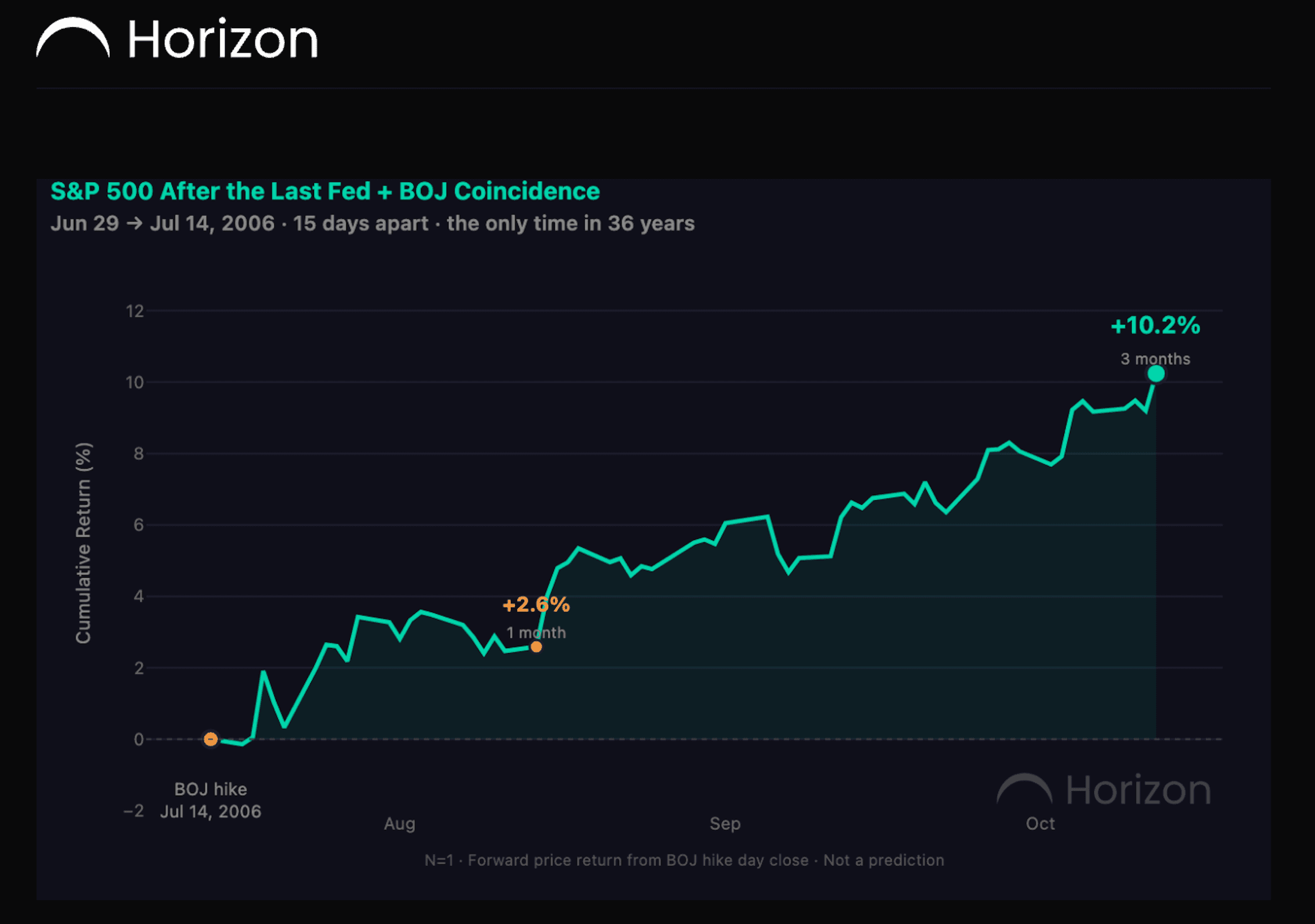
The Fed raised rates in late June and the Bank of Japan followed on July 14, just 15 days later.
We looked at what happened across the S&P 500, Nikkei 225 and USD/JPY after the BOJ decision.
| Market | 1 Month | 3 Months |
|---|---|---|
| S&P 500 | +2.59% | +10.24% |
| Nikkei 225 | +6.37% | +10.26% |
| USD/JPY | +0.44% | +2.71% |
Both equity markets were more than 10% higher three months after the BOJ hike.
That is not necessarily the outcome you would expect from two major central banks tightening monetary policy within weeks of each other.
Why this setup matters
If the BOJ hikes on September 18 as expected, the two decisions will have come only two days apart.
That would make the current episode even more tightly clustered than the only previous example in the 36-year study.
The historical comparison is interesting because simultaneous tightening can easily be framed as an obvious risk-off event. In the only comparable case we could find, that is not what followed.
Instead, both U.S. and Japanese equities rallied strongly over the next three months.
One observation is not a signal
There is an obvious limitation here: the sample size is one.
There is no statistical case for claiming that a Fed and BOJ tightening cluster is bullish, bearish or anything else based on a single historical episode.
The market structure in 2006 was also different from the market structure today. Growth, inflation, valuations, positioning and the starting level of rates all matter.
That is why I would not use the 2006 outcome as a forecast.
The useful takeaway
The useful part of the study is the rarity.
Markets have had plenty of Fed hikes and plenty of BOJ policy changes over the last three decades. What they have almost never had is both central banks tightening within the same 30-day window.
The only previous case was followed by strong equity performance rather than an immediate tightening-driven selloff.
If the BOJ follows the Fed this week, we will be watching a monetary-policy setup that has appeared only once since 1990. That makes the next few months worth tracking, even if history gives us nowhere near enough evidence to predict the outcome.
Share this post: