
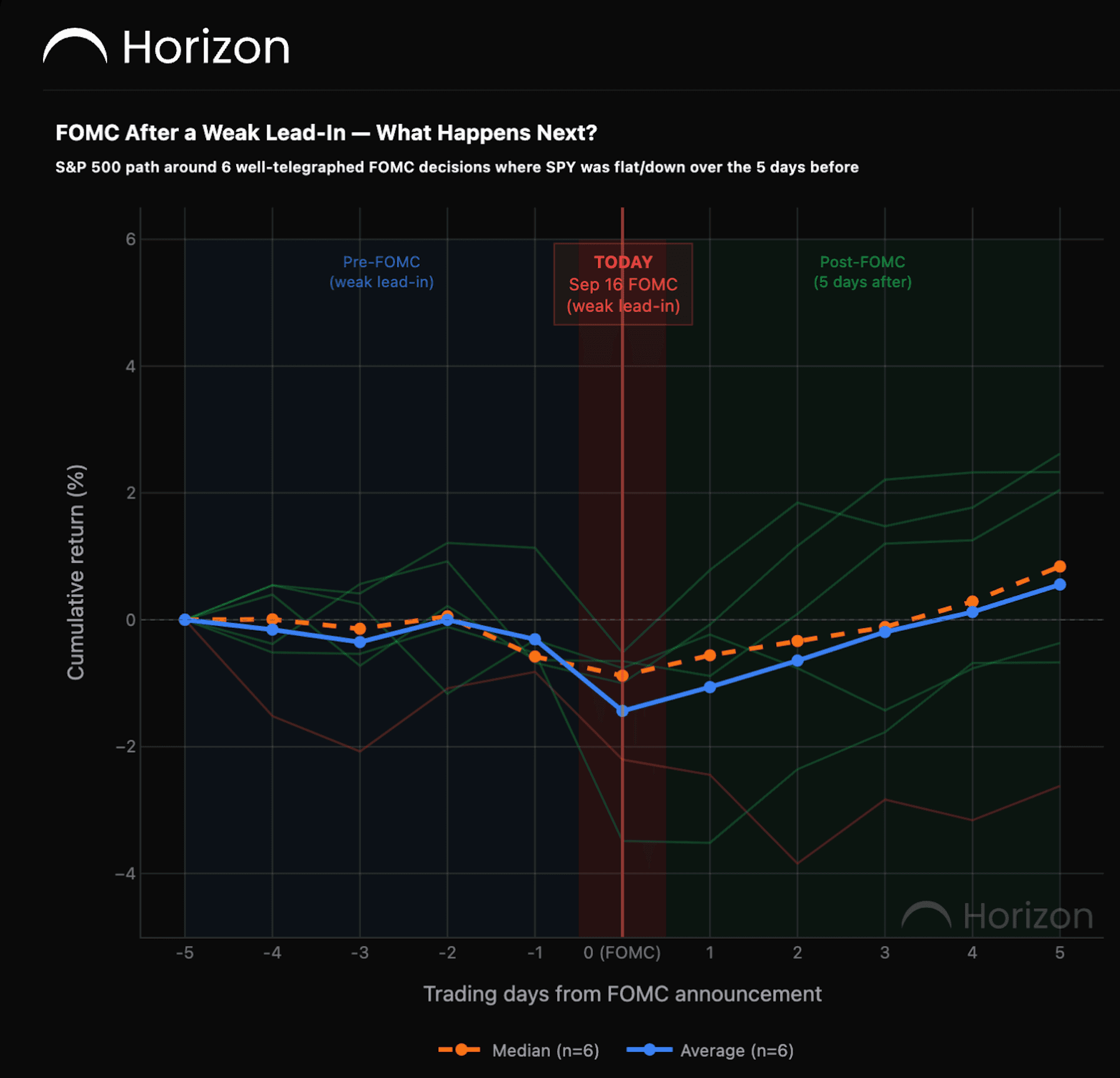
SPY came into today's FOMC decision flat to lower over the previous five trading days.
That made me curious about a simple question: when the market has already been weak into a well-telegraphed Fed decision, what has happened next?
The answer was more interesting after the announcement than on the announcement day itself.
Finding comparable meetings
We looked at six well-telegraphed FOMC meetings from January 2024 through June 2026 where SPY also had a weak five-day lead-in.
The sample is deliberately narrow. The goal was not to study every Fed meeting, but to isolate recent meetings with a similar setup going into the decision.
The first reaction was basically noise
On the FOMC day itself, the median move from the decision day to the next session was +0.25%.
Only half of the observations were positive.
That is not much of a pattern. The immediate market response was mixed, which makes sense given how much of an FOMC day depends on the statement, the press conference, positioning and what was already priced in.
The stronger result appeared over the following week.
Five of six were higher one week later
Five trading days after the decision, five of the six comparable meetings had produced a positive return.
The median move was +2.76%.
That is a much cleaner historical pattern than the same-day reaction.
In this small sample, markets that entered the FOMC meeting weak did not tend to resolve that weakness immediately. They tended to recover over the sessions that followed.
Why the lead-in may matter
Markets rarely react to a central-bank decision in isolation.
By the time the announcement arrives, investors have already spent days or weeks adjusting positions around expected policy, inflation data, labour-market data and the likely path of rates.
A weak lead-in can therefore mean some caution has already been expressed before the Fed actually speaks.
That does not guarantee a relief rally. It simply changes the starting point.
What I take from it
I would not treat six meetings as a trading rule.
The sample is too small, and FOMC outcomes are highly dependent on the details of each meeting.
But the historical context is useful. The strongest pattern in these recent weak-lead-in meetings was not a bullish announcement-day reaction. It was the recovery that developed over the following five trading days.
Five of six finished that window higher, with a median gain of 2.76%.
For today's meeting, that makes the next week more interesting to me than the first few minutes after the decision.
Share this post: