
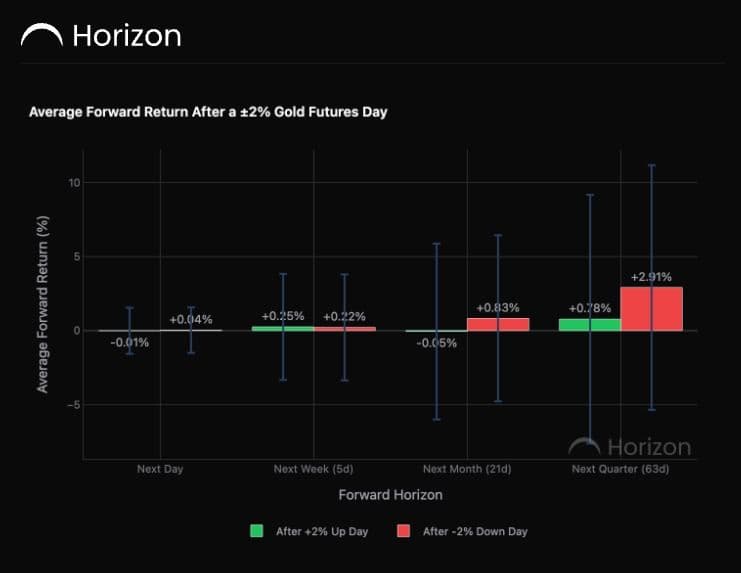
Gold futures rose 2.5% in a single session.
That is large enough to raise a useful question.
Does a strong one-day move usually lead to continuation, or does gold tend to give some of the move back?
The original research was built around that exact setup.
Large daily moves change the starting point
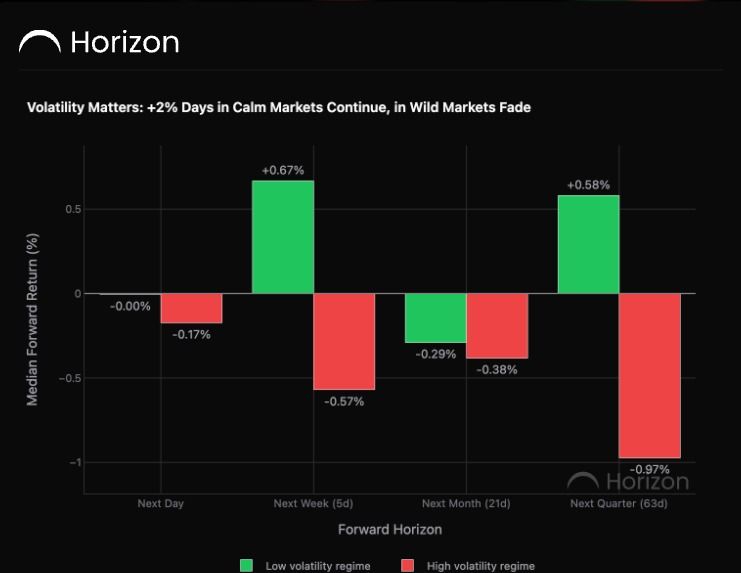
A 2.5% gain in gold is not a normal session.
It represents a significant repricing of rates, the dollar, inflation expectations, geopolitical risk or some combination of those factors.
Once a move that large has already happened, the next-day setup is very different from an ordinary trading day.
A large amount of information has already been absorbed.
Momentum and exhaustion can both be plausible
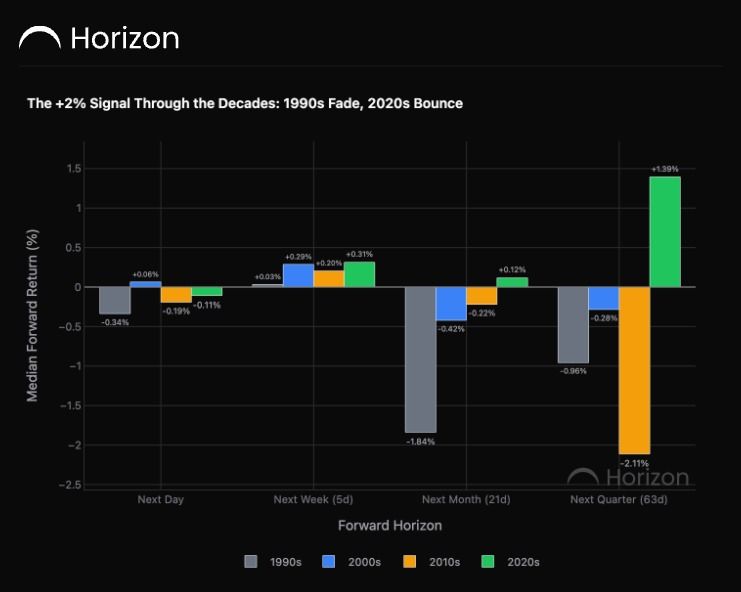
There are two competing forces after a large up day.
Momentum traders may continue buying because the move confirms a broader trend.
At the same time, short-term positioning can become stretched and encourage profit-taking.
That is why the forward path matters more than the headline move itself.
Context matters more than the number alone
A 2.5% gold rally driven by a collapsing dollar is not the same as one driven by a geopolitical shock.
The same daily return can come from very different underlying regimes.
That means historical averages should be treated as context rather than as a mechanical forecast.
The useful question
The strongest way to analyse a move like this is not "gold was up 2.5%, should I buy or sell?"
It is whether similar large up days tended to produce continuation over the following sessions and whether the current macro backdrop resembles those historical cases.
The one-day move is the trigger.
The regime determines how useful the trigger is.
The takeaway
A 2.5% rally in gold is large enough to matter.
It is not enough on its own to define what happens next.
The more useful framework is to treat the move as an event and compare the following path with prior large up days.
In markets like gold, the context behind the move usually matters as much as the move itself.
Share this post: