
The U.S. 10-year yield is sitting at the top of its one-year range.
At the same time, the Nasdaq-100 remains elevated.
That combination feels unusual because higher long-term yields are often treated as a headwind for growth stocks.
The data says the setup really is uncommon.
How often do both sit near one-year highs?
We looked at 6,447 trading days since 2000.
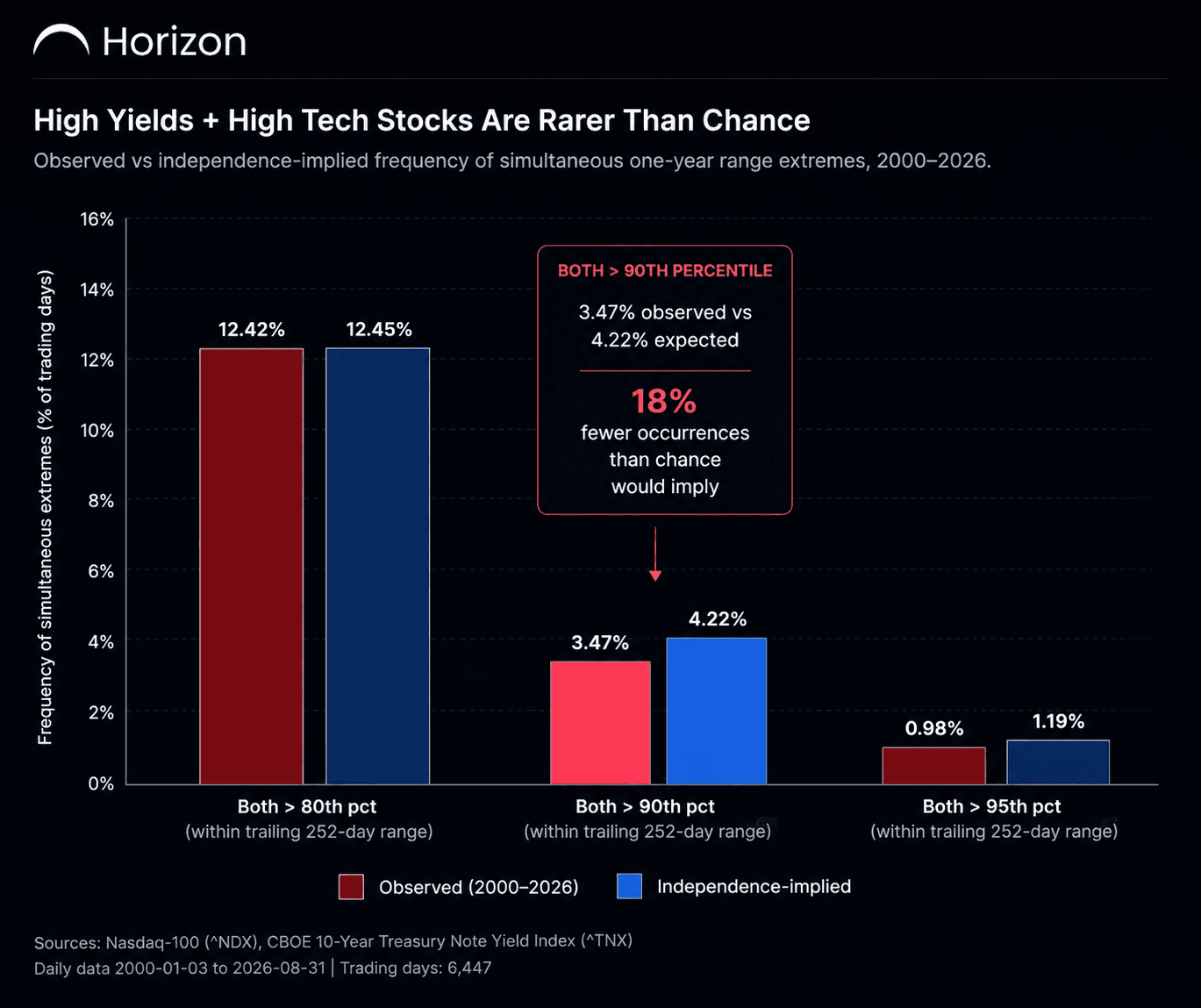
The Nasdaq-100 and U.S. 10-year yield were both above the 90th percentile of their trailing 252-day ranges on only 3.47% of days.
If the two variables reached those thresholds independently, chance would imply a joint occurrence rate of 4.22%.
The actual frequency was about 18% lower.
At the 95th-percentile threshold, the pattern was similar.
The observed joint frequency was 0.98%, compared with 1.19% expected by chance.
High yields do not automatically kill tech
The historical clusters are useful.
The biggest examples appeared in 2003, 2013 to 2014, late 2016 and early 2018.
Those were periods where stronger growth expectations were powerful enough to support equities even as long-term yields climbed.
That is an important distinction.
Rising yields can reflect tighter financial conditions.
They can also reflect stronger nominal growth.
The market reaction depends heavily on which force is dominating.
Why the combination is rare
Growth stocks are sensitive to discount rates.
All else equal, higher long-term yields reduce the present value of future cash flows.
That creates a natural tension between expensive growth equities and rising bond yields.
For both to remain near their highs, investors usually need a strong enough economic or earnings narrative to offset the valuation pressure.
That helps explain why the joint extreme appears less often than chance would suggest.
Where the current market sits
The 10-year yield is already at the 100th percentile of its trailing one-year range.
The Nasdaq-100 is around the 84.4th percentile.
So the current market is not yet in a full joint extreme.
A renewed Nasdaq push above the 90th percentile would move the setup into a historically uncommon regime.
The takeaway
High yields do not automatically mean weak technology stocks.
But having both long-term yields and growth equities near their one-year highs has historically been rare.
When it has happened, it often appeared during strong reflationary or growth regimes.
That is useful context.
It is not evidence that the current market must enter another major trend, but it does tell us that the combination is more unusual than it looks.
Share this post: