
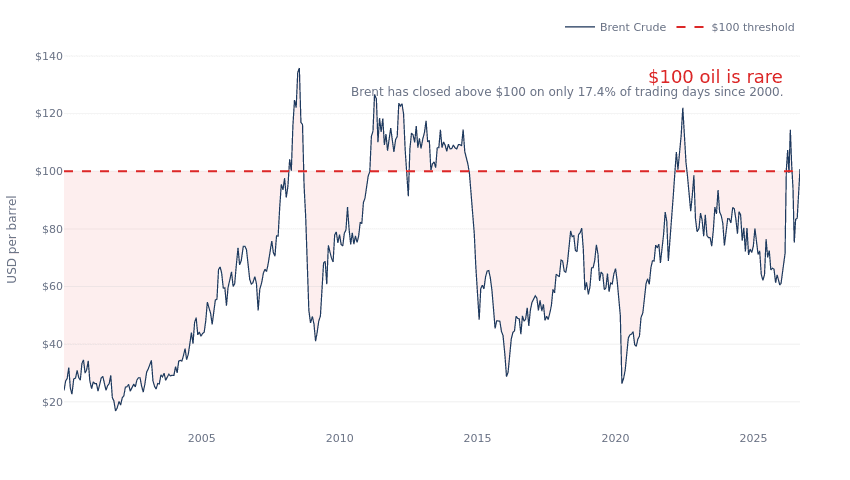
Brent crude has moved back above $100 per barrel.
That number carries obvious psychological weight, but it is also genuinely unusual in the historical data.
Since January 2000, Brent has closed above $100 on only 1,199 of 6,898 trading days.
That is 17.4% of the time.
Most trading days have been below $100
More than four out of every five trading days over the last 26 years saw Brent close below $100.
At $100.81, the current price sits around the 83rd percentile of all daily closes in the dataset.
So $100 is not an extreme price in the sense of being unprecedented.
It is still an elevated regime relative to most of modern oil-market history.
The first $100 close came in 2008
Brent first crossed the $100 level on February 28, 2008.
Since then, the market has moved above the threshold in 10 distinct episodes.
Some were brief.
Others lasted for years.
The longest continuous stretch above $100 ran for 555 trading days from July 2012 through September 2014.
That period is a useful reminder that a rare price regime can still persist once it begins.
Why the threshold matters
There is nothing mechanically special about $100.
Oil markets do not change behaviour because a round number has been crossed.
What the level does tell us is where the current price sits within its long-run distribution.
At $100, consumers, companies and policymakers are dealing with an oil price that has historically been present less than one-fifth of the time.
That can matter for inflation expectations, transportation costs, margins and energy-sector cash flows.
Rare does not mean unsustainable
One mistake is to assume that because $100 oil is historically uncommon, it must quickly fall back below the threshold.
The 2012 to 2014 episode shows why that logic is weak.
Brent can remain in an elevated regime for a long time when the underlying supply and demand environment supports it.
The historical rarity tells us where we are.
It does not tell us when the regime ends.
The takeaway
$100 oil is still unusual.
Brent has spent only 17.4% of trading days above that level since 2000, and today's price sits around the 83rd percentile of the full sample.
That makes the current move an elevated price regime rather than a normal one.
The next question is not whether $100 is historically high.
It is whether the conditions that pushed oil there are strong enough to keep it there.
Share this post: