
Humanoid robots are one of the most exciting areas in technology right now.
AI is moving into the physical world. Hardware costs are falling. Manufacturers are moving beyond demonstrations and into early deployments. The long-term opportunity could be enormous.
The more interesting question is how quickly that opportunity can scale.
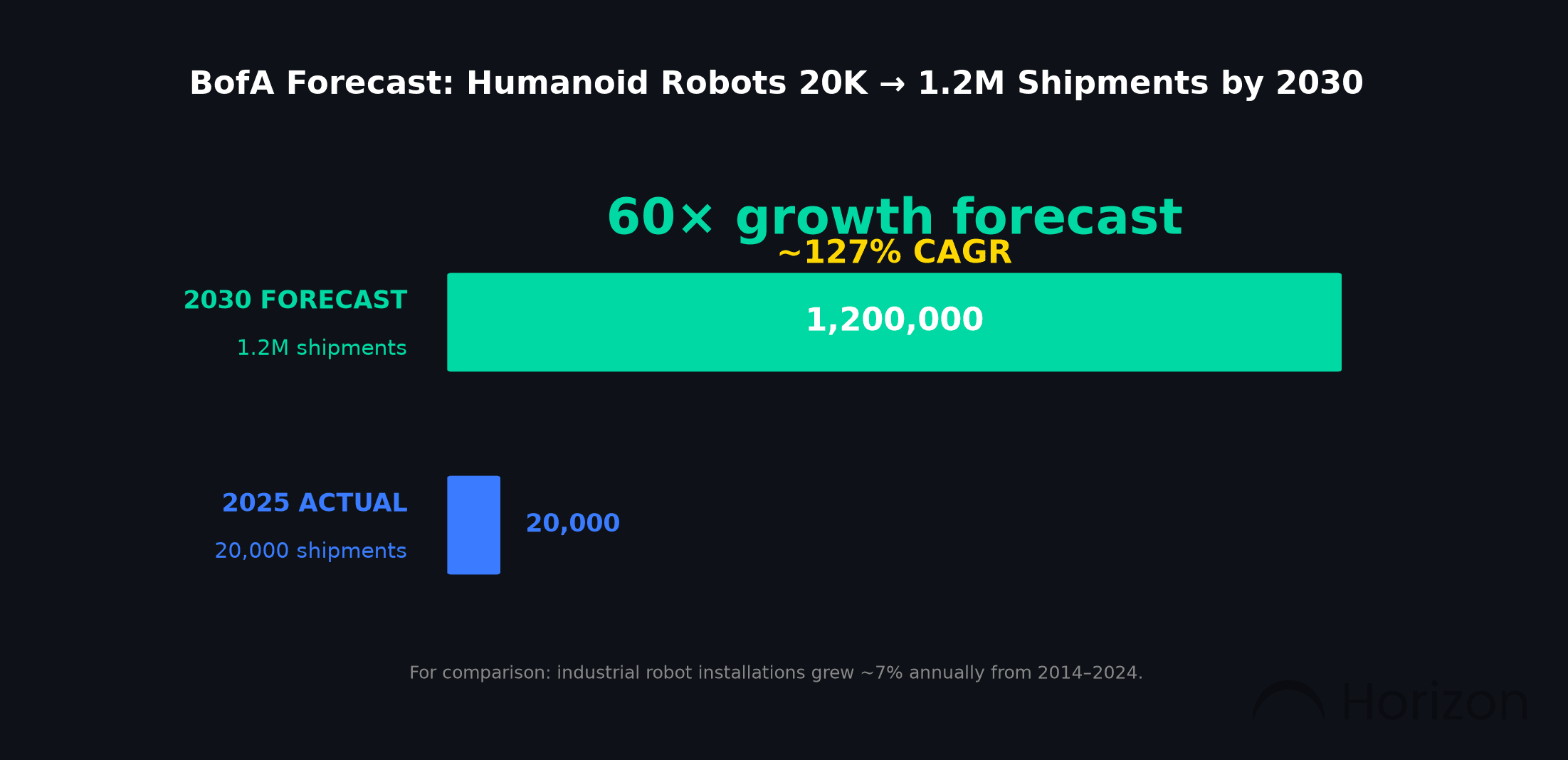
Bank of America Global Research forecasts annual humanoid robot shipments rising from 20,000 units in 2025 to 1.2 million by 2030. That is not a requirement for the industry to succeed. It is a growth target embedded in one of the more ambitious adoption forecasts for the next five years.
And it is a massive one.
From 20,000 to 1.2 million
BofA's March 2026 forecast puts annual humanoid shipments at 20,000 in 2025, 90,000 in 2026, 290,000 in 2027, 500,000 in 2028, 800,000 in 2029 and 1.2 million in 2030.
That means the forecast is not simply saying humanoid robots will grow.
It assumes they move from a very small commercial market today to more than one million units shipped every year by the end of the decade.
From BofA's own 2025 starting point, that is a 60-fold increase in annual shipments in five years, equivalent to roughly 127% compound annual growth.
The question is not whether the industry needs to hit that number.
The question is whether adoption can expand quickly enough for a forecast of that scale to become reality.
The starting point is still early
There is also uncertainty around exactly how large the humanoid market is today.
The International Federation of Robotics counted approximately 7,000 humanoid robots sold globally in 2025 for industrial and professional service applications. Its definition excludes consumer, military and medical robots, so it is narrower than some shipment estimates used elsewhere.
That difference matters. Humanoids are still such an early category that estimates can vary materially depending on what is being counted.
But every version tells broadly the same story: the current commercial base is small relative to the scale being forecast for the end of the decade.
What has to drive the expansion
There are credible reasons to expect rapid growth.
AI is making robots more capable of perceiving and responding to the physical world. Component costs are falling. More companies are entering the market. Industrial and service applications provide an obvious first step because structured environments are easier to automate than homes.
BofA expects these forces to push humanoids from pilots toward production and wider deployment.
That is the bullish case, and it is a compelling one.
The challenge is turning technical progress into economic adoption.
Businesses need robots that can perform useful work reliably, safely and cheaply enough to justify deployment. Manufacturing capacity has to scale. Maintenance and uptime have to improve. The available use cases have to broaden.
A great robot demo is not the same thing as a million-unit market.
A very different growth curve
Traditional industrial robotics provides useful context, although the markets are at very different stages.
Industrial robots are already a mature global category. Humanoids are starting from a tiny base, which means extremely high early growth rates are possible.
That distinction is important. Comparing the two directly would be misleading.
But it also highlights what makes the humanoid forecast interesting. The next five years are expected to be less about incremental growth and more about the creation of an entirely new robotics market at scale.
If BofA's trajectory is close, annual shipments move from tens of thousands to hundreds of thousands remarkably quickly, before crossing one million around the end of the decade.
The opportunity and the target
You can be bullish on humanoid robots without assuming every aggressive adoption forecast will be reached on schedule.
Those are two different views.
Humanoids could become a major technology platform even if adoption takes longer than currently projected. Equally, breakthroughs in AI, manufacturing and cost could accelerate deployment faster than expected.
That is why the next few years matter.
The key signal is no longer whether companies can build impressive humanoid robots. It is whether they can turn those machines into products that businesses and eventually consumers deploy at scale.
The takeaway
BofA forecasts annual humanoid robot shipments increasing from 20,000 in 2025 to 1.2 million by 2030.
That is a 60x expansion in five years.
It is not a requirement for humanoid robotics to succeed. It is a measure of how aggressive the current growth expectations have become.
The long-term robotics opportunity can be enormous while the path to mass adoption remains difficult.
Now the industry has to show how quickly it can close that gap.
Share this post: