
Orion180 priced its IPO at $12 after initially marketing shares at $15 to $17. That is a 25% discount to the midpoint of the original range.
At first glance, that looks like a clear warning sign. If an IPO needs to be repriced that aggressively before listing, it usually tells you something about demand during the book-building process.
The more interesting question is what happens after the shares start trading.
What we tested
We looked at 797 U.S. IPOs from 2011 to 2026 where the original marketed price range was available.
Of those, 149 IPOs priced at least 15% below the midpoint of their original range. The remaining 648 priced within their marketed range.
We then compared the median performance of the two groups across Day 1, one month, three months and six months.
| Horizon | Heavily discounted | Within range |
|---|---|---|
| Day 1 | +1.0% | +4.4% |
| 1 Month | +2.9% | +4.4% |
| 3 Months | +9.6% | +2.3% |
| 6 Months | +10.4% | -0.1% |
The warning shows up immediately
The clearest result was on the first day of trading.
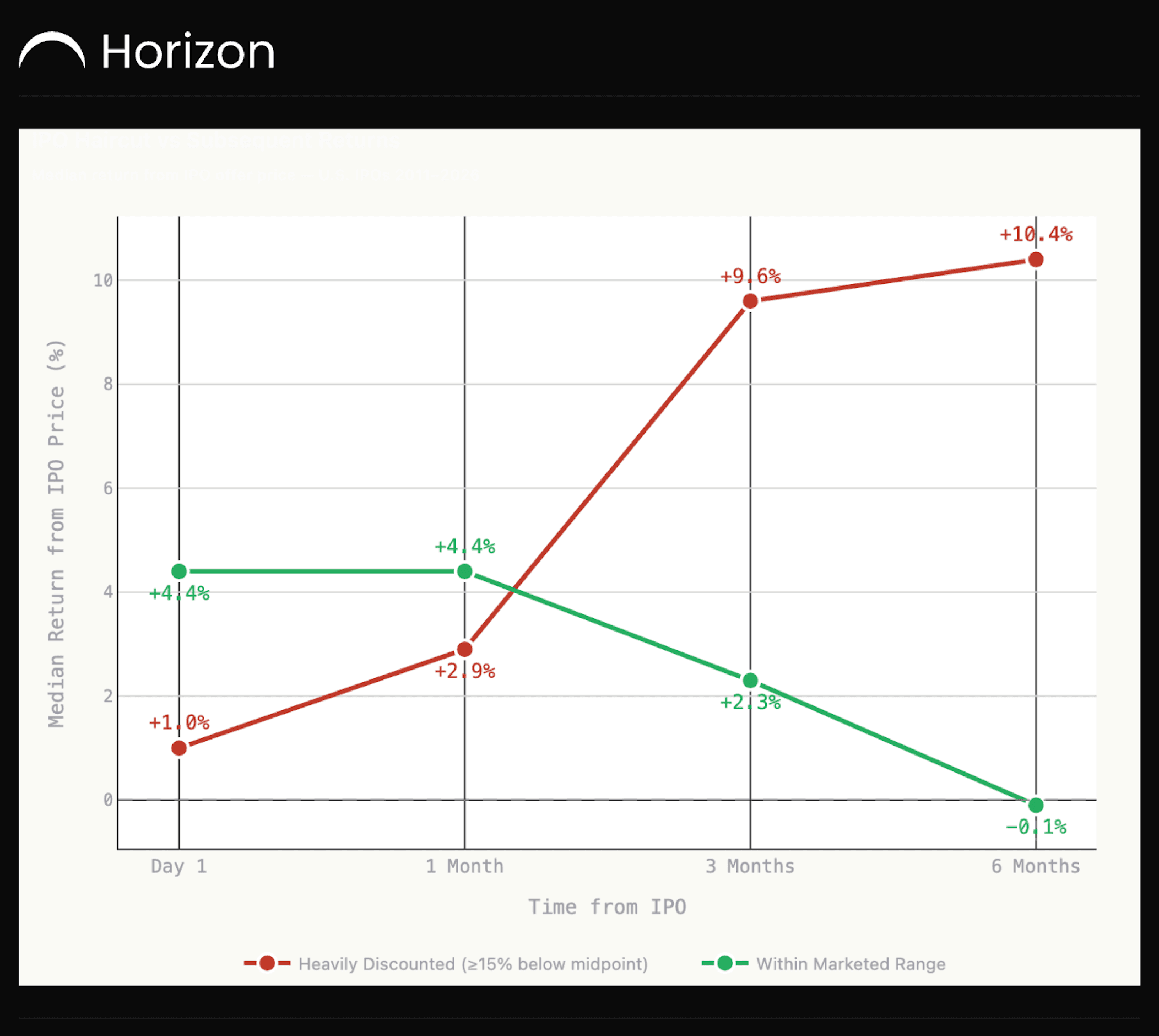
Heavily discounted IPOs produced a median Day 1 return of just 1.0%, compared with 4.4% for IPOs that priced within their original range. The difference was statistically significant at p=0.02.
That fits the intuitive story. A large pricing cut before listing appears to be a genuine signal that initial investor demand was weaker than expected.
But that is not where the story ends.
The gap disappears over time
By one month, the discounted group was still behind.
By three months, it had moved ahead. The median return reached 9.6%, compared with 2.3% for IPOs priced within range.
At six months, the difference was even larger: 10.4% for the heavily discounted group versus -0.1% for the within-range group.
That does not mean discounted IPOs have a proven medium-term edge. The three-month and six-month differences were not statistically significant, with p-values of 0.64 and 0.30.
What it does show is that the weak initial demand signal did not translate into persistently weaker returns.
Why that may happen
One possible explanation is valuation.
If weak book-building demand forces a company to accept a materially lower offer price, the stock begins public trading from a cheaper starting point. That can leave more room for a later rerating if the underlying business performs better than the cautious IPO pricing implied.
The data here does not prove that mechanism. It simply makes it plausible.
Orion180 is an unusually deep discount
Orion180's 25% haircut is also larger than the 22.2% median discount among the heavily discounted IPOs in the study.
That makes it a useful live case to watch.
History suggests the pricing cut should be taken seriously as a sign of weaker initial demand. It does not, however, tell us that the stock should remain weak once it begins trading.
The strongest result in the data is the Day 1 weakness. The more interesting result is what happened after that.
Share this post: