When markets are near their highs and demand for put protection collapses, the usual interpretation is complacency.
That often gets translated into a much stronger claim: investors are too comfortable, so a correction must be close.
History does not support that conclusion very well.
What we tested
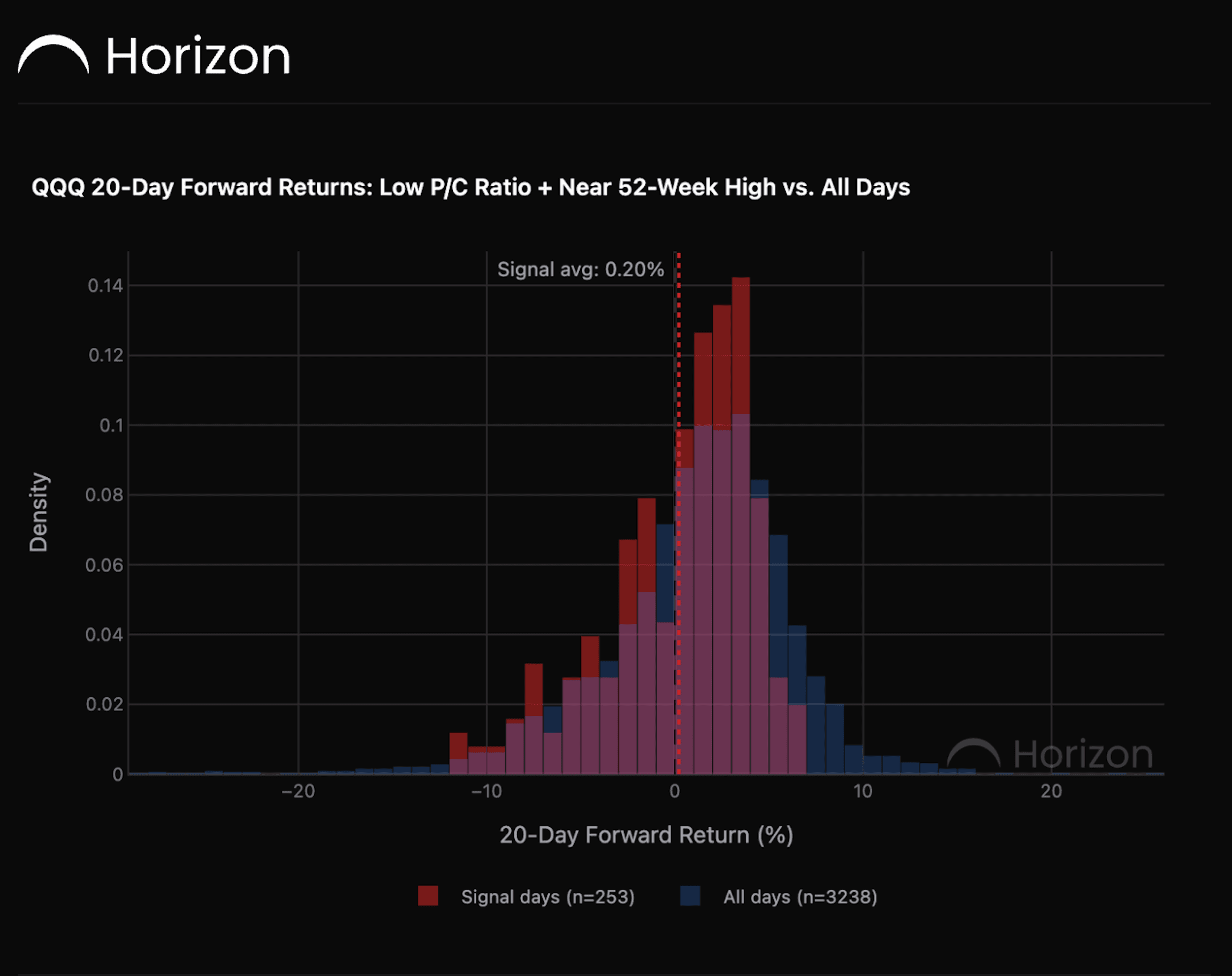
We looked at QQQ from 2006 through 2019 and isolated days where the index was near a 52-week high while equity put demand was extremely low.
There were 253 qualifying signal days.
We then measured QQQ's return over the following 20 trading days.
Most signals still finished higher
QQQ was positive 62.5% of the time over the next 20 trading days.
The median return was +1.34%.
That is not what you would expect from a clean crash warning.
If anything, the typical observation still ended higher.
The problem appears when you look beyond the median.
Average returns were much weaker than normal
Across all trading days in the sample, QQQ produced an average 20-day return of +1.12%.
When QQQ was near a 52-week high without applying the low put/call filter, the average was +0.55%.
On the low-put-demand signal days, the average fell to only +0.20%.
So the market still rose more often than it fell, but the quality of the forward return was materially worse.
The downside tail was the real difference
The worst 20-day outcome after one of these signals was -11.85%.
That helps explain why the average return was so weak despite a positive median and a 62.5% win rate.
Most episodes were fine.
The bad ones were much worse.
That is a different message from saying low put demand predicts a crash.
What complacency actually seems to mean
Extremely low demand for downside protection near market highs has not historically been a reliable reversal signal.
It looks more like a regime where investors are still willing to push the market higher, but the downside becomes more asymmetric when something goes wrong.
In other words, complacency did not consistently mark the top.
It reduced the margin for error.
The takeaway
Low put demand near a 52-week high is not, by itself, a reason to expect an imminent crash.
Across 253 historical signals, QQQ was still higher 62.5% of the time one month later.
The more useful warning is subtler: average returns were weaker than normal and the left tail was considerably uglier.
Complacency did not reliably predict the reversal. It made the bad outcomes more painful when they arrived.
Share this post: