
AMD and Meta both made unusually large moves today.
For stocks this large, an 8% move in a single session is rare enough to raise an obvious question: after a mega-cap suddenly reprices higher, does momentum continue or does the market give some of the move back?
The historical pattern is surprisingly two-stage.
123 mega-cap surge days
We looked at U.S. mega-cap stocks with market capitalizations above $500 billion at the time of the move and identified 123 sessions since 2011 where a stock gained at least 8% in one day.
The sample covered 15 companies. Tesla accounted for 26 events, Nvidia 14, Meta 12, Amazon 10 and Broadcom 10, with the remainder spread across Apple, Microsoft, Alphabet, AMD, JPMorgan, Visa, Walmart, Eli Lilly, Oracle and Intel.
For each event, we measured returns from the surge-day close over the next week, month and three months.
The first week usually gives some of it back
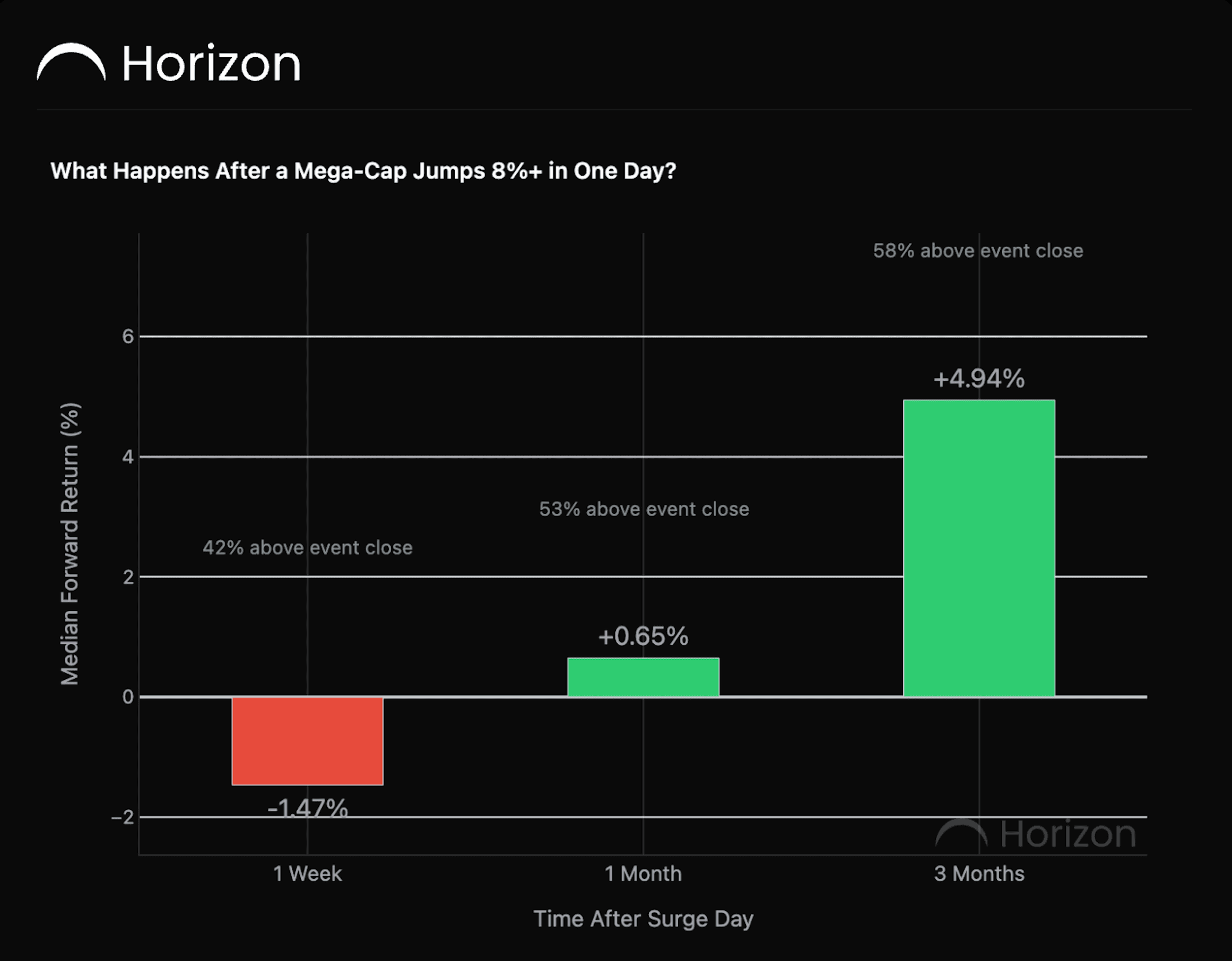
The median return over the next five trading days was -1.47%.
Only 41.7% of events were still above the surge-day close one week later.
That is the clearest part of the pattern. A huge one-day move has historically been followed by short-term profit taking more often than immediate continuation.
The picture changes with time
By one month, the median forward return had recovered to +0.65%, with 52.5% of events above the surge-day close.
At three months, the median return reached +4.94% and 58.2% of events were above the event-day close.
So the historical path has not looked like a simple momentum chase or a permanent reversal.
The typical pattern was an initial giveback, followed by gradually stronger returns over the following months.
Why the distinction matters
An 8% daily move can feel extreme for a company worth hundreds of billions of dollars.
But extreme does not automatically mean the move marked a top.
Historically, the immediate risk was concentrated in the first week. Over longer horizons, the median outcome improved and eventually moved back into positive territory.
That distinction is particularly relevant on days when several mega-caps are repricing sharply at the same time.
The sample is concentrated
There is an important limitation.
Tesla, Nvidia, Meta, Amazon and Broadcom account for more than 60% of the events in the sample. This is therefore heavily influenced by the behavior of volatile mega-cap technology and growth stocks.
It should not be read as a universal rule for every large company, and the historical medians do not predict what any individual stock will do next.
The takeaway
Mega-cap stocks that jump 8% or more in a day have historically tended to cool off first.
Across 123 qualifying events, the median stock fell 1.47% over the following week and fewer than 42% remained above the surge-day close.
But that weakness did not persist in the median case.
By three months, the median forward return was +4.94%, with 58.2% of events above the original surge-day close.
The historical pattern has been less "straight-line momentum" and more initial profit taking followed by gradual recovery.
Share this post: