
Large technology acquisitions usually come with a simple story.
The buyer gets a strategic asset, expands into a new market or strengthens its competitive position.
The stock market often takes longer to agree.
Across major U.S. technology acquisitions worth more than $10 billion, the historical pattern has been weak initially and much better several months later.
Fourteen major deals
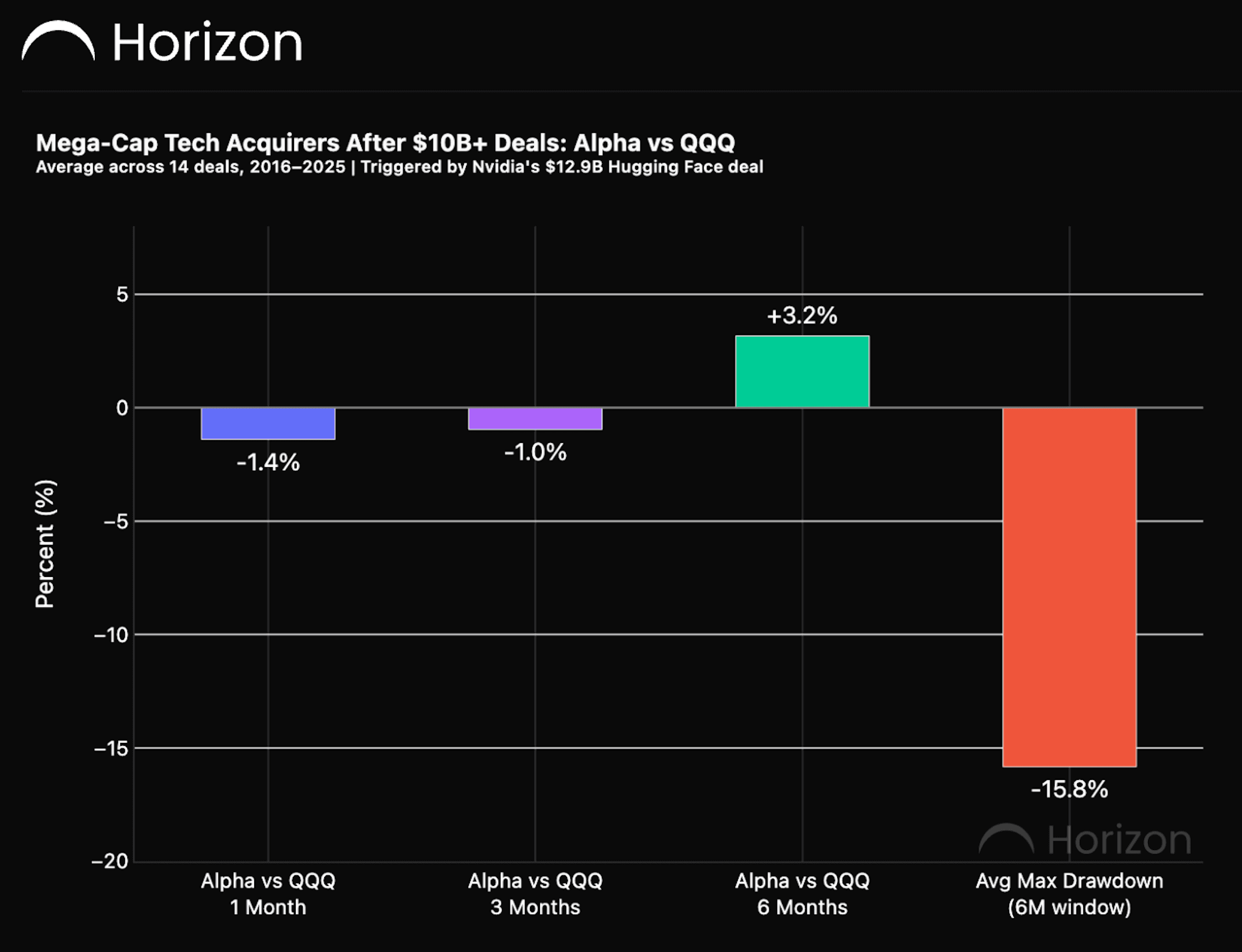
We looked at 14 U.S. mega-cap technology acquisitions worth at least $10 billion since 2016.
One month after the deal, the average acquirer had underperformed QQQ by 1.4%.
At three months, the average relative return was still negative at -1.0%.
By six months, the pattern had reversed.
Average alpha versus QQQ reached +3.2%.
The hit rate improved with time
Only 42.9% of acquirers had outperformed QQQ by the three-month mark.
By six months, that figure rose to 64.3%.
The median six-month alpha was also around +3.2%.
That suggests the market often needs time to become comfortable with the strategic logic of a large acquisition.
The first reaction is rarely the full story.
The path can still be painful
The average maximum drawdown over the six months after the deal was 15.8%.
That is the main catch.
Even deals that eventually produced relative outperformance often experienced meaningful weakness first.
Large acquisitions introduce uncertainty around integration, financing, execution and whether management has overpaid.
The strategic case may take months to prove itself.
Why the short-term reaction can be weak
When a mega-cap company announces a large acquisition, investors immediately know the cash cost.
What they do not yet know is whether the future benefits will justify it.
The downside is visible immediately.
The upside depends on execution.
That asymmetry can create weak-to-flat relative performance while the market waits for evidence.
Nvidia's current setup
Nvidia's $12.9 billion Hugging Face acquisition fits the historical bucket.
If the historical pattern holds, the more relevant window may be six months rather than the first few weeks.
That does not mean Nvidia should outperform.
It means large tech acquirers have historically shown their stronger relative results later, not immediately after the deal.
The takeaway
Mega-cap technology companies have tended to lag QQQ in the first few months after $10 billion-plus acquisitions.
By six months, the picture improved materially.
The trade-off is the path.
Even eventual winners often experienced double-digit drawdowns before the market became comfortable with the deal.
Large strategic acquisitions can work.
History suggests investors often demand proof first.
Share this post: