
Micron rallied 17.51% over five trading days, then fell 7.02% in a single session on August 18, 2026.
That is a violent momentum reversal.
The question is whether these wipeouts tend to snap back quickly or remain weak.
A screen of Micron's daily history back to 2010 found eight comparable events.
The first week was usually weak
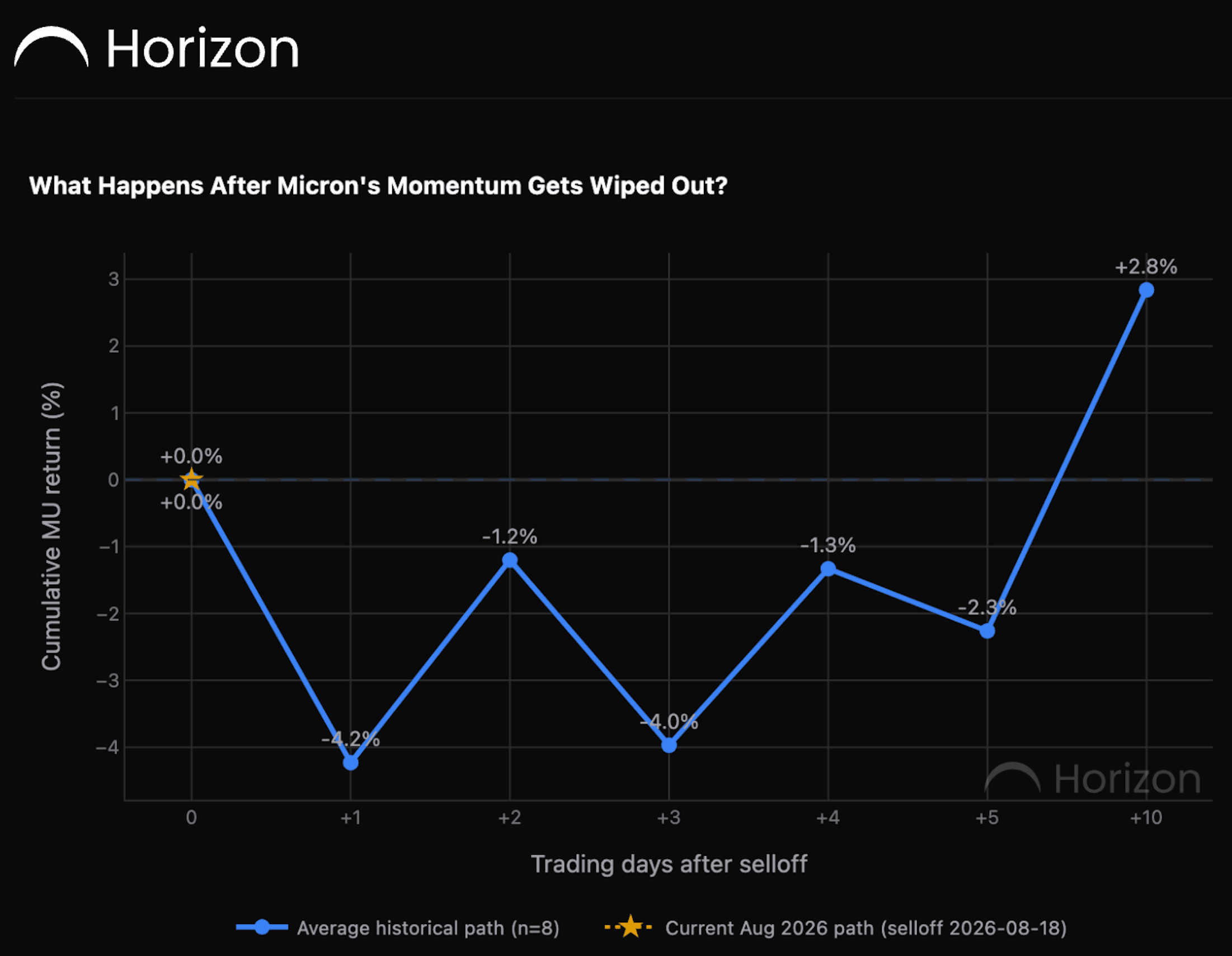
The average cumulative path after the reversal was:
- Day +1: -4.2%
- Day +2: -1.2%
- Day +3: -4.0%
- Day +4: -1.3%
- Day +5: -2.3%
- Day +10: +2.8%
The stock remained below the reversal-day close at every checkpoint through the first week.
Only three of the eight events were positive by Day +5.
The same three were positive by Day +10.
The Day +10 average hides a weak hit rate
By Day +10, the average recovered to +2.84%.
At first glance, that looks constructive.
The hit rate tells a different story.
Only 37.5% of events were actually positive.
That means a small number of strong rebounds pulled the average higher.
The recovery was not broad across the sample.
Why momentum wipeouts can take time
A 15% to 20% short-term rally can attract momentum buyers quickly.
When that move reverses by 5% to 7% in one session, the positioning unwind may not finish immediately.
Traders who bought late into the run can continue exiting over the following sessions.
That creates a very different setup from an isolated one-day selloff.
The decline is unwinding a prior momentum burst.
The current event is now a live test
The August 2026 setup matches the historical screen directly.
Micron gained 17.51% over five days and then fell 7.02% on the reversal day.
History suggests the first five sessions are the more vulnerable window.
If a broader rebound appears, it has tended to come later.
The takeaway
Micron momentum wipeouts have not historically produced immediate mean reversion.
Across eight prior events, the average path stayed negative throughout the first five trading days.
By Day +10, the average had recovered, but only 37.5% of the individual events were actually positive.
The first-week weakness is the cleaner historical pattern.
Share this post: