
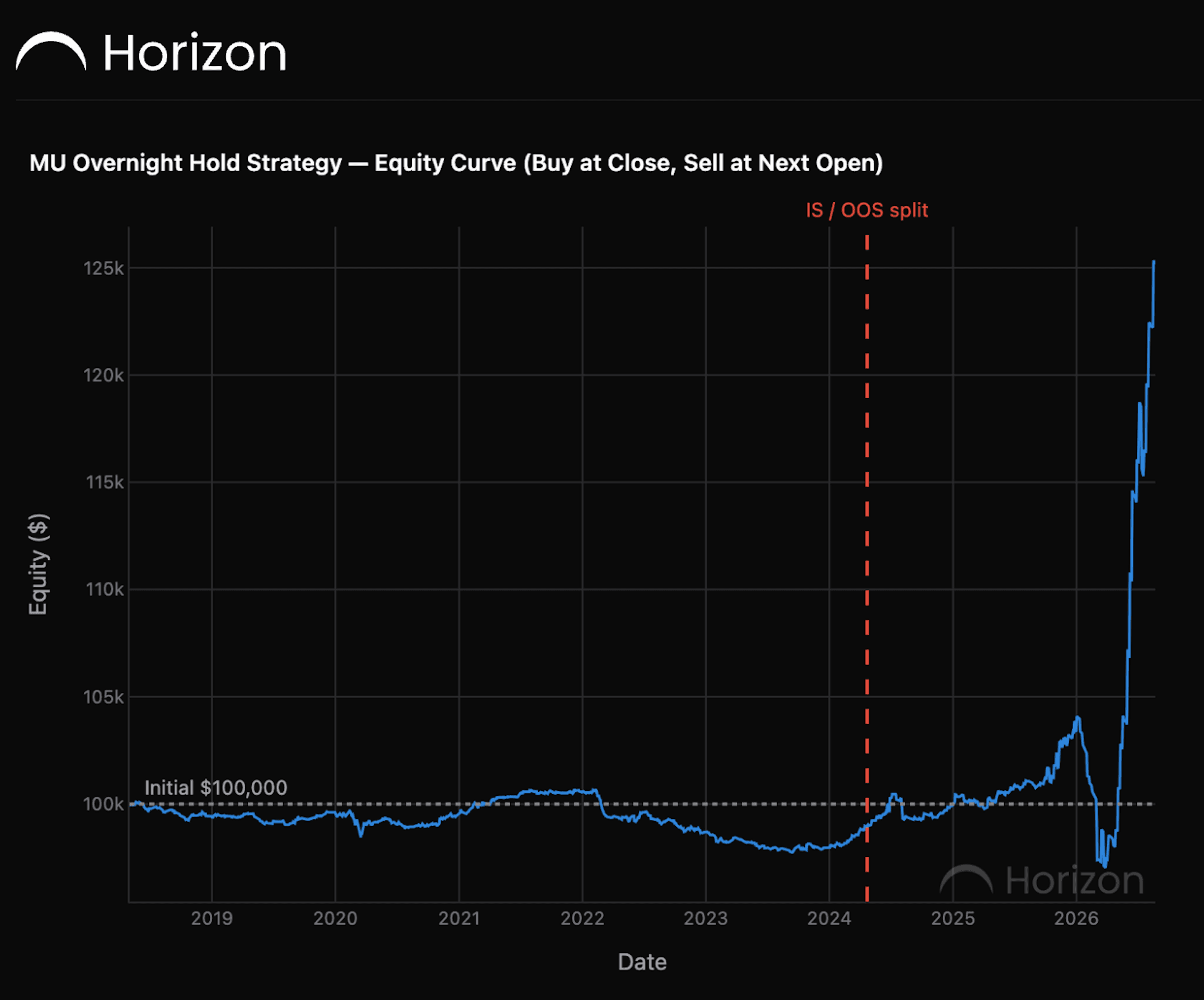
A simple Micron strategy has been circulating online: buy MU at the close, sell at the next open, and repeat every trading day.
On the surface, the backtest looks good.
From May 2018 through August 2026, using 100 shares per trade, the strategy generated a net profit of $25,158 and a total return of 25.16%.
The problem is where that profit came from.
The full backtest looks respectable
Across the entire sample, the strategy produced:
- Net profit: +$25,158
- Total return: +25.16%
- Profit factor: 1.54
- Max drawdown: -6.79%
- Win rate: 40.56%
The low win rate is not a problem by itself.
The edge came from payoff asymmetry.
The average winning overnight trade gained 0.65%, while the average loser lost 0.42%.
That is enough to make a strategy profitable even if most individual trades lose.
The equity curve tells a different story
The first 70% of the backtest lost $1,022.
The profit factor over that period was just 0.95.
The final 30% of the sample made $26,180, with a profit factor of 2.02.
So essentially all of the strategy's profit arrived in the most recent regime.
That is the real result.
A few large gaps did most of the work
Micron has produced several large overnight moves during the recent AI and memory cycle.
Those outsized gaps dramatically improved the economics of a strategy that had previously been flat to negative for years.
That means the full-sample result can be misleading.
A backtest may look robust when a small number of recent events are doing most of the heavy lifting.
Why regime dependence matters
An overnight anomaly can exist for structural reasons.
Earnings, Asian trading, semiconductor supply news and global risk sentiment all arrive while the U.S. market is closed.
But that does not mean the edge remains stable through every market regime.
If the economics of the strategy depend on a recent cluster of unusually large gaps, the future edge may depend on those conditions continuing.
The takeaway
The viral MU overnight strategy has been profitable over the full sample.
That part is true.
The more important result is that almost all of the profit came recently.
The first 70% of the test lost money, while the final 30% generated more than the strategy's entire net profit.
That makes the setup look less like a timeless overnight edge and more like a regime-dependent anomaly.
Share this post: