
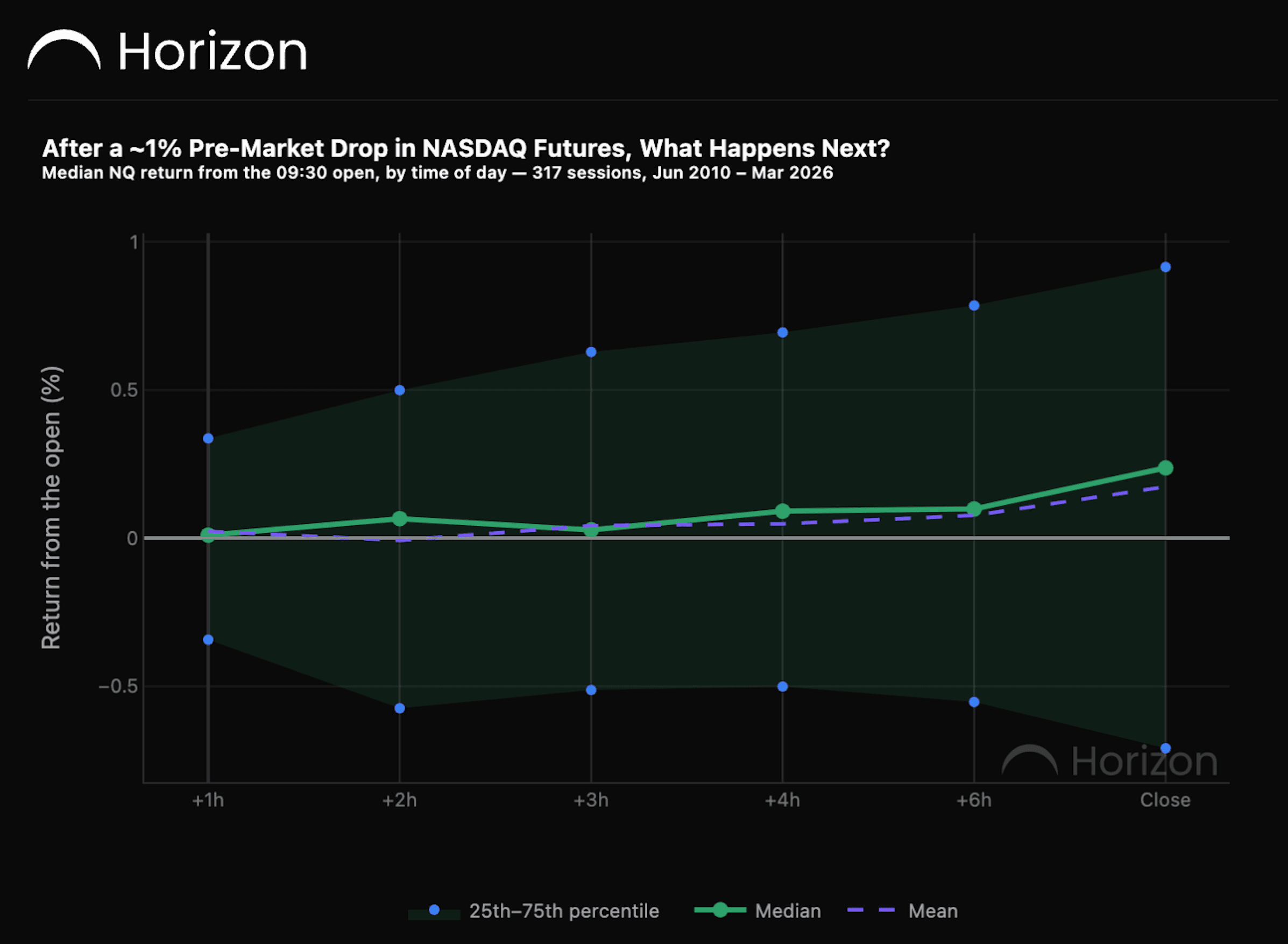
Nasdaq futures are down roughly 1% before the open today.
That immediately raises a useful question: when NQ comes into the cash session down around 1%, does the weakness normally continue after 9:30, or does the market bounce?
We tested every comparable session in the available NQ history.
317 Similar Pre-Market Drops
The sample uses hourly Nasdaq-100 E-mini futures data from June 2010 through March 2026.
A session qualifies when NQ is 0.7% to 1.5% below the previous session's 4:00 PM ET level at 9:05 AM ET.
That gives us 317 sessions.
From there, returns are measured from the 9:30 AM open through the rest of the trading day.
History Leans Toward a Small Bounce
The median path after the open is surprisingly quiet.
| From the open | Median return |
|---|---|
| +1 hour | +0.01% |
| +2 hours | +0.07% |
| +3 hours | +0.03% |
| +4 hours | +0.09% |
| +6 hours | +0.10% |
| Close | +0.24% |
By the close, 56% of the 317 sessions finished above the opening price. 42% finished below it and 2% were effectively flat.
So history does lean toward a bounce.
But only slightly.
A median gain of 0.24% from the open recovers only a fraction of an overnight decline of roughly 1%.
The Gap Usually Is Not Recovered
This is the more useful finding.
A large pre-market decline has not typically been followed by another large move lower.
But it has not usually produced a dramatic V-shaped recovery either.
Instead, the median session stabilizes.
The market opens lower, spends most of the day around that new level, and finishes modestly above the opening price.
That makes the pre-market decline itself a fairly weak directional signal for the rest of the session.
The Range of Outcomes Is Much Wider
The median hides a large distribution.
By the close, the middle 50% of historical outcomes ranged from approximately -0.71% to +0.91% from the open.
Some continuation days were much worse.
During periods including the 2011 euro crisis, 2015 China devaluation, 2025 tariff volatility and other risk-off episodes, the worst sessions extended another 2% to 3.5% lower from the open.
The strongest rebounds were roughly 2% to 3% higher.
So a 1% pre-market decline is not a clean mean-reversion signal. Most comparable sessions stabilized or bounced slightly, but the sessions that did continue lower contained meaningful tail risk.
What That Means for Today's Setup
With Nasdaq futures down roughly 1% before today's open, history does not strongly support either extreme.
Across 317 comparable sessions, 56% closed above the open and the median open-to-close move was +0.24%.
But the middle half of outcomes still ranged from -0.71% to +0.91%.
The historical base case is therefore not a full recovery and not another collapse.
It is stabilization.
The median is fairly uneventful. The tails are where the move becomes important.
Share this post: